

People express deep gratitude to Her Majesty Gyalyum Ashi Dorji Wangmo Wangchuck and the Tarayana Foundation, and commit to make the most of these opportunities to enhance their livelihoods.
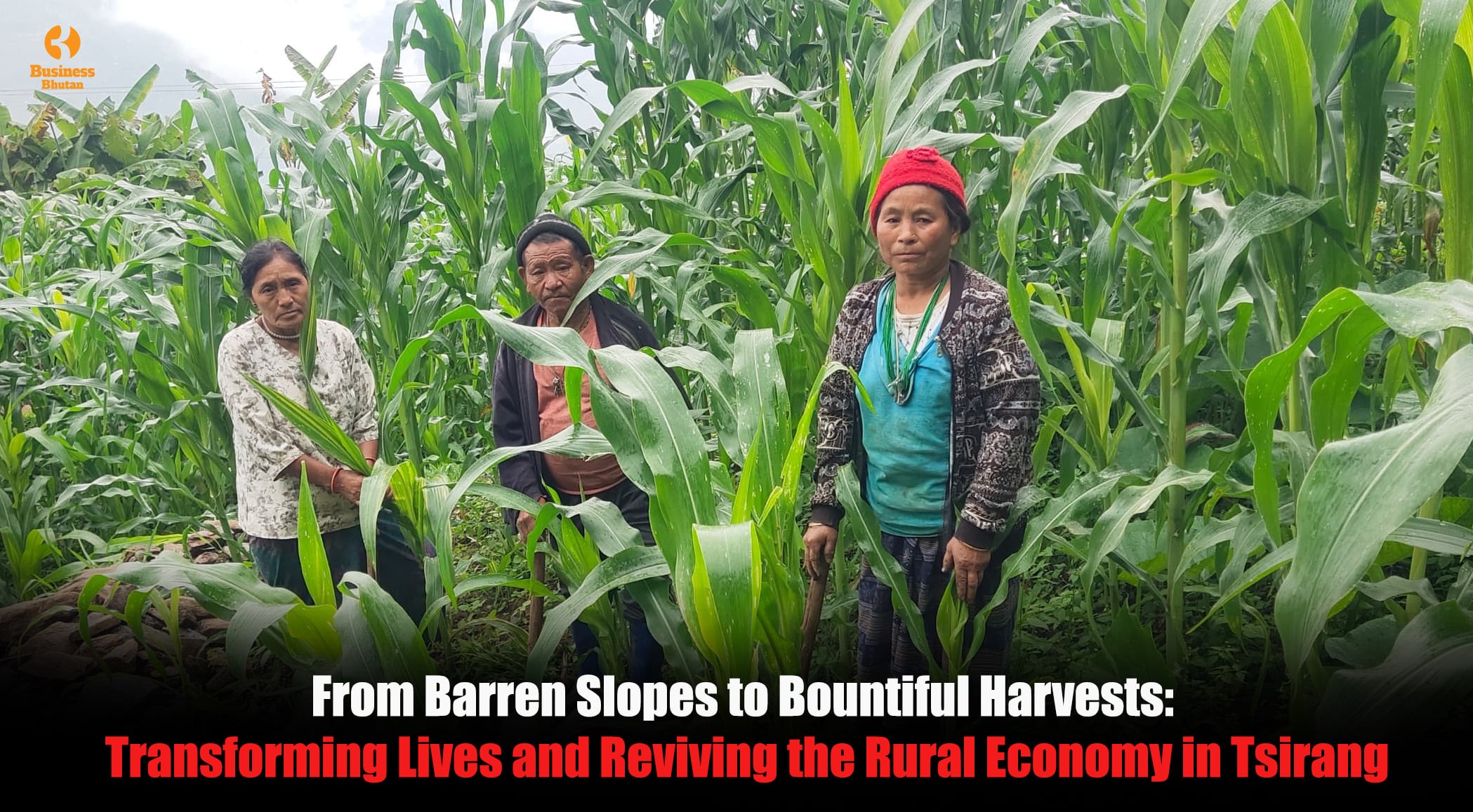
Where flat land is scarce and barren slopes once left abandoned, the farmers of Semjong village are now turning the tide with groundbreaking land terracing innovations. Jaseb Damapcha, 53, has embraced the natural contours of her landscape, transforming steep slopes into thriving gardens and farmland. Introduced by the Tarayana Foundation in partnership with WWF-Bhutan under the IKI Living Landscape project, sustainable land management (SLM) techniques are revolutionizing agriculture in this remote region.
With just two family members, Jaseb has tripled her vegetable and crop cultivation. She anticipates a significant boost to her family’s economy thanks to increased yields on her newly terraced land. Balakhop village, part of Semjong Gewog in Tsirang, has fully embraced these SLM practices through the WWF-Bhutan project, supported by the International Climate Initiative (IKI).
Reviving Abandoned Land and Expanding Farming Horizons
For years, many farmers left their land fallow due to steep slopes, soil erosion, limited water supply, and insufficient labor—factors that made cultivation difficult or impossible. This underutilization of arable land hindered local food security and livelihoods.
The project’s interventions, spanning more than 21.5 acres and benefiting over 36 households in Balakhop (and more than 100 in neighboring Zomling village), have turned this around. By adopting bench terracing and stone bunding, farmers have reclaimed degraded land, preserved precious topsoil, and restored soil fertility.
Jaseb recalls, “Neither traditional ploughing nor mechanized tilling was possible on our steep, rocky slopes. Now, with these techniques, we can cultivate efficiently and sustainably.” This innovation not only expands farming space but also encourages ecosystem restoration in the face of natural and human-induced land degradation.
From Soil Erosion to Agricultural Revival
Agriculture remains the backbone of the rural economy, and farmers here understand the vital importance of productive land. The IKI Living Landscape project has transitioned these communities toward modern, sustainable farming methods—helping farmers reconnect with their land and its potential.
Dhan Maya Mongar, 58, from upper Zomling, shares her renewed enthusiasm: “Previously, stones and poor soil fertility made farming a struggle. But with stone bunds creating barriers to control water and reduce erosion, I’m now motivated to cultivate more diverse crops throughout the year—beyond just maize, chilli, pumpkin, and beans.”
Dhan Maya and her husband have also started a compost pit, enriching their soil naturally. Deo Bdr Mafchen, 50, echoes this optimism: “Our village faced steep slopes and stones, but the ALD innovation gave us usable farming space. Now, we’re ready to produce more.”
Lok Bdr Balam Paki, Tshogpa of Zomling chiwog, notes, “Land abandonment has been reversed thanks to bench terracing, which simplifies farming while preserving biodiversity and strengthening resilience against environmental changes.”
Water Security and Community Empowerment
As part of the project’s holistic approach to sustainable agriculture, a water reservoir has been constructed to harvest spring water from Devithang. This reliable irrigation source is expected to significantly enhance year-round farm productivity by ensuring consistent water supply, especially during dry seasons. Beyond just irrigation, the project integrates comprehensive springshed management, including the installation of nature-based filtration systems and the construction of pipelines to channel clean water directly to the fields.
To promote long-term soil health and fertility, the initiative also provides training in vermicomposting—a natural method of producing nutrient-rich organic fertilizer. Farmers are now equipped with essential tools and knowledge to maintain and improve their land’s productivity in environmentally responsible ways.
The community’s capacity has been significantly strengthened through hands-on training in key areas such as soil conservation, stone bunding, napier grass plantation, water management, plumbing, and organic waste management. These activities were carried out with expert technical support from the National Soil Services Centre under the Department of Agriculture and the Ministry of Agriculture and Livestock. Together, these interventions empower local farmers to adopt climate-resilient practices and manage their resources more effectively and sustainably.
A Vision for the Future: Youth Engagement and Market Opportunities
Expressing deep gratitude to Her Majesty Gyalyum Ashi Dorji Wangmo Wangchuck and the Tarayana Foundation for their generous investment in the community, the villagers are committed to making the most of these opportunities to enhance their livelihoods. Deo Bdr Mafchen shares a forward-looking vision of agricultural expansion, with plans to introduce winter cropping and diversify their produce with new and innovative crops. He notes, “While many of our youth currently gravitate towards piggery and poultry farming due to their income potential, adopting simplified and high-yield farming techniques could renew their interest in agriculture and encourage them to return to the land.”
Supporting this optimism, the Tshogpa affirms that efforts are underway to identify and introduce additional crops, fruits, and vegetables sourced both from other regions of Bhutan and beyond. These initiatives aim to increase agricultural productivity and generate higher incomes for rural households. The farmers are especially hopeful about the emerging market in the nearby Gelephu Mindfulness City, where they anticipate selling their fresh produce. This access to a promising and reliable market is expected to significantly improve their economic stability while also strengthening their resilience against the challenges posed by climate change.
Sustainable Farming for Food Security and Prosperity
Namgay, a field officer with the Tarayana Foundation, highlights the transformative impact of the project on local farmers. He explains, “By significantly increasing agricultural production, farmers are now able to generate higher incomes and become less reliant on external or off-farm food sources. The comprehensive training provided through the project has empowered communities to take ownership of their farming practices, enabling them to cultivate their land independently while adopting sustainable and environmentally friendly methods.”
Echoing this progress, Chenga Tshering, the Principal Land Management Officer at the National Soil Service Centre, elaborates, “Thanks to the project’s interventions, farming communities have gained the capacity to mechanize certain agricultural operations, which increases efficiency and reduces manual labor. Additionally, farmers are actively improving soil fertility by utilizing farmyard manure and planting leguminous crops, which naturally enrich the soil with essential nutrients. These practices contribute to healthier, more productive farmland.”
Moreover, the introduction of vermicomposting has played a crucial role in enhancing long-term soil conservation. This eco-friendly technique not only enriches the soil but also improves its structure and moisture retention, thereby increasing resilience against climate variability. By securing soil health and fertility, vermicomposting helps safeguard food security and strengthens the livelihoods of farming families for generations to come.
Project Support and Acknowledgements
This transformative story is supported by the Federal Ministry for the Environment, Nature Conservation and Nuclear Safety through WWF-Bhutan, with the Journalism Reporting Grant from JAB on the IKI Living Landscape Project: Securing High Conservation Values in Southwestern Bhutan.
Sangay Rabten from Tsirang