

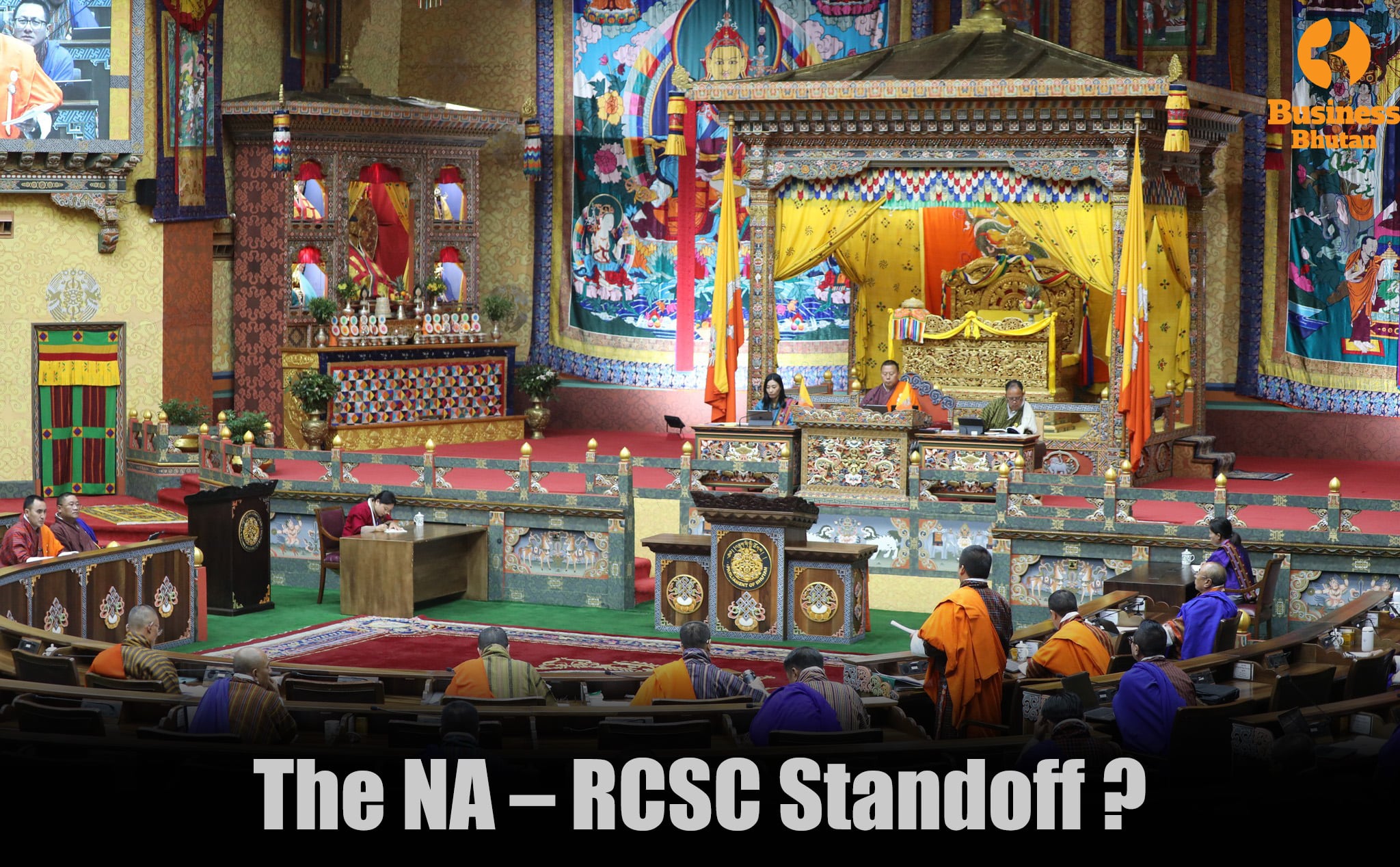
Except for the Cabinet members, including the Prime Minister, none of the NA members raised their hands when the Speaker asked those satisfied with the RCSC’s ATR to raise their hands
One of the issues that members of the National Assembly (NA) pursued since the first session of the Fourth Parliament, concerned the Royal Civil Service Commission’s (RCSC) Managing for Excellence (MaX) system, especially forced ranking and related themes like Partially Meeting Expectations (PME). The concerns of the NA were relayed to the Commission. However, when the Prime Minister (PM) informed the NA about the Action Taken Report (ATR) from the RCSC on May 28, 2025, none of the members of the NA, except ministers and the PM, were satisfied with the responses of the RCSC. The main factor for this was the RCSC’s response, which did not mention anything about the core concerns, the Bell Curve and the PME, and if the two would be removed, as recommended by the NA. Following this, questions have been asked, especially if the RCSC is blatantly refusing to follow the recommendations of the NA. This concern has heightened as the RCSC in its response to the NA during the last session of the Parliament had said that as an independent constitutional body, it has its own mandate and authority. “Neither the government nor the National Assembly has the mandate nor the authority to review the MaX System and eliminate the performance moderation (bell-curve) system as it is the core mandate of the Royal Civil Service Commission. Thus, the National Assembly’s resolution remains as a recommendation.”
NA members opine that the House has passed forth its recommendations to the RCSC as per the provisions of the Constitution and that the RCSC is also mandated to take action as per provisions of the Constitution.
According to members of the NA’s Good Governance Committee (GGC), Article 10 (2) of the Constitution states “Parliament shall ensure that the Government safeguards the interests of the nation and fulfils the aspirations of the people through public review of policies and issues, Bills and other legislations, and scrutiny of State functions.” Article 26 (4) states:”The Commission shall endeavour to ensure that civil servants render professional service, guided by the highest standards of ethics and integrity to promote good governance and social justice, in implementing the policies and programmes of the Government.” Article 26 (9) states that “The Commission shall submit an Annual Report on its policies and performances to the Druk Gyalpo and to the Prime Minister.” The GGC members argue that Parliament as a highest law making and oversight body exercised its power in accordance with the above provisions of the Constitution and that the RCSC is responsible to report to the Parliament through the government and the Prime Minister.
“As has been outlined in legal documents about the Constitution, ‘Parliament is a legislative body with lawmaking powers and not simply a grouping of delegates from various sections of the society. Parliament must ensure that the government safeguards the interest of the nation and fulfills the aspirations of the people. The representatives must discharge their responsibilities with a public review of policies and issues, of Bills and other legislations. The objective of every legislation has to be in the advancement of public welfare’,” a member of the GGC said. According to him, whatever the NA has recommended to the RCSC is in line with this “sacred article of the Constitution, and the underlying principles.” He added that the NA members recognize the need for monitoring and evaluation. “We respect accountability and understand that civil servants must be effective. But when the means employed to assess civil servants and ensure that they perform effectively is not right, it is our duty to inform the RCSC along with recommendations. This is what we did,” the member said.
The same was echoed by MPs from both parties, who also shared why the RCSC’s forced ranking and PME need to be done away with. MP Naiten Wangchuk of Monggar highlighted the importance of consulting civil servants and revisiting the PME rating, emphasizing its negative impact over the past seven years. “Civil servants are the backbone of the nation, and it is only right that the system reflects fairness and recognition,” he said.
MP Namgay Dorji of Khamdang-Ramjar shared that the force ranking system has led to disinterest and stifled innovation among civil servants. “Around 80% are rated ‘Good’ regardless of actual performance, which discourages improvement and initiative,” he said.
MP Lam Dorji, representative of Wamrong constituency said that despite the system being designed to foster performance habits, it remains largely unsuccessful after seven years.
MP Sonam Tashi of Lamgong-Wangchang pointed out the damage the forced ranking has caused to workplace relationships and overall morale. “This system has negatively impacted work culture and team cohesion,” he said.
MP Lhakpa Tshering Tamang of Sergithang-Tsirang Toed constituency shared that, during the previous review, they had at least submitted a request to repeal the force ranking criteria, although other elements of the MAX system could not be reversed. “The main dispute lies in the compulsory placement of civil servants under the PME. For instance, there is a mandatory placement of 5% of civil servants under the supervisor category, 3% under the P2 level, and 2% of civil servants in the education sector are required to be placed under PME. This is causing significant unrest among them,” the MP said that this method is not effective and must be discontinued.
MP, Rinchen Wangdi from Bartsham-Shongphu said the Bell-Curve Methodology of assessing performance of the civil servants, is a forced ranking system. “This is reported as the most demotivating factor by the civil servants who have resigned and also by those who are currently in the civil service.” He added that during the constituency visits, civil servants strongly expressed issues, challenges and adverse impact of MaX forced ranking system on overall morale and performance of the civil servants. “ The implementation of MaX has been for more than 7 years and found to be unpopular, particularly the forced ranking system among civil servants. Out of 3,200 civil servants surveyed, more than 43% cited MaX as reasons for their resignation and more than 73% of the surveyed civil servant respondents desired removal of the Partially Meeting Expectation (PME),” he said.
Additionally, the NA’s GGC has said that “this rigid requirement has created numerous issues on the ground.” “Agency heads are forced to make arbitrary decisions, often resulting in internal conflict and even voluntary PME placements by staff nearing resignation or by the agency heads themselves to avoid discord.” In some cases, well-performing civil servants have been unfairly rated as PME simply to meet the curve, leading to demoralization, reduced motivation, and even resignations. Although the system mandates targeted training for those rated under PME, MPs and the committee reported that no such support is actually provided. Similarly, those rated as ‘Excellent’ rarely receive tangible recognition, further undermining the credibility of the system.
The committee has called for a model that is evidence-based, contextual, and flexible. “Without such reform, the current system risks eroding trust, motivation, and the long-term retention of capable public servants.”
Meanwhile, a senior civil servant said it is extremely difficult to assess and concretely say that one staff or official falls under the PME. “Due to the need to identity some in this bracket, offices have had to request people, especially those who are on EoL to be on the PME ladder.” He also noted that civil servants in the P2 category due for promotion to P1 require rankings of “Very Good” or “Outstanding.” In order to facilitate such promotions, irrespective of whether an official is capable or not such rankings are given. “Those rated as PME, should be given opportunities for development through trainings and other means. The RCSC mandates that respective agencies conduct such trainings. However, agencies are not provided budget to conduct such trainings. Most of the time, agencies’ chief are made to undertake the assessments. Those adjudged as PME develop personal grudges against their seniors. There are other reasons, too, but these are some of the issues that make it very difficult for us to work and assess employees.”
Time Line and how the issue began
During the First Session of the Fourth Parliament, the NA’s Good Governance Committee (GGC) moved a motion, for Review on Managing for Excellence (MaX) in Civil service. It stated its rationale and reasons, underling that morale and motivation among civil servants in Bhutan are at an all-time low, leading to an unprecedented level of resignations. Key reasons for this exodus were cited.
The Motion stated that a survey by the GGC highlights the detrimental impact of the current Managing for Excellence (MaX) system, particularly the Forced Ranking category of Partially Meets Expectation (PME). “This system has eroded trust and morale, fostering disharmony and a negative work culture. To retain and motivate existing human resources, it is recommended to abolish the PME category, thereby promoting a healthier, more supportive working environment for civil servants.”
The Motion said that “the Forced Ranking system, particularly the Partially Meets Expectation (ME) category, undermines trust and morale and creates disharmony, reduces collaboration, and fosters a negative attitude among employees.” It also spelled that teachers face heavy workloads, poor leadership, and prolonged rural postings. “This results in a high attrition rate among teachers, further weakening the education system.”
Recommendations of GGC.
1.Urgency to embark on a bold and concrete measures to retain and motivate the existing human resource, before it is too late. One of the immediate recommendation based on the findings of questionnaire survey and consultation meeting with civil servants is to do away with the last category of Forced Ranking i.e. Partially Meets Expectation (PME) under Managing for Excellence.
- Currently the agencies are mandated to categorize 5% and 3% of their employees under Partially Meets Expectation category. This has ruined the working culture and morale of employees. It has done more harm than good. There is a lack of trust and empowerment in the system, undermining the role of immediate supervisors who are in a better position to judge their employees. This has created disharmony in an organization between the leader and subordinates, misunderstanding among the employees in a closely knitted society like ours.
- Above all, majority of those classified under Meeting Expectation and Good category (80% and 70% respectively) refuse to partake in extra initiatives on the premise that those in Exceeding Expectation and Very Good category will do it. Such negative attitude being developed by majority of employees in an organization is unhealthy for the system. Therefore, Forced Ranking category of PME to be removed for common good, as incentivsation based on differentiation is nonexistent.
RCSC Responds
In response, the RCSC during the Second Session of the Fourth Parliament, submitted “Resolution 9.4: Review on Managing for Excellence (MaX) in the Civil Service,” which apart from others include a Legal Framework.
The RCSC also quoted the Constitution “to clarify the entity responsible for executing this mandate.”
Article 26, Section 1: “There shall be a Royal Civil Service Commission, which shall promote and ensure an independent and apolitical civil service that will discharge its public duties in an efficient, transparent, and accountable manner.”
Section 4: “The Commission shall endeavour to ensure that civil servants render professional service, guided by the highest standards of ethics and integrity to promote good governance and social justice, in implementing the policies and programmes of the Government.”
Article 14, Section 13. The State shall make adequate financial provisions for the independent administration of constitutional bodies.
The RCSC stated that as an independent constitutional body, it has its own mandate and authority. “Neither the government nor the National Assembly has the mandate nor the authority to review the MaX System and eliminate the performance moderation (bell-curve) system as it is the core mandate of the Royal Civil Service Commission. Thus, the National Assembly’s resolution remains as a recommendation.”
Moving on to Statistical Analysis and provide data-driven support for the proposed resolutions, the RCSC stated that the claim of the NA resolution that 89% of resignations are linked to the performance management system lacks empirical support nor have we been able to gain access to research for the stated claim. “Additionally, the cited attrition rate of 35.49% in the Education services is inaccurately calculated, raising concerns about the study’s credibility. Further, noted there is no formal research conducted to establish a direct correlation between the MaX system’s moderation process and observed attrition rates.”
The submission also mentioned what the commission is doing about the PMS
Finally, an appeal was submitted for the way forward. The RCSC stated that to maximize the long-term benefits of the Performance Management System (PMS) and ensure a sustainable approach to performance management, particularly in implementing Performance-Based Incentives (PBI) as outlined in the 13th Five-Year Plan (FYP), it is crucial leaders be allowed to drive the initiative forward and give the system time to mature. “This maturation will enable us to fully realize the expected benefits of the PMS. Therefore, we would like to appeal to the parliament to allow the MaX system to mature and deliver its potential benefits. Unless a better alternative emerges that addresses the concerns raised, it is important that the PME(Needs Improvement) category is handled professionally by managers. While PME candidates may not be pleased with their assessments, the focus should be on providing them with targeted interventions to help them improve, rather than removing them from the system.”
Apart from the above, the RCSC has outlined other components such as:
- Global Performance Management System practices
- Examples of PMS in the civil service in other countries.
- Managing for Excellence (MaX) : 4.1. Evolution of PMS in the civil service in Bhutan:
- General view of civil servants on the MAX system. Why use the bell curve?
Gist of Current Response from RCSC
The Commission says it deeply values the concerns raised and welcomes the opportunity to further clarify its position. “In building a system that serves the larger national interest, some discomfort is inevitable, as change inherently challenges the status quo. However, the RCSC remains committed to minimizing disruptions while ensuring that systems lead to a more capable, high-performing civil service that can effectively drive national progress. The Commission will continue to refine its policies based on best practices and stakeholder feedback, fostering a system that upholds excellence and serves the Tsawa-Sum with unwavering dedication.”
On Legal Framework, the RCSC apart from other points said , that as mandated by the Constitution of the Kingdom of Bhutan, the Commission will continue to submit its Annual Report on policies and performance to the Honorable Prime Minister, as per Article 26, Section 9. “This includes updates on the Performance Management System, ensuring transparency and accountability in the administration of the civil service.”
It also said that the RCSC acknowledges that, during the formative years of the Performance Management System, it was not feasible to provide training to all civil servants categorized under PME. However, depending on leadership and financial capacity, some agencies have implemented targeted training programs for these individuals. It mettioned that recognizing the importance of supporting underperforming employees, the RCSC has trained civil servants in leadership positions on Coaching and Mentoring skills, emphasizing on performance coaching.
The RCSC also pointed out “Discrepancies in the survey results.” “To understand the difference, the Commission had requested access to the survey report referenced during the National Assembly session regarding the reasons for civil servants leaving the service, but was informed that the survey is still ongoing and the report is not yet ready. Additionally, the survey is being administered to a randomly sampled group of teachers and civil servants from various ministries and agencies. While the RCSC did not receive earlier versions of the survey report, we were provided with the questionnaire. Of the 20 questions, the majority focus on the Performance Management System (PMS), and the final question on reason of attrition includes PMS as one of the multiple-choice answers.”
“On the difference, the RCSC’s survey is focused exclusively on civil servants who are retiring from the system, with an emphasis on exit interviews. In contrast, the National Assembly’s survey targets current civil servants and is primarily focused on the Performance Management System (PMS), with the question on attrition included at the end. These differences in scope and focus likely contribute to the contrasting findings.”
Nidup Lhamo from Thimphu