

In the quiet village of Tamangdara, where the mountains once shifted with every monsoon, villagers are beginning to sleep more soundly. For decades, the land beneath their homes crept and cracked—slowly but relentlessly—reshaping the landscape and threatening lives, farms, and infrastructure.
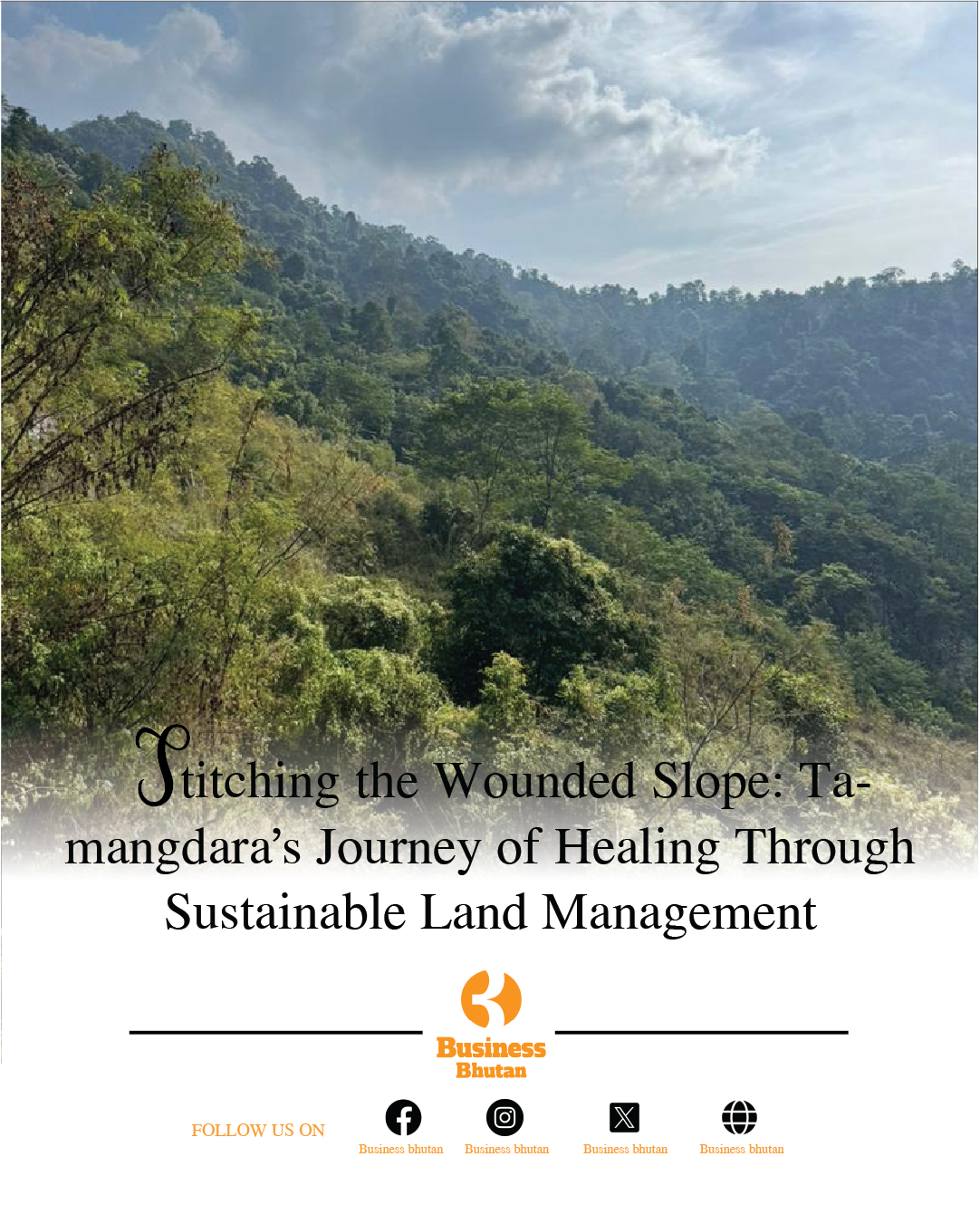
Today, however, the hillside carries new life and new hope. Rows of broom grass, Napier saplings, and fresh shrubs stand as guardians of stability. For resident Tika May Gurung, each sapling is more than just a plant—it is “a stitch on a wound.”
“Monsoon seasons were once a time of anxiety,” recalled village resident Mamta Tamang. “We stayed alert all night, watching the soil creep. Year after year, the movements widened cracks, damaged our homes and scared our families.”
Before the interventions, the village faced severe erosion and recurring landslides that carved deep gullies, washed away fertile soil, and threatened both the high-tension power line and the Phuentsholing–Samtse national highway running below.
Hope arrived with a Sustainable Land Management (SLM) initiative introduced through a UNDP-supported project. With training, new technologies, and simple, low-cost erosion-control methods, the community began reimagining their relationship with the land.
Among the most effective measures were the planting of Napier and broom grass—reinforced by carefully installed barbed-wire fencing to safeguard young growth.
“These plants keep the topsoil in place and reduce erosion. We feel safer now,” Mamta said. “The land is more stable, and landslide risks have gone down.”
She added that educating other at-risk communities would be cost-effective and could prevent future disasters elsewhere in the country.
For Samir Humagai, 44, the change is transformational. “About 80% of the land has now become stable. We no longer fear floods,” he said. Still, he sees room for improvement. “If bamboo saplings were supplied, it would help even more. Bamboo grows fast and is excellent for stabilizing soil, especially in areas the project hasn’t fully covered.”
Standing near the newly fenced slope, Arati Gurung, 54, pointed to the revived vegetation with pride. The community installed around 500 meters of fencing to stop cattle from grazing on the fragile ground.
“This has brought back lost plants and trees,” she said. “Earlier, animals roamed freely, but now everyone is careful. The area is slowly transforming—lush, alive, and reassuring.”
Yet Arati is mindful that healing takes time. “The slope is still wounded,” she said softly. “But it’s healing. And if we protect it, it will heal fully.”
The shift in mindset is equally significant. Em Nath Bista shared that the past three years—since the introduction of SLM measures—have been the longest the land has gone without major damage.
“Broom grass roots help bind the soil, and the fencing protects young plants. People now take responsibility and plant more vegetation on their own,” he said. However, he hopes for more hands-on training on rehabilitating landslide-prone areas.
Suman Gurung, Chairperson of the Tamangdara Community Forest, highlighted the introduction of new norms since 2020 to limit harmful activities near the landslide zone and ensure sustainable use of water resources. Annual tree planting on June 2 has become a community tradition.
Village head Arjun Gurung believes Tamangdara’s success story should be replicated elsewhere. “The interventions have worked. Other vulnerable communities need the same kind of support and guidance.”
According to UNDP, the SLM project directly benefited 21 households. Key interventions included planting 4,050 saplings across 6.46 acres, planting 1,500 bundles of broom grass, planting 10,000 stems of Napier grass, terracing 80 decimals of land, constructing seven dry stone walls, diverting surface runoff, and mapping landslide-prone zones using GIS.
Before these interventions, Tamangdara experienced massive landslides covering nearly 10 acres every year. The risks posed to homes, farmland, and the national highway were so severe that UNDP warned they could force villagers to migrate if left unchecked.
Today, as the slope slowly greens, residents say they stand more confidently on their land. They credit the knowledge, tools, and community engagement fostered through the project for giving them renewed hope.
Looking across the recovering hillside, Tika May Gurung reflected on what the change means for her community. “The slope remains scarred, but it is healing. And so are we,” she said. “Every sapling is a stitch, binding the land together—one root at a time.”
Tamangdara’s story is no longer one of erosion and fear, but one of resilience, restoration, and a community reclaiming its future.
This story was covered as a part of the media reporting grant funded by Australian Government through ABC International Development and JAB.
Nidup Lhamo
from Tamangdara, Samtse