


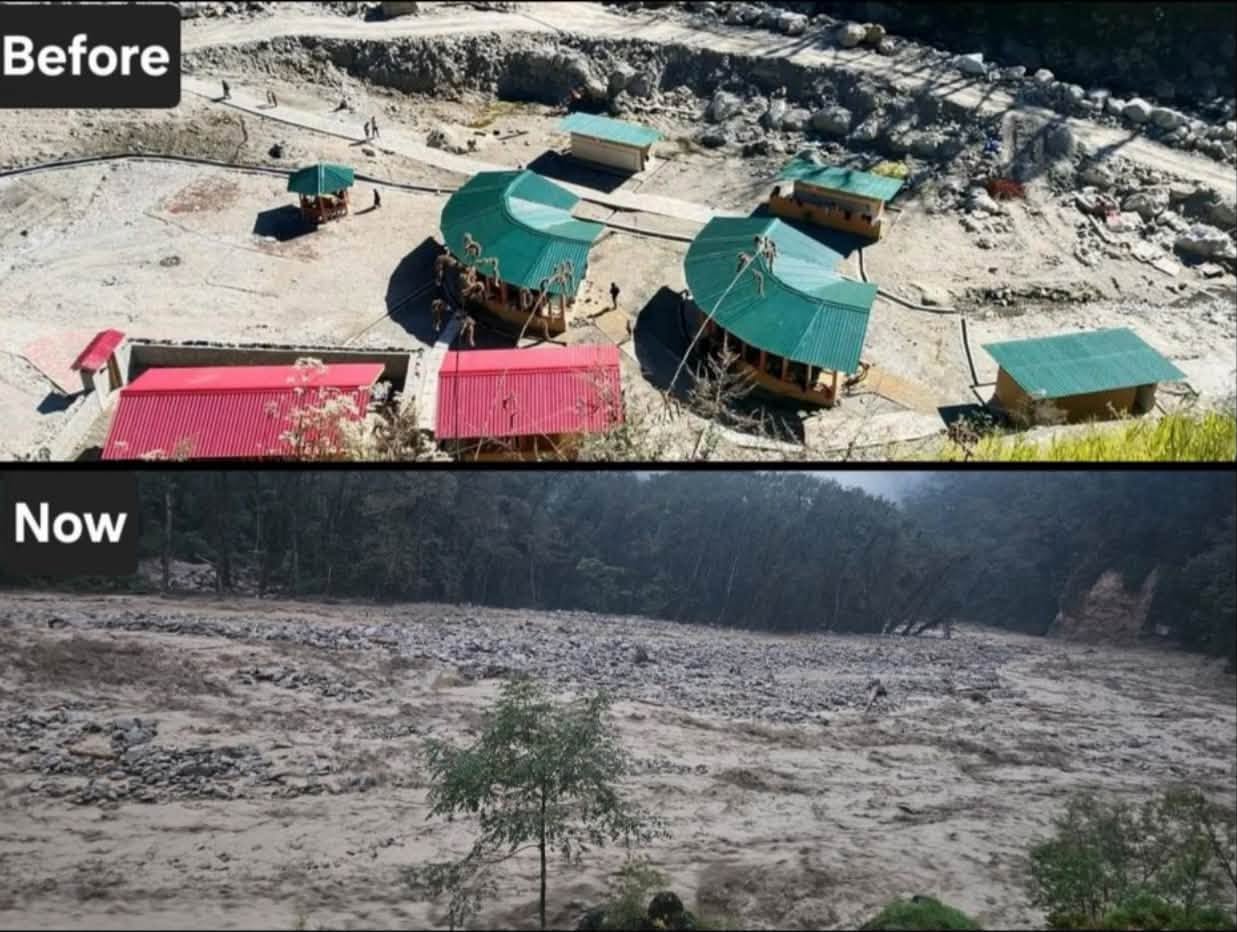
A Glacial Lake Outburst Flood (GLOF) from Shintaphu Lake in Lungo Chiwog, Laya Gewog, Gasa, has caused extensive damage to public infrastructure, washed away the facilities at Gasa Tsachu, disrupted hydropower operations and cut off communities in parts of Punakha. With an artificial lake formed downstream following the outburst, authorities are concerned about the possibility of another flood even as they assess the damage and monitor the situation.
The incident occurred on the evening of October 29, 2026, with the Gasa Dzongkhag Administration receiving the first report of a suspected lake outburst from a Laya resident at approximately 7:47 PM.
Authorities immediately alerted residents of Taktsemakhang, Tsachu and surrounding areas and instructed them to evacuate to safer locations as a precautionary measure.
According to a preliminary disaster report issued by the Gasa Dzongkhag Administration, no casualties had been reported at the time of reporting. However, the flood caused substantial damage to infrastructure in Taktsemakhang and Gasa Tsachu, while its impact extended downstream into Punakha along the Mo Chhu.
The destruction at Gasa Tsachu has been particularly severe, with almost the entire hot spring facility washed away. The damaged infrastructure includes the Tsachu water source, two public soaking ponds, VIP and VVIP soaking ponds, a children’s soaking pond, resting areas, public toilets, canopies, a newly constructed hot stone bathhouse, two changing rooms, a sales counter and the parking area.
Around 350 metres of the road leading towards the Tsachu and a toilet near the Royal Guest House have also been washed away. The Royal Guest House and D-Type Guest House have been identified as infrastructure at potential risk.
At Taktsemakhang, the newly constructed public washroom, an Army Camp storeroom and a section of the Gasa-Laya highway, approximately 21 kilometres from Gasa, have been damaged.
The destruction of Gasa Tsachu represents a major loss of public infrastructure and a setback for an important tourism and recreation destination in the district. The full financial cost of the damage is yet to be established.
Punakha communities cut off
The flood has also caused considerable damage in Punakha, particularly along the Mo Chhu.
Two Bailey bridges connecting Zhelngosa Chiwog and Gumgang-Yorbo Chiwog in Goenshari Gewog have been severely damaged, cutting off residents of the two chiwogs from other areas. The gewog administration has submitted a damage report to the dzongkhag administration.
The solar-powered irrigation water lifting system serving Dochhukha-Dzomlingthang-Ritsa Chiwog under Guma Gewog has also been partially damaged. According to a local leader, the system is currently non-functional, although the full extent of the damage is yet to be assessed.
Flood debris has also covered a section of the Punakha-Gasa Highway in Dzomlingthang, raising concerns about road access and the movement of people and essential supplies.
As a precaution, Punakha Dzong was temporarily closed to visitors and tourists from October 30 until further notice.
The damage across the two dzongkhags illustrates how a single glacial lake outburst can affect communities, public services and infrastructure across a wide geographical area. Roads, bridges, irrigation systems and tourism facilities are particularly vulnerable because they are often located along river corridors.
Artificial lake raises fresh concerns
The immediate concern, however, is the formation of an artificial lake at the confluence below Taktsemakhang in Laya.
The GLOF has reportedly blocked the flow of the Shingchala stream, which originates from the Gangchhen Taak side of Laya, resulting in water accumulating behind the debris.
The formation of this lake has raised concerns about a possible secondary outburst. If the natural blockage gives way, the accumulated water could be released suddenly, generating another surge downstream and causing further damage to infrastructure and communities along the river.
Authorities have warned residents living downstream to remain vigilant and take necessary precautions, as a possible outburst could occur without much warning.
The Prime Minister visited Taktsemakhang to inspect the affected area and assess the situation on the ground. During the visit, the artificial lake formed at the confluence of Sintaphu Chhu and Lungu Chhu/Gangchen Taak Chhu was inspected. The assessment indicated that the lake was not considered highly dangerous, and controlled explosions were being considered to facilitate the safe drainage of the accumulated water.
However, any intervention to release the water will require careful assessment of downstream conditions. An uncontrolled or poorly timed release could expose communities and infrastructure to another sudden surge. The safety of the operation will therefore depend on understanding the volume of accumulated water, the stability of the natural blockage and the capacity of the downstream river channel.
The National Centre for Hydrology and Meteorology (NCHM) had planned to deploy a technical team to the source of the flood to assess the situation. However, officials said adverse weather conditions prevented the team from reaching the site, and the Centre could not provide any findings at the time of reporting.
Although a water-level monitoring station is located at Taktsemakhang, an NCHM official earlier said that no alert had been triggered at the time of the incident. This may indicate that the floodwater had not yet reached the monitoring station.
The absence of an alert, however, should not be interpreted as evidence that there is no danger. Monitoring stations can only provide information on the conditions at their respective locations, and a sudden change in water flow or a secondary outburst may require additional monitoring upstream and downstream.
Hydropower operations affected
The GLOF has also raised concerns about the safety and continuity of hydropower operations along the Punatsangchhu basin.
No damage has been reported at Punatsangchhu-I or Punatsangchhu-II hydropower projects so far. However, construction work at Punatsangchhu-I has been halted pending a fuller assessment of the artificial lake and potential downstream risks.
Power generation at Punatsangchhu-II has also remained suspended as officials wait for water levels to stabilise and continue monitoring upstream conditions.
The disruption highlights the vulnerability of hydropower infrastructure to sudden changes in river flows, particularly during GLOF events when large volumes of water, sediment, boulders and debris can move downstream within a short period.
Even when dams and powerhouses are not directly damaged, sudden changes in water levels and heavy sediment loads can affect intake structures, turbines, access roads and other critical infrastructure. Prolonged interruptions can also affect electricity generation and project operations.
A warning of future glacial hazards
Shintaphu Lake, located below Wakila Mountain in Lungo, Laya Gewog, is among Bhutan’s 17 potentially dangerous glacial lakes and lies at the source of the Mo Chhu.
Its outburst is a reminder of the growing risks posed by glacial lakes in a country where communities, roads, hydropower projects and other critical infrastructure are often situated along river valleys.
The danger does not end when the initial floodwater passes. A GLOF can trigger secondary hazards, including landslides, riverbank erosion, debris accumulation and the formation of temporary lakes. Natural blockages created by boulders, sediment and other materials can subsequently fail, releasing another wave of water downstream.
Climate change adds to these concerns. Rising temperatures contribute to glacier retreat and changes in glacial lake conditions, increasing the need for regular surveillance and risk assessment. Although not every glacial lake will necessarily produce an outburst, the consequences of a sudden release can be devastating, particularly where downstream settlements and infrastructure have limited protection.
The Shintaphu incident also raises questions about the adequacy of existing early-warning and emergency response systems. Monitoring stations are important, but they must be supported by reliable communication networks, regular field assessments, clear evacuation procedures and coordination between agencies and local communities.
For remote settlements such as Laya, timely access to information is particularly critical. Difficult terrain, adverse weather and limited connectivity can delay technical assessments and emergency interventions precisely when they are most needed.
There is also a need to examine the vulnerability of infrastructure constructed along river corridors. Bridges, highways, irrigation systems and public facilities should be assessed against potential flood scenarios, including the possibility of repeated outbursts. Contingency plans must ensure that communities are not left isolated when critical bridges and access roads are damaged.
The incident underscores the importance of strengthening glacial lake monitoring, improving downstream warning systems, identifying vulnerable settlements and infrastructure, and conducting regular disaster preparedness exercises. Where necessary, risk-reduction measures such as controlled drainage, engineering interventions and designated evacuation routes should be considered based on scientific assessments.
For now, authorities are continuing to monitor the situation, while the full extent of the damage and overall impact of the disaster will be established once it is safe to access the affected areas.
The immediate priority is to ensure that the artificial lake does not trigger another destructive flood. But beyond the emergency response, the Shintaphu GLOF should serve as a serious warning that Bhutan’s exposure to glacial hazards requires sustained attention, investment and preparedness.
The destruction in Gasa and disruption in Punakha demonstrate how quickly a natural hazard originating in a remote mountain lake can affect communities, public infrastructure, tourism and national energy operations. Preventing the next disaster will depend not only on responding effectively when an outburst occurs, but also on anticipating the risks before they turn into another catastrophe.
Sangay Rabten, Thimphu