

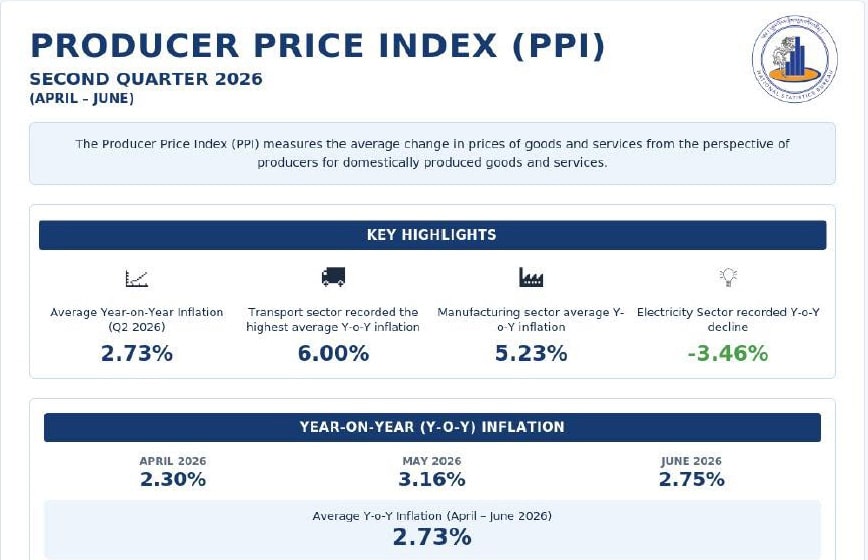
Producer prices in Bhutan increased by an average 2.73 percent year-on-year in the second quarter of 2026, reflecting higher prices across key productive sectors, particularly transport and manufacturing, while a decline in electricity prices helped moderate overall producer price pressures.
According to the Producer Price Index (PPI) for the second quarter of 2026 (April-June), producer prices increased compared with the same quarter of 2025. The PPI measures the average change in the prices of goods and services from the perspective of producers of domestically produced goods and services.
The quarterly increase comes amid a continued upward movement in producer-price inflation after the index recorded negative year-on-year growth in late 2025. The year-on-year inflation rate stood at 2.30 percent in April, increased to 3.16 percent in May, before easing slightly to 2.75 percent in June. The average year-on-year inflation for the three-month period was therefore 2.73 percent.
The transport sector recorded the highest year-on-year inflation at 6 percent during the quarter, making it the largest contributor among the highlighted sectors. Higher transport-related costs can have a broad impact on the economy because transportation is closely linked to the movement of raw materials, agricultural products, manufactured goods and consumer commodities. An increase in transport costs can therefore feed into production and distribution costs across other sectors.
The manufacturing sector also recorded a significant year-on-year increase of 5.23 percent. The rise indicates continued cost pressures within domestic manufacturing and could have implications for the prices of locally produced goods. Manufacturing costs are influenced by several factors, including transportation, raw materials, imported inputs, labour and energy costs.
The National Statistic Bureau (NSB) identified transport, forestry and logging, and manufacturing as the major drivers of the increase in producer prices during the quarter. The forestry and logging sector is particularly significant for Bhutan because of its links with construction, furniture production, wood-based industries and other downstream economic activities.
In contrast, the electricity sector recorded a 3.46 percent year-on-year decline, exerting downward pressure on overall producer prices. The decline in electricity prices partly offset increases recorded in other sectors. According to the NSB, lower energy charges were a key factor behind the downward pressure from the electricity sector.
The development is important for domestic producers because electricity is a major production input for energy-intensive industries. Lower electricity costs can help reduce operating expenses and improve the competitiveness of businesses, particularly manufacturers and other enterprises with significant power consumption.
Month-on-month producer-price inflation stood at 0.65 percent in April, increased slightly to 0.72 percent in May, and then declined sharply by 1.01 percent in June. The decline in June represents the first significant monthly reduction after several months of increases. The monthly PPI stood at 99.88 in April, rose to 100.59 in May, and fell to 99.58 in June.
The year-on-year trend also shows a gradual recovery in producer prices after a sharp contraction in late 2025. The year-on-year rate was 0.73 percent in July 2025, rising to 1.61 percent in August before declining to 0.37 percent in September and 0.30 percent in October.
Producer-price inflation then fell to negative 1.48 percent in November 2025 and remained negative at -0.54 percent in December. The trend reversed in 2026, with year-on-year inflation increasing to 0.31 percent in January, 0.79 percent in February and 1.54 percent in March. The rate accelerated further to 2.30 percent in April and 3.16 percent in May before easing to 2.75 percent in June.
Implications for the economy
The latest PPI figures provide an important indication of price pressures at the production stage before they potentially filter through to consumers.
A sustained increase in producer prices can raise the cost of doing business and, depending on market conditions, may eventually translate into higher retail prices. However, the June decline in monthly producer prices and the fall in electricity costs could help contain some of the pressure on businesses.
Tashi Namgyal, Thimphu