

Only 653 women, or 17.6 percent, of the 3,696 aspiring Local Government candidates have registered for the new Functional Literacy and Possession of Skills Test (FLT), raising concerns that the revised requirements could be discouraging more women from entering grassroots politics.
Men account for 82.4 percent, with 3,043 registrations, compared with 653 women.
At Level 1, which has 2,227 candidates, 1,973 are men and 254 are women. At Level 2, of the 1,469 candidates, 1,072 are men and 397 are women.
The stark gender gap has prompted serving and aspiring women leaders to question whether apprehension over the new FLT may be keeping some potential candidates away from local elections.
While they acknowledge the need for local leaders to acquire new skills, particularly digital competency as public services increasingly move online, several women leaders said the introduction of new requirements should be accompanied by adequate training and encouragement so that competency standards do not inadvertently become barriers to participation.
Quite a few might have stayed back
Narang Gup Dechen Zangmo of Mongar said fear of the revised requirements could have discouraged some potential candidates.
“Quite a few might have stayed back fearing the new FLT,” she said, recalling that many women as well as men had previously come forward to sit for the test and contest local elections.
She questioned the necessity of imposing the FLT on candidates who have already completed Class X or XII.
“If most of the candidates are Class X and XII graduates, there is no necessity for FLT. Otherwise, it just shows there is no trust in the country’s education system,” she said.
She suggested that if digital competency is considered essential, candidates could instead receive IT training through relevant institutions or sit for a separate digital-skills assessment.
For her, however, the larger concern is ensuring that women do not interpret the new requirements as a reason to stay away from public service.
“Women should come forward. We can perform once responsibility is bestowed,” she said.
Digital skills necessary, but training matters
Phongmey Gup Sonam Wangmo of Trashigang said the new FLT had created apprehension among aspiring candidates generally, but the impact could be more significant on women given their already low representation.
She acknowledged that digital competency has become increasingly important for local government leaders but questioned whether the timing and manner of introducing the requirements could discourage people from coming forward.
“This is a time when people should be encouraged to shoulder responsibility, especially when most of the people, mostly youth, leave overseas,” she said.
Rather than lowering competency standards, she suggested that candidates could sit for the FLT and subsequently receive additional training in IT and digital skills.
She said local leaders must be able to navigate a government system that is becoming increasingly digital, but the new requirements should not create an impression that women are less capable of using technology.
“When women can operate every latest developing digital application, there is no point they can be inefficient,” she said.
She also warned that a continued shortage of women in local decision-making could affect the inclusiveness of governance.
Greater participation of women, she said, would also strengthen Bhutan’s ability to attract support from international development partners for programmes promoting inclusive governance.
Fear keeping some women away
Orong Mangmi Sangay Lhamo of Samdrup Jongkhar said she had recently encouraged several women in her gewog to register for the FLT and attend available preparatory training.
Some, however, told her they were afraid of the new requirements and had decided not to register.
“The fear is there,” she said, suggesting that the low number of women registering could be partly linked to apprehension surrounding the revised test.
For some women, however, the fear has eased after they received an opportunity to prepare.
Twenty-seven-year-old Pema Wangmo, an aspiring Tshogpa candidate from ThuenmungTokari Chiwog under Tsamang Gewog, Mongar, said villagers encouraged her to contest.
“I have to accept their wishes and I want to contest in the election,” she said.
But she initially worried after hearing that the FLT would be different from the test conducted in the past. She questioned whether she would be able to pass.
Her confidence improved after attending preparatory training conducted by the Bhutan Centre for Media and Democracy (BCMD).
Similarly, aspiring Tshogpa candidate Phurpa Lhamo from Changmey Chiwog under Shongphu Gewog, Trashigang, said the announcement of the revised FLT initially made her lose confidence about contesting.
She wondered whether other women might also have decided against registering because of the new requirements.
“Or is it that serving leaders failed in the past?” she questioned.
Nevertheless, she said the new requirements should be accepted as public services are increasingly delivered through digital platforms.
Not everyone sees FLT as a barrier
Not all aspiring women candidates believe the new requirements are a problem.
Sangay Choden, an aspiring Gup candidate from Saling Gewog, said digital literacy should be regarded as a basic competency for anyone taking on public responsibility.
“Be it man or woman, any public servant must be equipped with digital literacy. This is to align with His Majesty’s vision for digitalisation. We have to learn technology to cope with the digital world, and ECB setting new criteria is a good move,” she said.
Her view captures another side of the debate: the question is not necessarily whether the FLT should be demanding, but whether aspiring candidates are being given sufficient opportunity to acquire the skills they are now expected to demonstrate.
Why the FLT was changed
The Commission on FLT and Possession of Skills for aspiring candidates has said the revised requirements are intended to modernise public service delivery and ultimately benefit the public.
According to the Commission, the responsibilities of local government leaders have expanded considerably, requiring them to possess competencies that reflect the changing nature of public administration.
The argument for a revised FLT is therefore rooted in the changing demands of local governance. Local leaders are increasingly expected to deal with digital platforms, online government services, electronic communication, administrative procedures and more complex public-service responsibilities.
The debate is consequently not simply about whether candidates should be tested.
It is about how competency standards can be raised without narrowing the pool of people willing and able to serve.
The figures make the concern particularly relevant for women. With women accounting for less than one-fifth of all FLT registrants, any additional barrier—real or perceived—could further reduce an already limited female presence in local government.
Training could be the bridge
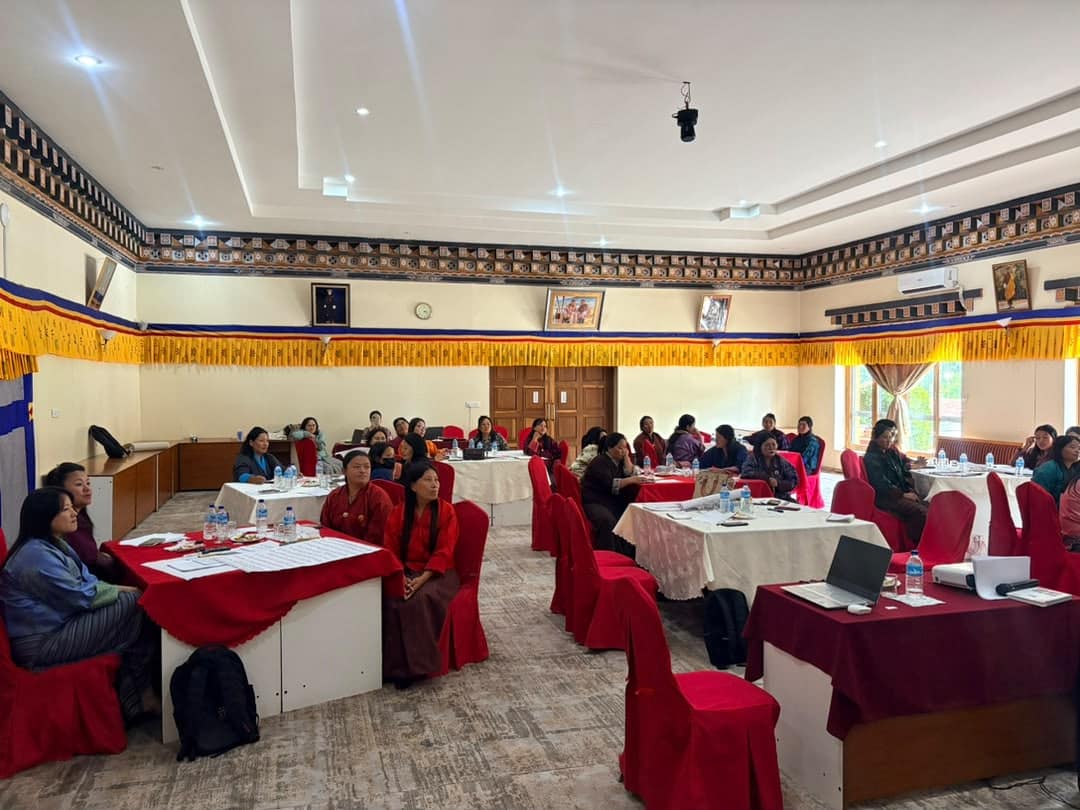
BCMD has attempted to address part of this gap by conducting FLT training for aspiring women candidates in Mongar from 16 to 18 August under the theme “Strengthening People-Centric and Inclusive Access to Justice.” The programme is supported by UNDP Bhutan and European Union.
Such programmes could become increasingly important as candidates prepare for a test that is different from the one many have experienced in the past.
The experiences of women like Pema Wangmo suggest that access to preparation can make a difference. Her initial apprehension did not disappear because the test became easier; it diminished because she received an opportunity to understand and prepare for it.
That distinction matters.
If Bhutan wants stronger and more capable local governments, raising the competency bar may be necessary. But if the new requirements unintentionally cause capable people—particularly women—to withdraw before they even try, the country could lose valuable leadership capacity at the grassroots level.
The challenge, therefore, is to strike a balance between competence and inclusion.
Women leaders interviewed by Business Bhutan are not necessarily calling for the standards to be abandoned. Rather, they are asking that the introduction of new standards be matched by training, information and encouragement.
Sangay Rabten, Mongar