

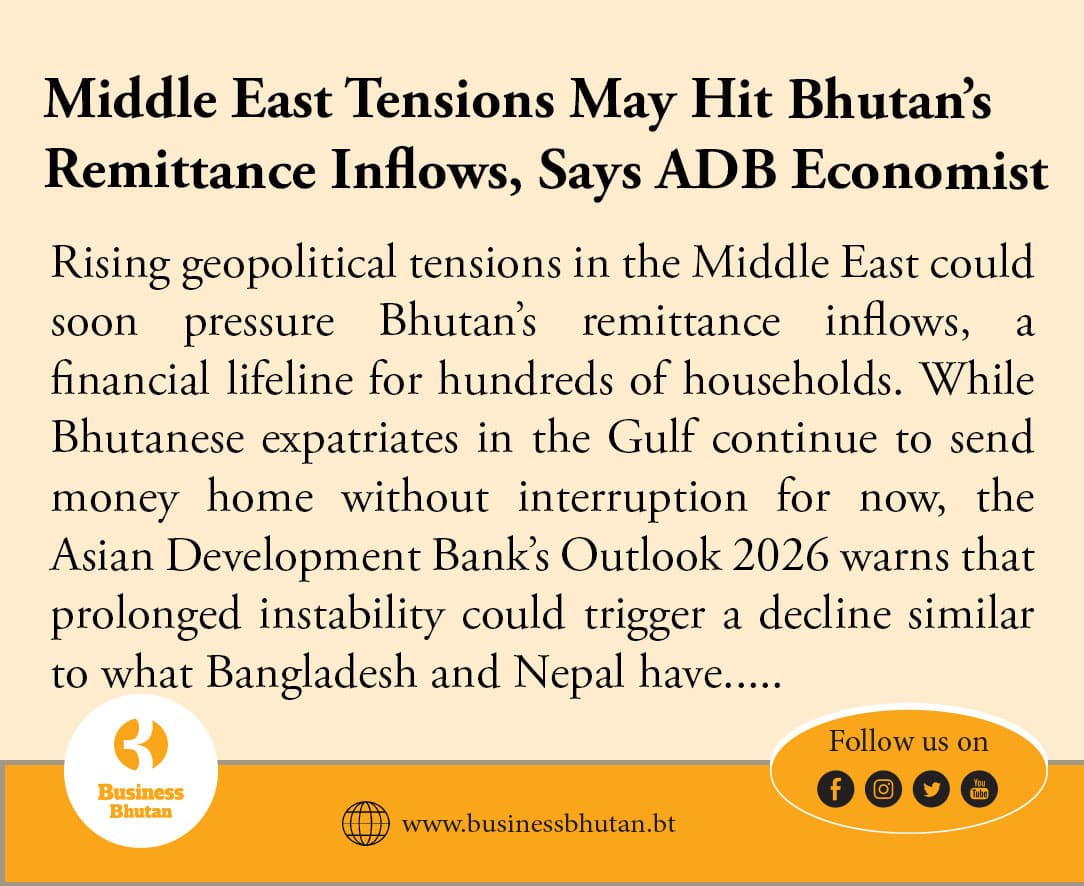
Rising geopolitical tensions in the Middle East could soon pressure Bhutan’s remittance inflows, a financial lifeline for hundreds of households. While Bhutanese expatriates in the Gulf continue to send money home without interruption for now, the Asian Development Bank’s Outlook 2026 warns that prolonged instability could trigger a decline similar to what Bangladesh and Nepal have already begun to experience.
Speaking at the launch of the ADB Outlook 2026 on April 10, ADB Economist Gabriele Ciminelli cautioned that Bhutan is more exposed than it may appear. He noted that any escalation in the region risks undermining economic activity and job security for migrant workers, which would inevitably affect the volume of money they can send back. “Bhutan is closely connected to the Middle East through labour migration. Should the conflict intensify or disrupt sectoral employment, remittance flows are likely to be affected,” he said.
“Remittances could weaken if geopolitical tensions in the Middle East severely disrupt labor markets there, affecting the jobs and incomes of migrant workers. However, past experience suggests remittances are often quite resilient in times of stress,” he said adding that during COVID-19, “they held up better than expected because many migrant workers preferred to cut their own consumption or use savings before reducing the money sent home.” “So, it is possible that remittances to Bhutan could slow if the shock is prolonged and severe, but this is not a clear-cut outcome.”
The Economist also said it is possible that workers in the services sector will face larger income losses than those in the construction sector. “Hence, the sector in which Bhutanese migrant workers in the Middle East work will be important for the final effects.”
While 7,380 Bhutanese in the Gulf Cooperation Council (GCC) countries have registered with the Embassy of Bhutan in Kuwait, the Overseas Employment Program Monitoring Survey Report 2025 says that an estimated 7,861 Bhutanese are currently working across the Middle East. Kuwait hosts the largest share, with 5,531 Bhutanese workers, followed by Qatar with 1,171 and the United Arab Emirates with 997. Smaller Bhutanese communities exist in Bahrain and Oman. Their collective earnings have become a vital source of income for families in Bhutan, helping to support education, healthcare, and household consumption.
Macro-economic data from the Royal Monetary Authority (RMA) highlights the importance of these contributions. Kuwait ranks among the top three remittance-sending countries for Bhutan, contributing USD 14.9 million in 2024 and USD 15.7 million in 2025 between January and October. Qatar accounted for USD 3.3 million in 2024 and USD 3.6 million in 2025, while the United Arab Emirates contributed USD 2.9 million in 2024 and USD 3.1 million the following year. These steady flows underscore the growing reliance on Middle Eastern employment.
Overall remittances surged sharply in 2025, driven largely by Bhutanese workers in Australia. Transfers increased from USD 11.8 million in January to USD 22.9 million in May, offering crucial support during economic challenges and reinforcing household resilience. Recognizing their importance, the government has introduced incentives to encourage the use of formal remittance channels and further strengthen the economy.
Despite the mounting regional tensions, many Bhutanese workers in the Gulf say their income remains stable. Those contacted by Business Bhutan reported no disruptions to their wages or employment so far. Pema Lhamo, who works in the Middle East, noted that although grocery prices have risen, her salary and remittance habits remain unchanged. “I have been able to send the same amount back home every month,” she said.
In Kuwait, Sonam Pelden also confirmed that she continues to remit the same amount she did before the conflict began, while Kencho Lhamo said she has yet to feel any direct impact, though she acknowledged uncertainty about the future.
For now, Bhutan’s remittance lifeline from the Middle East remains intact. But with regional tensions far from resolved, economists warn that the coming months will be crucial in determining whether these vital financial flows can withstand the geopolitical storm.
Although Bhutan’s migrant community in the Middle East remains relatively small compared to larger diaspora populations in countries such as Australia, Canada, and the United States, the trend has been steadily rising over the past decade. While there are an estimated 7,861 Bhutanese now, this marks a sharp increase from September 2023, when only about 2,500 Bhutanese were actively employed across GCC countries.
The rise of Bhutanese migration to the Middle East began in 2013 with the launch of the Overseas Employment Program (OEP). Designed to create structured overseas job opportunities for Bhutanese youth, particularly in service-oriented sectors, the programme has since become a key pathway for employment abroad. Since its inception, more than 8,600 Bhutanese have travelled to the Middle East for work, with most deployed in Kuwait, Qatar, the UAE, Bahrain, and Oman.
Sangay Rabten, Thimphu