

Bhutan’s extraordinary biodiversity—long celebrated for its medicinal plants, pristine landscapes, and deep cultural roots in traditional healing—may one day offer new possibilities in cancer treatment. This prospect was highlighted by Ken Koh, Chief Executive Officer of KITKOJI Pte Ltd and founder of Remission Biotech, during his visit to Bhutan in last month (March, 2026). While he emphasized the immense potential of Bhutan’s natural environment, he also cautioned that scientific discovery requires time, rigorous research, and sustained collaboration.
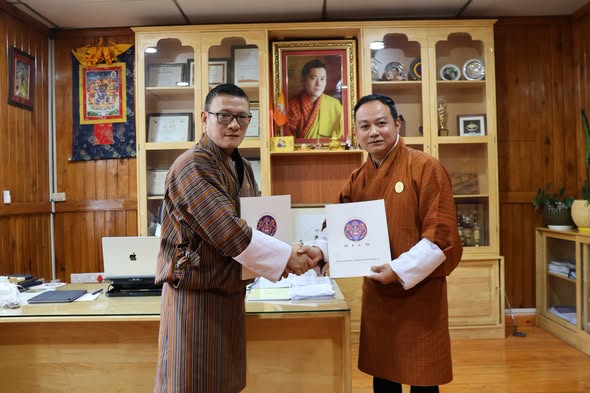
Koh’s comments come at a moment of renewed interest in expanding Bhutan’s traditional medicine system—Sowa Rigpa—into global therapeutic markets. His visit coincided with a landmark Memorandum of Understanding (MoU) signed between Menjong Sorig Pharmaceuticals Corporation Limited and KITKOJI. The agreement aims to combine Bhutanese traditional medical knowledge with advanced biotechnology, including the development of an artificial intelligence–powered diagnostic platform. For a country that has long aspired to position its traditional medicine on the global stage, the partnership marks a significant step forward.
Despite the enthusiasm, Koh remained careful not to overstate the scientific progress so far. He clarified that Remission Biotech has not yet conducted concrete research on Bhutanese plants or fungi. “No specific medicinal plants within the country have been identified or scientifically tested for cancer treatment,” he said, adding that his current studies are based entirely in Singapore. He has already entered research collaboration agreements with the National Cancer Centre Singapore, but potential studies involving Bhutan’s flora or mycobiota remain exploratory at this stage.
Koh stressed transparency, noting that while Bhutan’s biodiversity offers promising ground, no assumptions should be made without robust scientific validation. “No concrete research identifying specific medicinal plants within the country is being carried out,” he reiterated. This includes both plant-based medicine and his own specialized area of research—mycobiota, or the fungi kingdom. Koh explained that fungi, unlike plants, form a separate kingdom and are an emerging frontier in biomedicine. Some fungal compounds have shown anti-cancer potential globally, but whether Bhutan’s forests contain similar species remains unknown.
While Remission Biotech has produced two herbal remedies to date, these products represent only the beginning of a long scientific journey. Koh emphasized that their focus is not on commercializing traditional medicine alone, but on integrating modern drug discovery processes with nature-derived compounds. This, he said, aligns well with Bhutan’s Sowa Rigpa system, which continues to gain recognition internationally. “There is a unique opportunity here to bridge ancient healing wisdom with modern biotechnology,” Koh said, noting that collaboration between MenjongSorig and Remission Biotech could eventually pave the way for developing Ayurvedic or herbal-based treatments, provided scientific evidence supports their efficacy.
Experts in Bhutan agree that the Kingdom’s ecosystems hold significant yet largely untapped potential. Bhutan is home to thousands of plant species, including many with recorded medicinal properties. Yet only a small fraction have undergone laboratory-level investigation for anti-cancer attributes. Scientific research is limited by resource constraints, regulatory considerations, biodiversity protection laws, and the need for advanced pharmaceutical infrastructure. Koh’s visit, and the new MoU, therefore represent early steps toward bridging these gaps.
The importance of accelerating cancer research extends beyond academic interest. Cancer remains a growing public health emergency in Bhutan, with incidence rates rising steadily over the last decade. According to the latest national data, one in every 16 Bhutanese is now at risk of dying from cancer. Between 2023 and 2024 alone, approximately 580 males and 650 females were diagnosed with various forms of the disease, and more than 400 cancer-related deaths were recorded. The increasing prevalence places significant strain on healthcare systems and families alike.
The economic cost is equally alarming. During the 2024–2025 financial year, more than 1,200 cancer patients were referred abroad for advanced treatment. The total cost exceeded Nu 730 million—a staggering increase of over 150 percent since 2021. These rising expenses underscore the urgency of developing cost-effective diagnostic and therapeutic alternatives within Bhutan, either through enhanced domestic capacity or innovative global partnerships.
The MoU with KITKOJI offers one such pathway. Beyond research and drug development, the agreement aims to support the creation of an AI-based diagnostic platform that could accelerate early cancer detection—a critical factor in improving survival rates. Early detection remains a global challenge, but in Bhutan, geographical barriers and late presentation exacerbate the problem. Technology-assisted diagnostics could become a transformative tool in closing this gap.
For now, however, both Bhutanese and international experts agree that the road ahead requires patience, sustained funding, and scientific rigor. Bhutan’s forests may well contain undiscovered compounds with anti-cancer potential, but unlocking these secrets will demand years of ethnobotanical study, laboratory testing, clinical trials, and regulatory approval. Moreover, any harvesting of medicinal resources must adhere to strict sustainability standards to protect Bhutan’s fragile ecosystems.
Still, the optimism sparked by Remission Biotech’s visit reflects a broader shift in the country’s approach to health innovation. Bhutan is increasingly looking outward, forming collaborations that can reinforce its traditional strengths while embracing new technologies. The convergence of biodiversity, traditional medicine, and biotechnology may ultimately position Bhutan as an emerging player in the global wellness and pharmaceutical sectors.
Sangay Rabten, Thimphu