

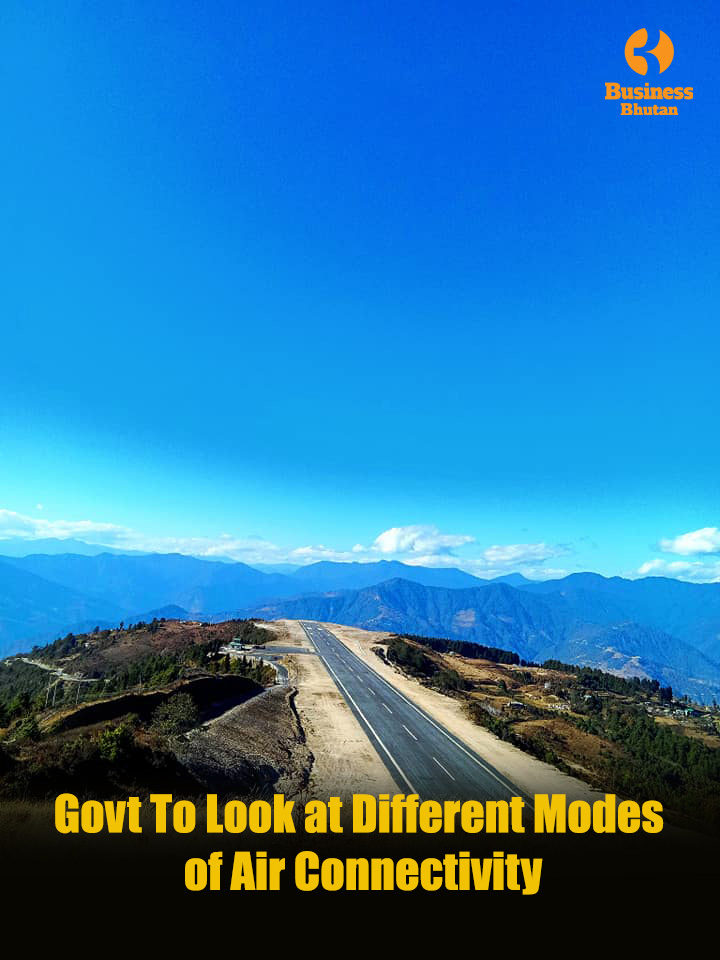
Tour operators say that with no area in the east identified as feasible for establishing domestic airport, it has become imperative to expand Yongphula airport
During the Question and Answer session in the National Assembly (NA) earlier this week, one of the key topics of discussion was the establishment of domestic airports. In the course of the deliberations, the government informed the House that the Leader of the Opposition Party, Dasho Pema Chewang, had proposed an alternative to the development of domestic airports.
According to the Prime Minister, the Opposition Leader had suggested that, at this juncture, the procurement of helicopters might serve as a more effective measure—particularly in supporting the growth of Bhutan’s tourism sector. The PM added that he had asked the Ministry of Infrastructure and Transport to study the possibility of bringing big helicopters to Bhutan, which could help improve connectivity across the country.
While the government has yet to discuss and decide on its future course of action, an official from Heli Bhutan, the country’s first company providing helicopter services, welcomed the Opposition’s recommendations, while outlining some challenges that would be encountered. Additionally, tour operators say that the government’s inability to identify potential sites for airports in Eastern Bhutan has made it imperative for the government to develop and expand Yongphula domestic airport.
“Apart from tourism, helicopters are vital for quick responses in emergencies. They can operate in bad weather conditions when airplanes cannot fly. This ability to operate in adverse weather makes helicopters crucial for delivering urgent medical aid, transporting supplies, or responding to emergencies in hard-to-reach areas,” said the spokesperson.
Speaking about the cost and challenges of helicopter operations in the country, the official said that maintaining and operating helicopters is relatively affordable. “If there is support from the government, the viability of helicopter services would grow,” he added.
Regarding challenges that would be confronted, he noted that weather remains a big challenge where bad weather often causes delays or cancellations, affecting reliable service. “The other is the lack of designated helipads across the country. Currently, only a few locations like Samtse, Lunana, Gangtay, and Mongar have proper designated helipads. Many villages and districts do not have official landing sites, making helicopter operations difficult.” he said.
The official also emphasized the need for the government to build more helipads, especially in rural areas which would boost tourism. “Having more helipads would also reduce the time needed for permission and landings, making helicopter services faster and more reliable. The lack of proper landing sites is a major logistical problem,” Heli Bhutan’s official maintained.
Meanwhile, in the beginning of 2024, Drukair Corporation procured two new helicopters. According to Drukair, they spend about USD 8.5 M, which is nearly Nu 700 M.
Currently, the choppers under Drukair provides services that include medical evacuation, sightseeing, and search and rescue among others.
Heli Bhutan’s H-125 helicopter is a versatile high-altitude aircraft made in France. It can accommodate up to six passengers. It is a single-engine light utility helicopter, worth around 350 million ngultrum.
The deliberation also saw members raising queries about currently identified domestic airports, namely Samrang and Yoeseltse. On questions from the National Assembly (NA) member from Nganglam, Lamdra Wangdi on reasons behind the selection of the sites, Minister for the Ministry of Infrastructure and Transport (MoIT) explained that these locations were selected based on topography, weather, land availability, and the absence of mountains. While these locations have been identified based on the above factors, other feasibility studies, including cost benefit analysis is yet to be done.
While the Minister has stated that the potential expansion of Yonphula Airport remains under review, private tour operators emphasize its critical role in connecting Eastern Bhutan to the national air network. They underscore its significance in ensuring equitable distribution of tourism benefits across the country.
“Acknowledging this, the National Council has also recommended prioritizing improvements in the reliability of domestic flights to both Yonphula and Bumthang airports as part of a broader strategy for balanced tourism development,” said a Thimphu-based tour operator.
He further noted, “The National Council’s recommendation likely reflects the financial constraints associated with constructing new airports, as well as the government’s ongoing challenges in identifying suitable locations for such infrastructure in the East. Given these factors, the expansion of Yonphula Airport emerges as a strategically vital investment for inclusive and sustainable regional development.”
Sonam Dorji, a tour operator, echoed similar sentiments, emphasizing that the operational challenges at Yonphula Airport are manageable.
“We understand that the primary issue lies with the current restriction that allows flights to land from only one direction. If that is the case, developing infrastructure to enable two-way landings should be feasible,” he stated.
Sonam further pointed out that one of the key challenges in promoting tourism in Eastern Bhutan is the time required for travel. “A significant portion of a visitor’s itinerary is consumed by transit. Additionally, tourists are required to pay the Sustainable Development Fee (SDF) even during travel days, which adds to the cost and acts as a deterrent.”
He added that the introduction of reliable and regular flight schedules would greatly enhance accessibility and make Eastern Bhutan a more attractive destination for tourists.
In an interview with this paper a year back, officials from the Department of Air Transport and Authority had said Yongphula airport is currently a one-way landing and take-off airport. An official mentioned that the landscape and weather conditions in the area make it challenging to establish an alternative runway like Paro airport, which has an all-way runway. He added that there are plans to study the possibility of establishing another alternative way to land and take off.
Another official had said that although it is not currently feasible to establish an alternative runway for the Yonphula domestic airport, once the RESA (Runway End Safety Area) constructions are completed, it may be possible to establish other alternative runways.
Sherab Dorji from Thimphu