

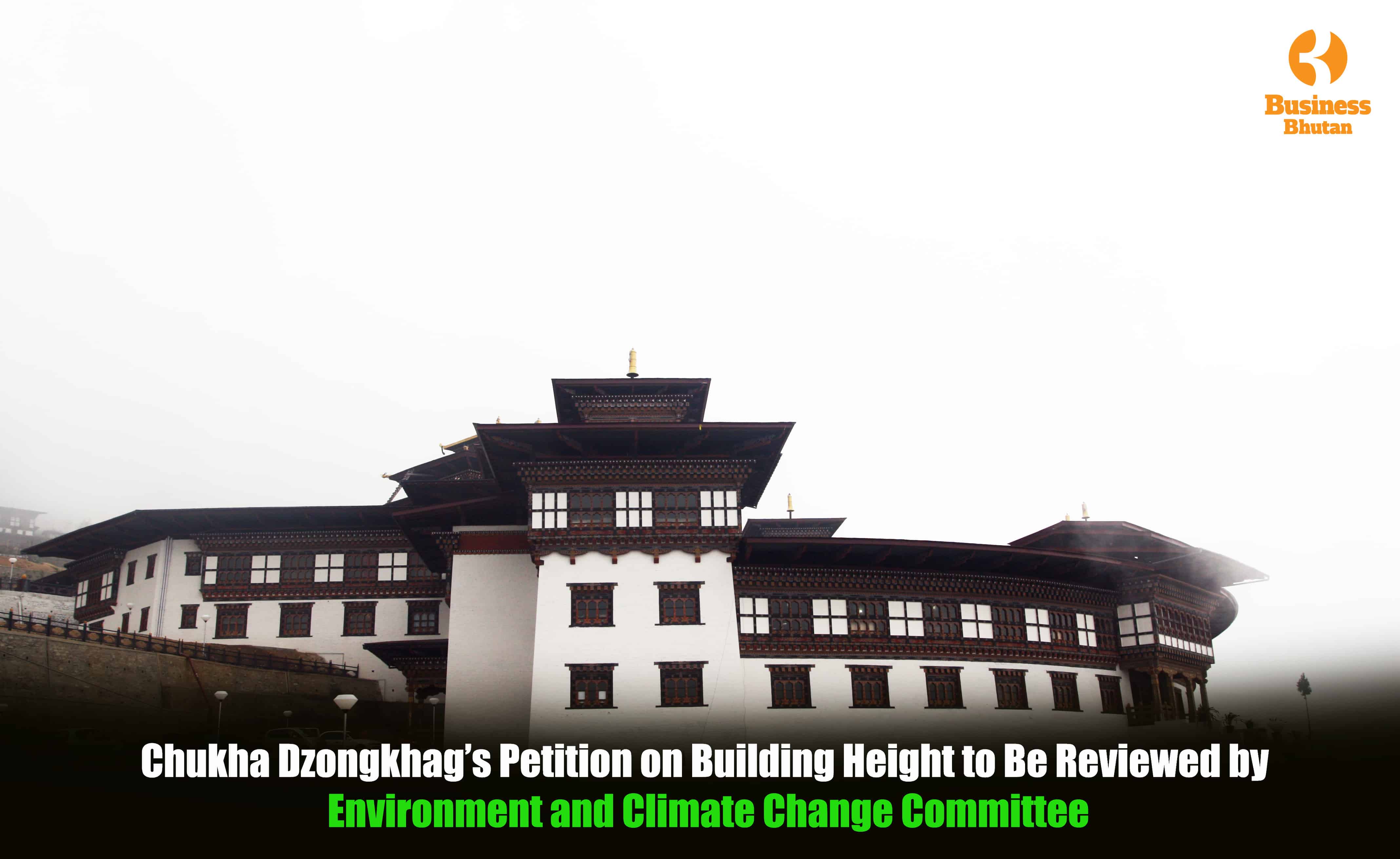
The National Assembly (NA) deliberated on May 30 on a petition submitted by Chukha Dzongkhag, seeking permission for the construction of five-story buildings in its Yenlag Thromde. The matter has been deferred to the upcoming winter session, with the NA Speaker instructing the Legislative Committee to study the proposal in detail and submit its findings in the next session.
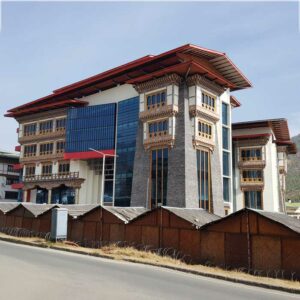
The petition, formally introduced in the House by the Member of Parliament (MP) for Bongo-Chapchha constituency, Pempa, argues that increasing the permissible building height from three to five stories would contribute to balanced regional development and improve the standard of living for residents in the Yenlag Thromde. Chukha Dzongkhag currently permits only three-story structures.
MP Pempa emphasized that constructing five-story buildings in Chukha is not only economically viable but also geographically feasible. As the primary gateway for foreign visitors entering Bhutan, he argued that Chukha must present a modern and progressive image. “The lack of taller buildings may reflect poorly on the region’s development,” he said.
He further noted that Chukha is home to numerous employees of major hydropower projects such as Chukha and Tala. The housing shortage in the area forces many employees to reside in outdated accommodations, including bungalows. Addressing this issue, the MP stressed, would not only benefit Chukha but could also serve as a precedent for other dzongkhags facing similar challenges.
Government Response
In response, the Minister for Infrastructure and Transport (MoIT), Lyonpo Chandra Bdr Gurung, clarified that he cannot unilaterally grant such permission by virtue of his ministerial position. He stated that a multidisciplinary team of technical experts would be dispatched to conduct a comprehensive assessment, including an evaluation of the topography, environmental implications, and population density to determine the economic feasibility of the proposed changes.
The Minister noted that any decision of this nature must be guided by consultations with the High-Level Committee, legal experts, and the Office of the Attorney General (OAG). Discussions have also been held with the Dzongkhag administration and the local community, he added.
Importantly, the Minister informed the House that the Supreme Court has issued a directive to temporarily halt progress on the matter, pending further review.
Parliamentary Debate
MP Sonam Tashi of Lamgong-Wangchang supported the petition, stating that with changing times and evolving family needs, the current building restrictions are no longer practical. “Every family today requires more space, and limiting construction to three stories hinders both housing and economic opportunities,” he said.
However, concerns were raised by MP Tshewang Rinzin of South Thimphu and Opposition MP Kinzang Wangchuk of Dramedtse-Ngatshang. They argued that Chukha, like many other towns, lacks a comprehensive urban development plan. MP Kinzang Wangchuk further highlighted Bhutan’s vulnerability to seismic activity, cautioning that taller buildings could increase risks in earthquake-prone regions.
Legislative Framework on Petitions
According to the Rules of Procedure of the National Assembly 2022, a petition is a formal request presented to the House to take action within its jurisdiction. Petitions must be submitted within a specified time frame and may be presented by any member on behalf of a petitioner, clearly indicating the name of the presenter.
Once accepted by the Speaker, the Secretary General compiles the petitions for a preliminary meeting. If approved, the petitions are included in the order of business for discussion.
Petitions must concern matters pending before the House, fall within its jurisdiction, or address issues of general public interest for which no other legal remedy exists. They must be respectful, free of unparliamentary language, and must not serve personal interests. Supporting documents such as letters or affidavits may not be attached.
Once a petition is referred to a responsible Minister, a written response is submitted to the Secretary General, who then circulates the response to members, including the presenter and principal petitioners. If the House is not in session, the response is deemed circulated upon receipt by the Secretary General.
All petitions, upon presentation, are referred to a relevant Committee—in this case, the Environment and Climate Change Committee. The Committee is responsible for examining the petition, assessing its compliance with legal and procedural standards, and reporting back to the House with findings and potential remedial measures.
Sangay Rabten from Thimphu