


The Government will rely on stronger private sector productivity, competitiveness and profitability to improve wages and working conditions for private sector employees, rather than directly prescribing salary increases to match public sector pay revisions.
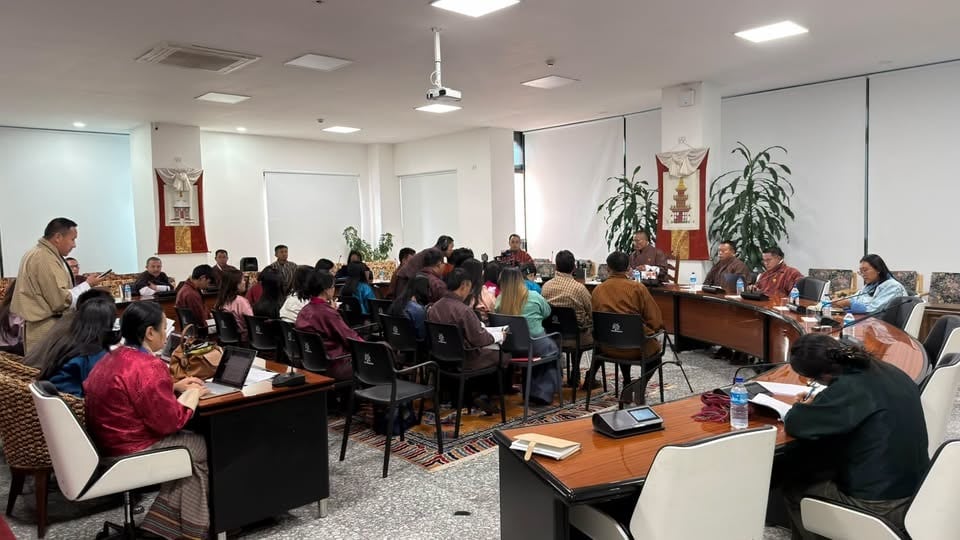
This was stated by Finance Secretary Leki Wangmo during the 33rd Meet-the-Press session, in response to concerns that the upcoming recommendations of the Seventh Pay Commission could widen the income gap between public and private sector employees and place additional pressure on the cost of living.
The concern is that while public servants may benefit from higher salaries, private sector employees could face rising housing rents, food prices and other living expenses without corresponding increases in their earnings, potentially eroding their purchasing power.
The Finance Secretary said the Seventh Pay Commission was constituted to review the remuneration framework for public servants, taking into account the cost of living, the need to attract and retain talent in the civil service and the Government’s overall fiscal capacity.
“While the review primarily concerns public sector remuneration, the Government recognises that public and private sector employees are part of the same economy and that changes in public sector salaries can have wider economic implications,” she said.
However, she argued that higher public sector salaries could also generate economic opportunities for private businesses by increasing consumption, savings and investment.
“Any increase in disposable income can translate into higher consumption, savings and investment, generating additional demand for goods and services. This, in turn, can create business opportunities and stimulate economic activity in the private sector,” she said.
The extent to which private businesses benefit, she added, would depend on the economy’s ability to respond to increased demand through higher production, supply and productivity.
The Government’s investment programme under the 13th Five-Year Plan is expected to provide an important source of business opportunities. Capital expenditure under the Plan will generate demand across construction, transport, tourism, hospitality, agriculture, manufacturing and professional services.
As businesses secure contracts, expand operations and improve productivity, they should become better positioned to raise wages, improve working conditions and offer more sustainable employment.
However, the Finance Secretary made it clear that the Government does not intend to impose uniform salary adjustments on private businesses to match public sector revisions.
“The most sustainable way of improving private sector wages is to strengthen the productivity, competitiveness and profitability of private enterprises,” she said.
She explained that private businesses differ considerably in size, nature and financial capacity. A salary increase that one company can comfortably absorb could place considerable pressure on a smaller enterprise, potentially affecting its operations, recruitment and ability to retain workers.
Directly prescribing salary adjustments across the private sector, therefore, may not be appropriate.
Instead, the Government will focus on creating an enabling business environment through improved access to finance, skills development, infrastructure, market access and favourable business conditions, while ensuring that labour standards and workers’ rights are protected.
The approach places the responsibility for sustainable wage growth largely on expanding the productive capacity of businesses, while the Government seeks to create conditions in which enterprises can grow and generate better-paying jobs.
On concerns about inflation and rising living costs following public sector salary increases, the Finance Secretary acknowledged that increased household spending could put pressure on the prices of housing, food and other essential goods and services.
She said the Government would need to monitor these developments and introduce appropriate policy responses to address inflationary pressures and protect households.
This is an important consideration for an economy where public and private sector employees share the same housing, food and consumer markets. If demand rises faster than the supply of goods and services, higher disposable incomes could translate into increased prices rather than improved purchasing power.
For private sector workers, the implications could be particularly significant if their salaries remain unchanged while rents and essential expenses increase.
The Finance Secretary said the Government’s broader objective was to ensure that economic growth benefits all sections of society rather than being concentrated among public sector employees.
“Ultimately, the Government’s objective is not simply to improve remuneration in the public sector, but to create an economy in which productivity gains and economic growth translate into better incomes and living standards across all segments of society,” she said.
She added that a dynamic and competitive private sector capable of generating productive employment and offering increasingly attractive remuneration would be central to achieving this objective.
The response comes as the Seventh Pay Commission, constituted with effect from October 1, 2026, reviews the salary structure, allowances and benefits of public servants.
Sherab Dorji, Thimphu