Some years are special than others. Some more defining and 2025 was such a defining year for Gelephu Mindfulness City (GMC). From unprecedented nationwide volunteerism to landmark infrastructure developments and international recognition, GMC has emerged as a symbol of collective national pride and forward-looking ambition.
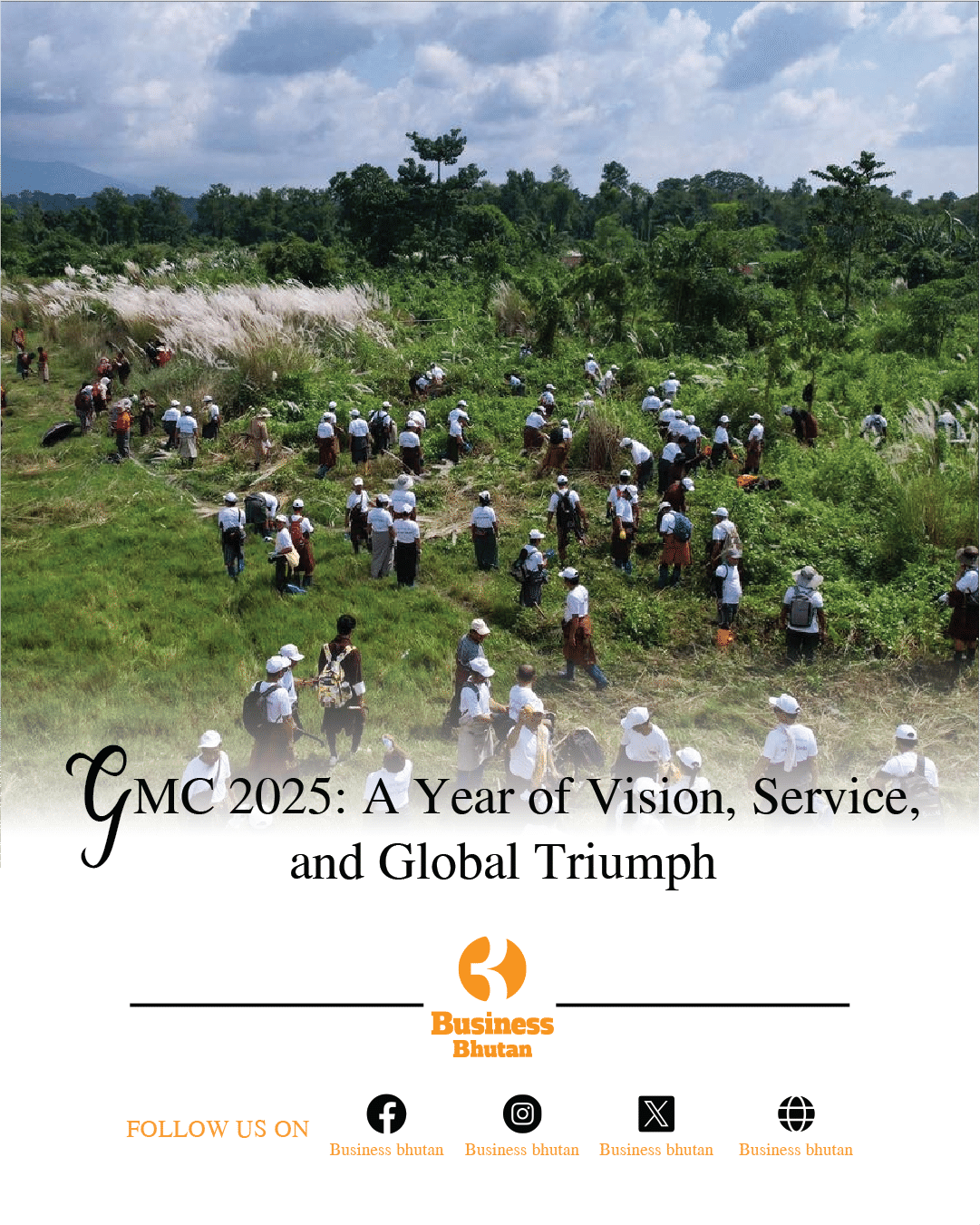
At the heart of GMC’s progress was a nationwide surge of citizen engagement through multiple rounds of zhabtog—voluntary service inspired by the vision of His Majesty The King. The first wave of volunteers saw around 2,000 participants clearing and preparing initial sites, setting the stage for a city designed to serve both people and nature. Momentum surged during the second phase from September 4–8, when over 7,000 volunteers from across Bhutan pruned trees, cleared over 700 acres of land, and prepared parks and public spaces. By the third phase, more than 8,000 citizens were actively engaged, symbolizing a nationwide spirit of service that united Parliament members, civil servants, Desuups, Gyalsups, and local communities.
The fourth volunteer phase marked another milestone, with Pelsung taking full responsibility for team management and catering, demonstrating the maturity and organizational capacity of Bhutanese volunteerism. These coordinated efforts not only shaped GMC’s physical landscape but also reinforced a moral foundation of shared ownership, community, and civic pride.
2025 also witnessed landmark initiatives central to GMC’s identity. On December 17, coinciding with Bhutan’s National Day, GMC launched TER, the world’s first sovereign-backed, physical gold-backed digital token. Derived from the Dzongkha word for “treasure,” TER represents a pioneering fusion of Bhutanese values with global financial innovation, signaling the nation’s embrace of a values-driven digital economy.
Infrastructure achievements further cemented GMC’s global profile. The Gelephu International Airport, a flagship project anchoring the city’s future, officially broke ground on July 8, with 15% of earthworks completed by November. The project, designed by the Bjarke Ingels Group (BIG) in collaboration with NACO, has already won the Holcim Foundation for Sustainable Construction Award and the World Architecture Festival’s top honor in the future projects category. Showcased as the “Ancient Future” installation at the 19th Venice Architecture Biennale, the airport exemplifies a seamless integration of Bhutanese craftsmanship, sustainability, and modern design.
The airport officially welcomed its first international flight on December 8, connecting Gelephu to Kolkata via Drukair. The inaugural flight, celebrated with a traditional water cannon salute in Kolkata, positioned Gelephu as Bhutan’s newest international aviation gateway, opening unprecedented economic and cultural opportunities. Financing for the airport was further strengthened by the Gelephu Nation Building Bond, launched in May 2025 to fund construction through citizen and investor participation.
Spiritual and cultural dimensions flourished in tandem with physical development. In just one year, the city received 30 applications, of which 14 have been approved so far: Jarong Khasho Chorten, Dordhen Tashi Gomang Chorten, Shambhala Dzong, Guru Nangsi Zilnon Lhakhang, Ugyen Norlha Lhakhang, Kangyur Labyrinth, Kurkulee Centre, Druk Ugyen Samye Ling, Kesang Do-ngag Shedrupling, Maitreya Temple, Vajrakilaya Research Center, Barched Kuensel Chorten, Tara Retreat Center, and Gyenyen Neykhang.
Groundbreaking ceremonies in November marked the start of the Kangyur Labyrinth and Kesang Do Ngag Shedrupling, while His Majesty granted royal approval for the Druk Ugyen Samye Ling, Gelephu Maitreya Temple, and Tara Retreat Centre. The Lotus-Born Trail, a sacred pilgrimage route, began construction in December, weaving wellness and mindfulness into the city’s urban fabric.
Tourism initiatives positioned GMC as Bhutan’s emerging creative southern gateway. From September 9–12, over 60 domestic tour operators explored the city and surrounding areas, gaining insight into its cultural, spiritual, and ecological potential. Youth engagement featured prominently through programs such as Pelsung and Innovate for GMC, empowering Bhutanese youth to co-create solutions for a modern, mindful urban environment. His Majesty personally visited GMC in December, meeting cohorts of Pelsups and reviewing ongoing projects.
Institutional and governance frameworks were strengthened under GMC Royal Charter No. 1 of 2024 and the Application of Laws Act 2024, establishing GMC as a Special Administrative Region blending Bhutanese law with select Singaporean and Abu Dhabi Global Market financial regulations. Strategic partnerships, including a MoU with Khaitan & Co, India, enhanced investor confidence and cross-border legal cooperation.
His Majesty also highlighted GMC’s innovative land and equity structure, ensuring landowners retain their stakes while 94% of state land is held collectively for national benefit. A strategic financial reserve of 10,000 Bitcoin (approx. USD 1 billion) was allocated to GMC, providing strong long-term support for the city’s development.
As 2025 closes, Gelephu Mindfulness City stands as a beacon of national pride, spiritual depth, and forward-looking vision. The combined force of citizen service, cutting-edge infrastructure, international recognition, and cultural preservation makes GMC a living testament to Bhutanese values in action, demonstrating that sustainable development and mindful urbanization can coexist harmoniously. With future phases ahead, GMC continues to evolve as a national endeavor that is boldly local, yet globally aspirational.
Tashi Namgyal
From Thimphu