

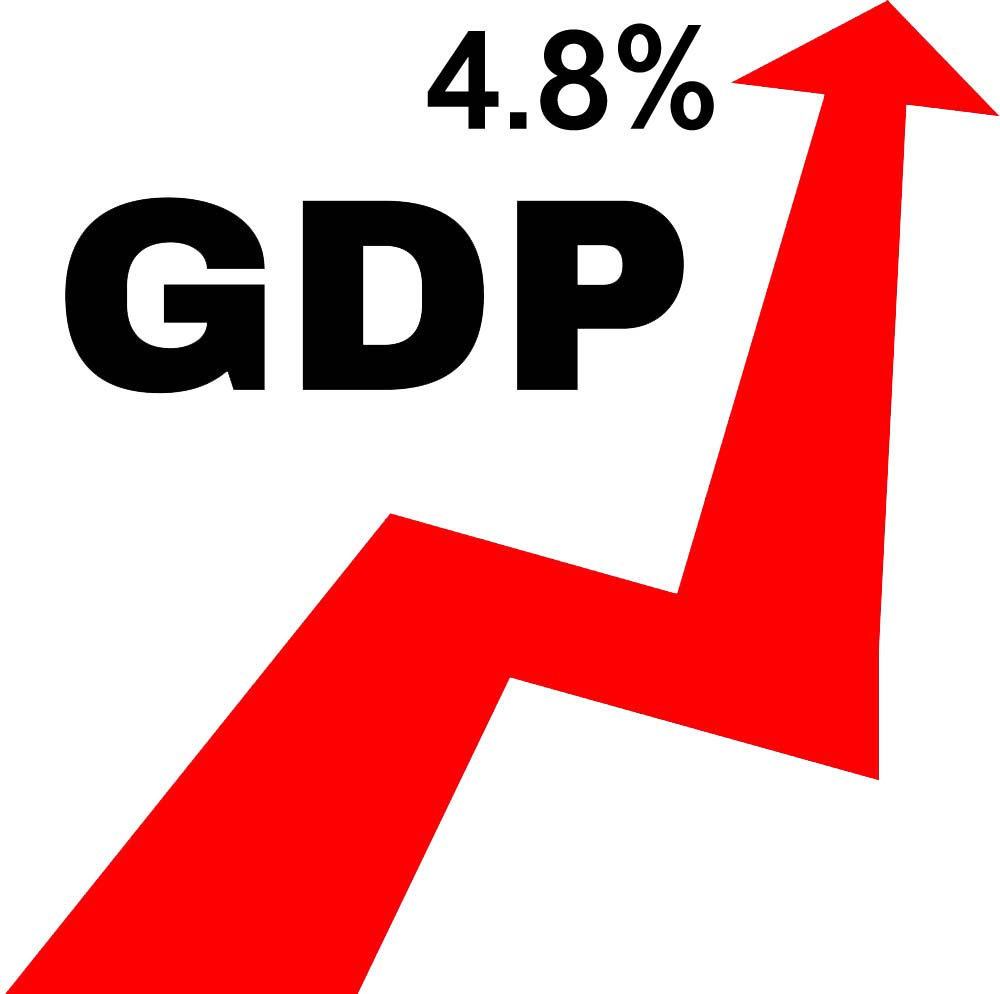
The estimated size of the economy was Nu 249,388.19 million, recording a growth of 4.88 percent in 2023. The growth was lower by 0.33 percentage points as compared to the 5.21 percent growth in 2022. This is according to the national accounts statistics 2024 released by the National Statistics Bureau (NSB) yesterday.
The key economic sectors that contributed to this growth were hotels and restaurants, which experienced a growth of 50.64 percent, mining and quarrying with a growth of 36.96 percent, and finance and insurance with a growth of 13.42 percent. On the other hand, the construction, electricity, and agriculture (crops) sectors experienced declines of -7.19 percent, -2.05 percent, and -1.95 percent, respectively.
On the demand side of the economy (GDP by Expenditure), the final consumption expenditure (FCE) increased by 5.78 percent. The primary contributors to this growth were household final consumption expenditure, which increased by 7.61 percent, and government final consumption, which grew by 1.41 percent. Further, there was a significant increase of 30.68 percent in the export of goods and services.
The Gross Domestic Capital Formation (GFCF), after experiencing a robust growth of 28.84 percent in 2022, contracted by 41.45 percentage points in 2023. The import of goods and services for the same period decreased by -0.61 percent.
The Gross National Income (GNI) registered a growth of 4.54 percent in 2023, representing a deceleration of 1.19 percentage point compared to the 5.73 percent growth in the previous year. An increase in the inflow of primary income compared to the prior year is the main contributor to this growth.
In 2023, the inflow of primary income was recorded at Nu 2,947 million, up from the previous year’s inflow of Nu 2,602.10 million. During the same period, the primary income outflow to the Rest of the World (RoW) was recorded at Nu 16,677.36 million, compared to Nu 14,436.85 million in the previous year.
GDP per capita increased to Nu 323,764.71 (USD 3,919.55), up from Nu 301,289.48 (USD 3,833.03) in 2022. In real terms, this represented a growth of 2.96 percent as compared to 5.21 percent in the previous year. The Gross National Income (GNI) per capita in 2023 witnessed a growth by 2.62 percent which is lower as compared to a growth of 5.73 percent in 2022, resulting in a deceleration of 3.11 percentage points. In nominal terms, GNI per capita in 2023 was recorded at Nu 305,939.45 (USD 3,703.75), compared to Nu 285,637.72 (USD 3,633.91) in the previous year.
The GDP deflator, also known as the implicit price deflator, measures the price change for goods and services produced within the domestic economy. The inflation, based on the Implicit Price Deflator (IPD), was recorded at 4.37 percent in 2023, a drop of 1.42 percentage points compared to the inflation rate of 5.79 percent in 2022. This indicates deceleration in the rate of price change from the previous year for the goods and services produced within the economy.
Similarly, the annual price change, as measured by the Consumer Price Index (CPI), stood at 4.23 percent in 2023, compared to 5.64 percent in 2022. This represents a decrease in inflation of 1.41 percentage points.
The economy recorded a gross national savings of Nu 49,129.23 million, an increase of Nu 768.19 million from Nu 48,361.04 million in 2022. Within the total national savings, government savings stood at a deficit of Nu 9,559.87 million, while private savings (including households, private, and public corporations) amounted to Nu 58,689.09 million. Despite the rise in national savings during 2023, the domestic investment demand could not be fully met by national savings, resulting in a saving-investment gap of Nu 54,785.20 million.
The nominal investment for 2023 was estimated at Nu 112,682.85 million, which is significantly higher than the gross national saving of Nu 49,129.23 million recorded in 2023. In real terms, investment declined by -12.61 percent in 2023, compared to a substantial growth of 28.84 percent in 2022, marking a significant drop of 41.45 percentage points.
Despite the negative growth in investment during 2023, there was an increase in national savings. This combination led to a rise in the saving-investment (SI) ratio, which increased to 0.44 in 2023 from 0.38 in 2022. The saving-investment (SI) ratio is a measure of the extent to which national savings can cover domestic investment. An SI ratio of 0.44 in 2023 indicates that national savings were able to finance only 44 percent of the total domestic figure. However, this represents an improvement of 6 percentage points from 38 percent in 2022. The increase in the SI ratio reflects a greater reliance on national savings to support investment activities in the economy, despite the decline in the level of investment.
In 2023, among the three broad economic sectors, the tertiary sector recorded the highest share of the economy with 55.49 percent, followed by the secondary sector with 29.55 percent, and the primary sector with 14.96 percent. While the primary and secondary sectors saw a drop in their shares by 0.29 percentage points and 2.27 percentage points respectively, the tertiary sector’s share increased by 1.98 percentage points compared to the previous year.
By Tashi Namgyal, Thimphu