

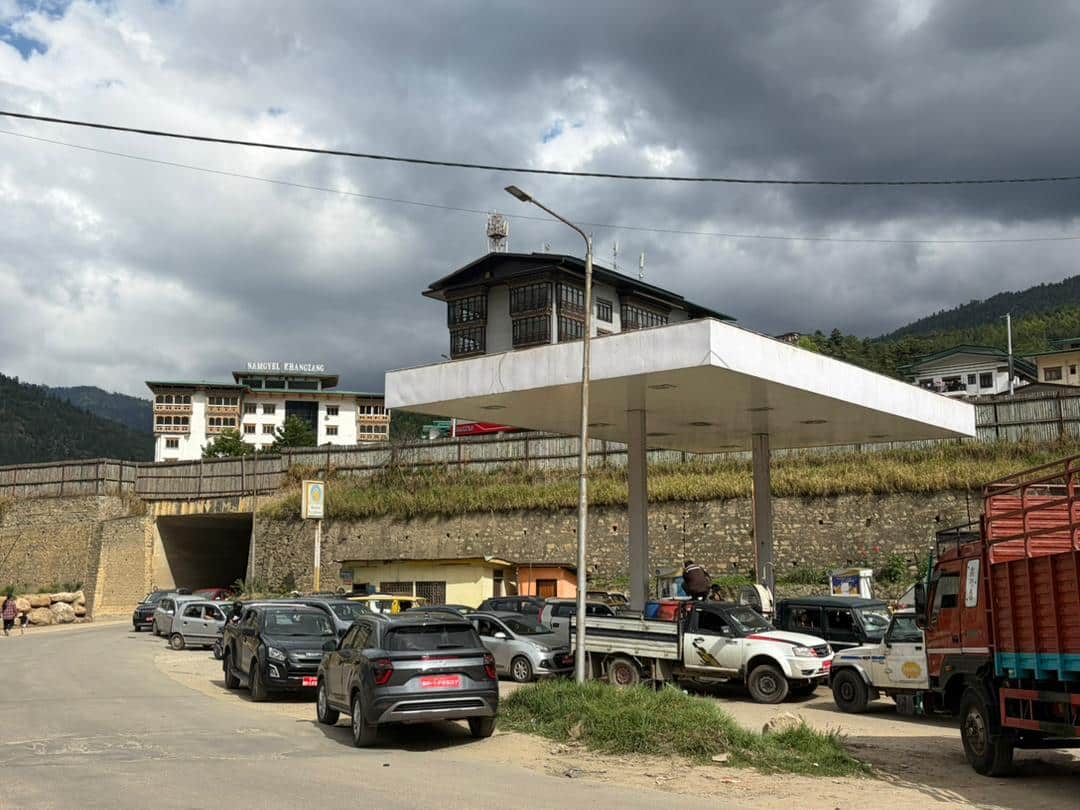
Amid discussions in the Business Session of the 37th Parliament on Bhutan’s fuel pricing mechanisms, a recent upward revision in fuel prices in India has yet again triggered concern in Bhutan, with many motorists rushing to refuel their vehicles in anticipation of a possible domestic adjustment.
On May 15, 2026, India’s state-run oil marketing companies (OMCs) announced a Rs 3 per litre increase in petrol and diesel prices, marking one of the most notable retail adjustments in recent years. In major Indian cities, petrol and diesel prices were revised upward, with New Delhi recording petrol at Rs 97.77 per litre and diesel at Rs 90.67 per litre. Mumbai saw petrol rise to Rs 106.68 and diesel to Rs 93.14, while Kolkata reported petrol at Rs 108.74 and diesel at Rs 95.13. In Chennai, petrol reached Rs 103.67 and diesel Rs 95.25 per litre.
According to international media reports, including Reuters, the increase was linked to rising input costs for Indian fuel retailers, driven by sustained global crude oil price pressures and ongoing geopolitical tensions in West Asia. Indian OMCs reportedly stated that retail fuel prices had remained largely stable since April 2022, despite significant volatility in global oil markets, making the recent adjustment necessary to offset accumulated cost pressures.
Following the announcement, fuel stations in Thimphu witnessed increased traffic on May 14 and 15, as motorists rushed to refill tanks amid speculation that Bhutan could follow a similar upward revision. Although the Royal Government has not issued any official notification on fuel price changes, public uncertainty has grown due to Bhutan’s complete reliance on imported petroleum products from India. Meanwhile, the Department of Trade on 15 May informed that there is no disruption in the supply of fuel .
Bhutan imports nearly all of its fuel from Indian OMC, with supplies transported by road tankers through the Siliguri Corridor before being stored and distributed across the country. Additional supply support is also drawn from depots in Assam when required. Given this structure, changes in Indian procurement or wholesale fuel costs, whether influenced by global crude prices, refinery margins, or domestic policy adjustments, often affect Bhutan’s landed import cost of fuel.
This structural dependence means that Bhutan’s fuel pricing is indirectly influenced by developments in the Indian market, although adjustments are not always immediate or identical.
Over the years, Bhutan has experienced fuel price revisions that broadly correspond with global and regional oil market movements. In November 2021, fuel prices in Bhutan were revised upward amid rising international crude oil prices. Petrol increased to around Nu 86.28 per litre, while diesel rose to approximately Nu 82.93 per litre, reflecting higher import costs faced by Indian suppliers at the time.
A sharper adjustment was recorded in March 2026, when Bhutan saw a significant increase in fuel prices. Petrol rose from about Nu 63.29 to over Nu 85 per litre, while diesel increased from around Nu 70.18 to over Nu 108 per litre, driven by higher landed import costs and volatility in global crude oil markets.
In April 2026, another revision followed, with petrol increasing by about Nu 5 per litre and diesel registering a smaller upward adjustment. These successive changes reflected continued fluctuations in import costs from Indian supply sources and the lagged transmission of international price trends into Bhutan’s domestic market.
These developments highlight Bhutan’s structural dependence on India for petroleum imports. However, the pass-through from Indian price changes to Bhutan is not automatic. Final pump prices in Bhutan are also shaped by transportation costs, storage and distribution expenses, domestic taxation, and regulatory decisions by relevant authorities.
As a result, while Indian fuel price movements are an important influencing factor, Bhutan’s pricing system does not function as a direct mirror of India’s retail pricing. Adjustments may be delayed, partially absorbed, or vary in magnitude depending on domestic economic considerations.
With the latest increase in India coming after a prolonged period of price stability, attention in Bhutan remains focused on whether the change will lead to any domestic revision in the coming days or weeks. For now, the absence of an official announcement has not stopped public speculation, as past trends continue to shape expectations that regional fuel price movements may eventually influence Bhutan’s market.
Sangay Rabten, Thimphu