

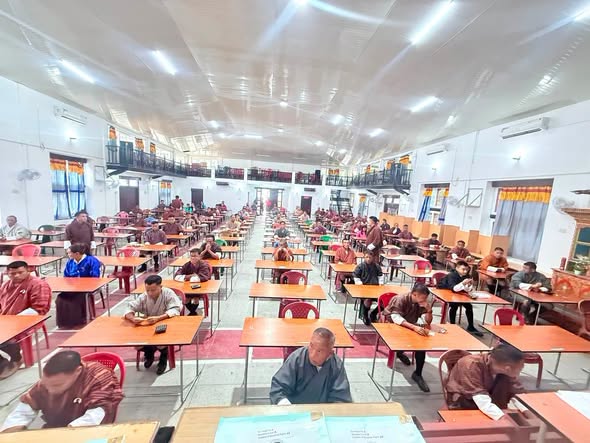
The results of the Functional Literacy and Possession of Skills Test (FLT) for the second phase of the Fourth Local Government Elections 2027 have produced a diverse pool of potential candidates, with qualification rates varying considerably between the two competency levels.
Of the 1,706 candidates who completed both components of the test for Competency Level 1, 1,203 qualified, giving a qualification rate of 70.51 percent. At Level 2, 823 of 1,009 candidates qualified, resulting in a higher qualification rate of 81.57 percent. The mean scores were 60.99 for Level 1 and 62.10 for Level 2.
The two competency levels determine eligibility for different local government positions. Level 1 certification allows candidates to file nominations for Gup, Mangmi and Thromde Ngotshab, while Level 2 certification is required for Gewog Tshogpa and Thromde Tshogpa positions.
The results therefore offer an early picture of the potential candidate pool, although the qualification rates should not be interpreted as a direct comparison of test difficulty because the two levels assess candidates seeking different positions.
One serving male Gup from eastern Bhutan said the test was challenging and that his score was “not as expected.”
Thousands registered, but not all completed the test
Interest in the upcoming local elections was substantial, with 3,698 candidates registering for the FLT through the online system, including candidates from all 205 Gewogs and Samdrup Jongkhar Thromde.
However, only 2,734 candidates appeared for the assessment, and 19 of them completed only the written Functional Competency Assessment. This left 2,715 candidates who completed both the FCA and the Functional Competency Engagement (FCE).
The revised FLT comprises a written Functional Competency Assessment and a Functional Competency Engagement, or viva voce. The ECB introduced the competency-based system to assess functional skills relevant to local leadership and public service delivery, including computational, communication and digital competencies.
Women remain a minority in the candidate pool
The registration figures also reveal a substantial gender imbalance, particularly among candidates seeking Level 1 positions.
Of the 2,228 candidates registered for Level 1, 1,974 were men and 254 were women. Level 2 registrations comprised 1,079 men and 395 women.
Women therefore accounted for only about 11 percent of Level 1 registrations, compared with about 27 percent at Level 2.
Among those who completed Level 1, 70.87 percent of male candidates qualified, compared with 67.56 percent of female candidates. The ECB recorded 1,521 male and 185 female Level 1 test-takers.
The figures show a gender gap in both participation and, at Level 1, qualification. However, they do not establish why fewer women registered or why qualification rates differed. Factors such as access to preparation, education, employment, family responsibilities and other social or economic circumstances would require separate assessment.
For some women who took the test, the experience highlighted practical challenges.
Phul Maya Katwal of Kana Gewog, Dagana, who appeared for Level 1, said the test was difficult after being away from formal education for many years. She said her writing speed had declined and she was unable to attempt all the questions.
“English could also have been included, with candidates required to pass it with 50 percent, rather than having only Dzongkha,” she said.
Sharmila Gurung of Phuntshothpelri Gewog, who attempted Level 2, said some questions were beyond her expectations. Although she attempted all the questions, she did not qualify.
She said she would continue trying until she passed and was able to serve as a local leader in her community.
The Bhutan Centre for Media and Democracy also conducted training for aspiring women leaders to prepare for the FLT and encourage their participation in the 2027 elections. Of more than 650 registered aspiring women leaders, however, only about 120 attended the training. Officials earlier told the media that time constraints and domestic responsibilities prevented some from attending.
Academic qualifications do not determine eligibility
The results also underline the diversity of educational backgrounds among aspiring local leaders.
Class XII graduates formed the largest group of test-takers, followed by Class X graduates. The pool also included degree holders, diploma and certificate holders, candidates with Class VIII and primary education, monastic education and non-formal education.
Among those who qualified at Level 1 were 17 Master’s degree holders, 285 Bachelor’s degree holders, 390 Class XII graduates and 249 Class X graduates. Others included candidates with Class VIII, primary, monastic and non-formal education.
At Level 2, successful candidates similarly came from varied educational backgrounds, including 20 Bachelor’s degree holders, 315 Class XII graduates, 241 Class X graduates and candidates with lower formal education, monastic and non-formal education.
The results demonstrate that formal academic qualifications alone do not determine eligibility. The FLT is designed to establish whether candidates possess the functional competencies required for the positions they seek.
Most incumbents who took the test qualified
The results also provide an indication of continuity among existing local leaders.
Of the 352 incumbent candidates who sat the Level 1 test—comprising 162 Gups, 183 Mangmis and seven Thromde Ngotshabs—286 qualified for Level 1 certification.
This means that more than four-fifths of the incumbents who took the test met the competency requirements and remain eligible to seek the corresponding positions.
Whether they ultimately contest, however, will depend on their individual decisions and the subsequent nomination process.
57 candidates shift to Level 2 pathway
The FLT results have also opened an alternative pathway for 57 Level 1 candidates.
These candidates did not achieve the required aggregate score of 50 percent for Level 1 certification but secured at least 40 percent in both the FCA and FCE. Under the prescribed criteria, they are eligible to receive Level 2 certification.
This means that not meeting the Level 1 aggregate threshold does not necessarily end a candidate’s eligibility to contest local government elections; qualifying candidates may still pursue Level 2 positions.
1,749 previous certificate holders expand the pool
The potential pool of Tshogpa candidates is also considerably larger than the 823 candidates who qualified through the latest test.
The ECB will issue Level 2 certificates to 1,749 individuals who already hold previously issued FLT certificates and have expressed their intention to contest Tshogpa elections in the second phase. Other existing certificate holders who intend to contest may apply through their respective Dzongkhag Election Offices.
A first picture of the 2027 elections
The FLT results provide an early picture of who may contest the second phase of the 2027 Local Government Elections, but they do not yet determine the final candidate lists or the competitiveness of individual constituencies.
The second phase will cover the 205 Gewog Tshogdes and Samdrup Jongkhar Thromde. The ECB has stated that the current terms conclude on 21 January 2027, with the elections to be conducted within the statutory period from 22 January to 21 April 2027. The definitive election schedule will be announced separately.
The next decisive stage will therefore be nomination. It will reveal how many qualified candidates actually enter the race, which constituencies attract multiple candidates and where candidate shortages may remain.
The ECB’s post-test assessment already shows that the candidate distribution is uneven: while many Gewogs and Chiwogs have several potential candidates, some have only one or two, and the Commission’s current scenario includes 70 Chiwogs without a candidate.
The FLT has therefore done more than test functional competency. It has provided the first detailed glimpse of the size, educational diversity, gender composition and geographic spread of the potential local leadership pool ahead of the 2027 elections.
The challenge now moves beyond the test itself: whether the qualified pool translates into sufficient and meaningful participation across Bhutan’s local governments will become clearer when nominations open.
Sangay Rabten, Thimphu