


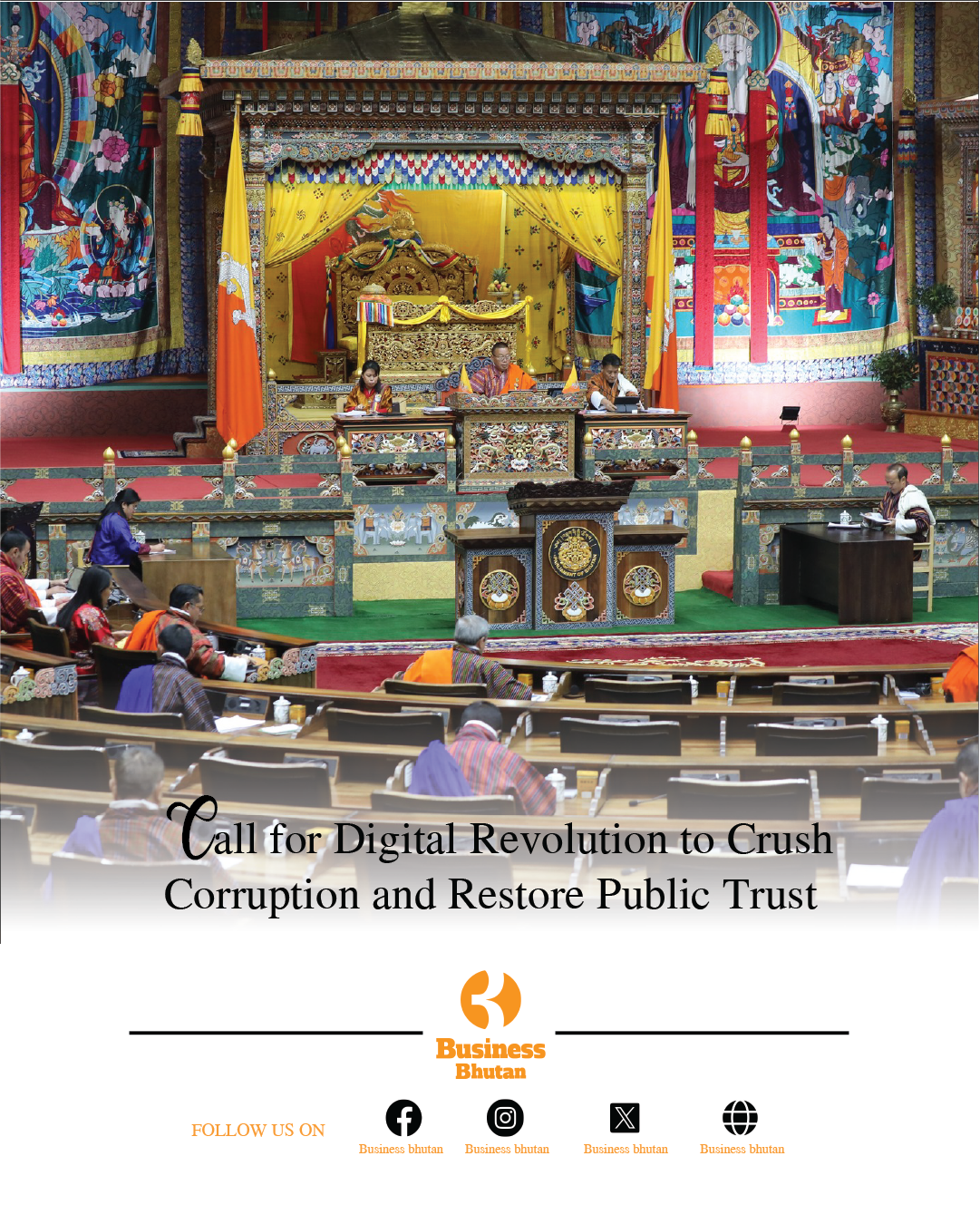
In a bold move to tackle systemic corruption, the Good Governance Committee has urged the National Assembly to fast-track a nationwide digital transformation of Bhutan’s government services. The Committee argues that only a fully integrated, secure digital platform can eliminate the loopholes and discretionary power that have allowed corruption to thrive, and in doing so, restore public confidence in governance.
During the 5th Sitting of the 4th Session of the Fourth Parliament, the Committee called for the immediate rollout of a unified government platform that combines e-payments, e-procurement, automated approvals, and integrated human resource systems. By minimizing human interfaces and discretionary decision-making, the initiative aims to make corruption far harder to hide, ensuring transparency and accountability at every level of government.
“Excessive human discretion has been at the heart of systemic governance failures,” said a committee membe. “A robust digital system can enforce transparency in procurement, mandate e-payments, and make personnel management objective and fair. This is how we close the loopholes that have eroded public trust.”
Recent surveys paint a stark picture of the corruption landscape in Bhutan. Public perception of corruption has jumped from 14 percent in 2012 to 38.3 percent in 2022, with nearly 40 percent of citizens reportedly “accustomed” to corrupt practices. Gift-giving remains common, often justified as cultural reciprocity, while half of Bhutanese youth admit they would lie or cheat if no harm were perceived. Media scrutiny is weak, with investigative and analytical reporting rare, allowing misinformation and cynicism to persist.
The Committee emphasized that digital governance is not merely about efficiency; it is about integrity by design. By making financial transactions, approvals, and procurement processes fully transparent, a digital government leaves no room for favoritism, patronage, or abuse of authority. In addition, such a platform can expand equitable access to services, reaching even the most remote communities, ensuring that integrity is not limited to urban centers.
However, technology alone is not enough. The Committee stressed the need to embed ethics, integrity, and anti-corruption principles across Bhutan’s national curriculum and public service frameworks. By nurturing a culture of accountability from youth to civil servants, ethical governance can become a societal norm rather than a distant aspiration.
The Committee also highlighted ongoing challenges that threaten Bhutan’s anti-corruption efforts. Corruption remains normalized in daily life, fueled by weak enforcement, low penalties, and vulnerabilities within critical agencies such as customs, immigration, and police. High staff turnover in anti-corruption bodies has further weakened institutional capacity, highlighting the urgent need for incentives, recognition, and career progression to retain expertise.
In response, the House of Parliament endorsed the ACC’s recommendations in full. Stricter penalties for senior officials, stronger integrity mechanisms, and preventive systems were all approved, alongside urgent implementation of digital governance initiatives and nationwide ethics education programs. The Committee will submit detailed progress reports in the next session, ensuring accountability and sustained momentum.
Beyond enforcement, technology supports education and awareness. E-learning modules and online campaigns teach civil servants and the public about ethics, integrity, and anti-corruption practices, fostering a culture of accountability that reinforces systemic reforms.
Technology transforms governance by closing loopholes, reducing discretionary power, and enabling proactive monitoring. When combined with strong institutions, ethical education, and legal safeguards, digital systems can significantly curb corruption, strengthen public trust, and build a more transparent and accountable society. In today’s digital era, leveraging technology is not optional—it is essential for a fair and just governance system.
Bhutan’s lawmakers have sent a powerful message: corruption cannot thrive in a transparent, digital, and ethically driven system. By combining technology with education and systemic reforms, Bhutan is positioning itself to protect public trust, safeguard national development, and ensure that integrity becomes the defining feature of governance in the 21st century.
Sangay Rabten
FromThimphu