

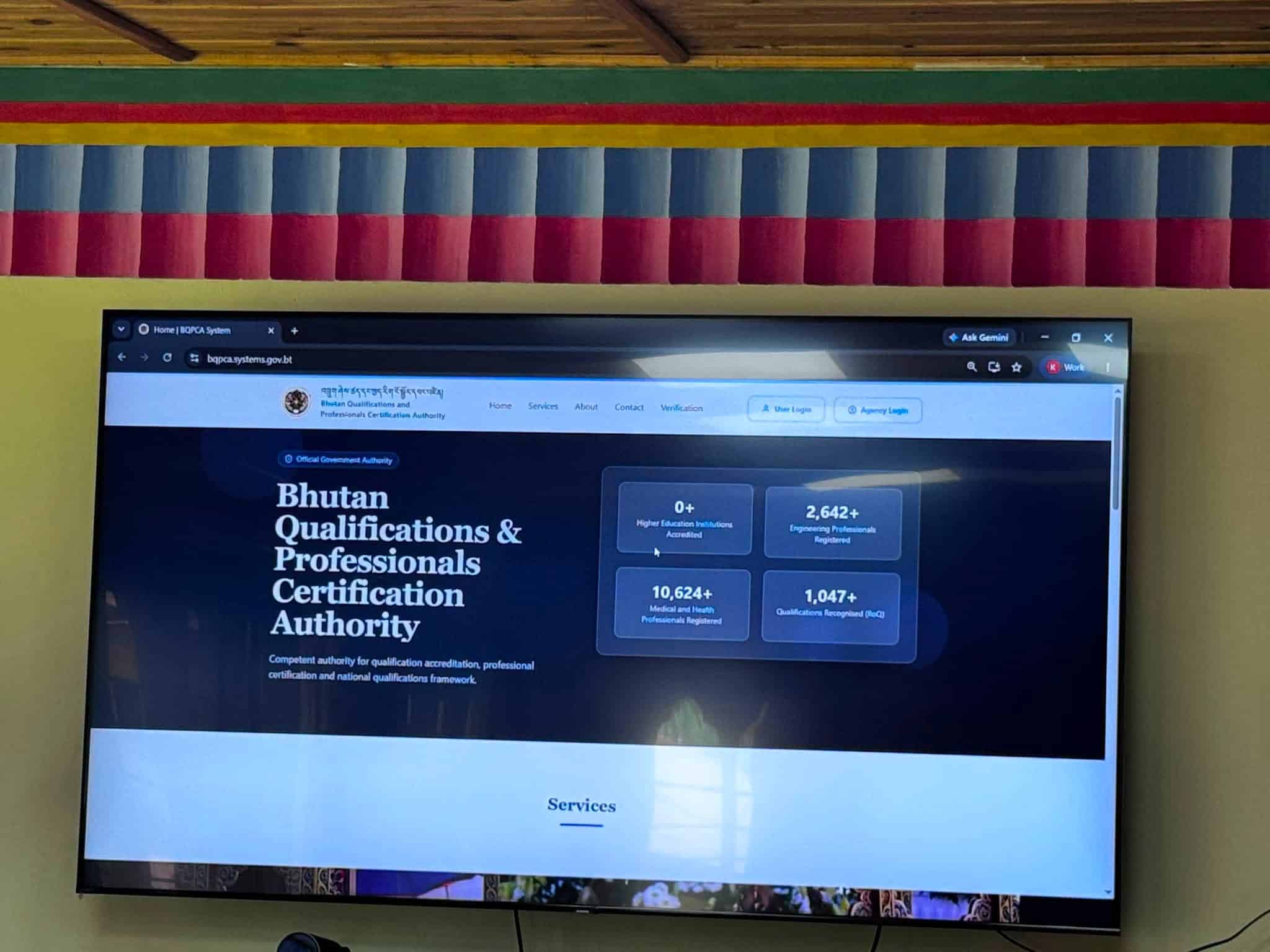
The Bhutan Qualifications and Professionals Certification Authority (BQPCA) has launched an inte-grated digital system that connects its regulatory services with key government systems, reducing the need for repeated data entry and submission of information already held by the government.
The system, launched on September 2, connects BQPCA services with government systems including the Department of Civil Registration and Census, Bhutan Food and Drug Authority (BFDA), Bhu-tan Construction and Transport Authority (BCTA), Royal Civil Service Commission and the Ministry of Industry, Commerce and Employment.
BQPCA Director Dr Ugyen Tshewang said the shift was necessary as the authority’s responsibilities expanded and manual processes became increasingly difficult to manage.
He said the objective was to move towards a more efficient, transparent and user-centred regulatory system.
One practical change is the handling of personal in-formation.
The director said that under the manual process, staff had to enter information such as a person’s CID number, village and parents’ names separately. With the BQPCA system connected to the Department of Civil Registration and Census, entering a CID number can allow other relevant information to be retrieved from the connected government system.
He said this would save time and improve data ac-curacy.
The system is designed to allow information already held by the government to be verified and shared where appropriate, reducing the need for citizens and institutions to repeatedly provide the same information.
The Secretary of the Ministry of Education and Skills Development, Dasho Tshewang Chophel Dorji said this was an important distinction between simply putting government services online and carrying out digital transformation.
He said digital transformation should not mean re-producing an existing manual process on a digital platform. Instead, the government should examine whether unnecessary steps can be removed, whether information already held by the government can be retrieved instead of requested again, and whether systems can communicate with one another.
The BQPCA system currently brings together ser-vices of three councils including the Medical and Health Professionals Council (MHPC), Higher Education Quality Council (HEQC) and Engineering Professionals Council (EPC).
For MHPC and EPC, the system covers professional registration, re-registration, renewal, additional qualifications and institute registration. It also supports certificates of good standing and Continuing Professional Development (CPD), including CPD provider services, self-CPD submissions and CPD record management.
For HEQC, the platform covers recognition of qualification certificates, second-copy issuance, higher education institution accreditation, accreditation renewal, regulatory reporting and accreditation appeal processing.
Applicants and professionals can access the services remotely, submit applications and track their application status through the digital platform.
Previously, several processes required applicants to visit BQPCA offices to submit applications and, in some cases, return to collect certificates and formal outcomes. Manual handovers between officers and departments contributed to longer processing times, while applicants had limited visibility of their application status.
The new system introduces structured digital work-flows, role-based approvals and traceable records, allowing applications to move through defined stages and creating a digital record of regulatory decisions.
Interconnection with other government systems is a key component of the platform.
The HEQC system is connected with the integrated business system of the Ministry of Industry, Com-merce and Employment and the Department of Civil Registration and Census. The EPC system is con-nected with the Bhutan Construction and Transport Authority, while the MHPC system is connected with the Bhutan Food and Drug Authority.
BQPCA said these linkages are intended to support information verification, strengthen data integrity and reduce duplication.
The Secretary said interoperability could reduce the need for citizens and institutions to repeatedly provide information already held by the government, while improving accuracy, shortening processing times and reducing administrative burdens.
He said citizens experience government as one government rather than as individual ministries, departments and agencies, and digital systems should increasingly reflect this by working together.
The system is also intended to strengthen BQPCA’s regulatory oversight by creating structured digital records that can support management re-porting, planning, auditability and decision-making.
For professionals, the platform provides a digital record of qualifications, registration and CPD activities. Institutions can submit accreditation and registration requests digitally, maintain regulatory information and track renewal and compliance requirements.
The system was developed by DrukSmart Private Limited, with the GovTech Agency serving as the procuring agency and technical lead. BQPCA and its council teams provided service-process expertise and user feedback during development.
The platform is expected to be expanded to other BQPCA services.
An Education Consultancy and Placement Firms (ECPF) module under HEQC is planned for a separate rollout by the end of September. The planned module will cover registration and renewal, profile and licence-related services, compliance management, education fair and visitor-clearance services, institutional linkages and student-placement reporting.
A Teaching Professionals Council module is also planned as part of the future expansion of the common digital platform.
The Secretary said BQPCA should also explore further digital services, including digital credentials, professional registries, integrated CPD management, competency-based assessments and data-driven regulatory planning and oversight.
At the same time, he cautioned that greater integration would require attention to data governance, privacy, cybersecurity and information security.
BQPCA also plans to progressively develop the platform into a SMART regulatory system. Potential future features include automated renewal and compliance alerts, application-completeness checks, performance dashboards, improved mobile accessibility, expanded government-system integration and applicant feedback and service-satisfaction analytics.
These features are planned enhancements and are not part of the current launch.
For now, the main change is that BQPCA’s core regulatory services are available through a common digital platform and can draw on information from connected government systems where appropriate.
The system is intended to reduce repeated data submission and manual processing for applicants and institutions, while giving BQPCA more structured and traceable records for regulatory over-sight.
Nidup Lhamo, Thimphu