

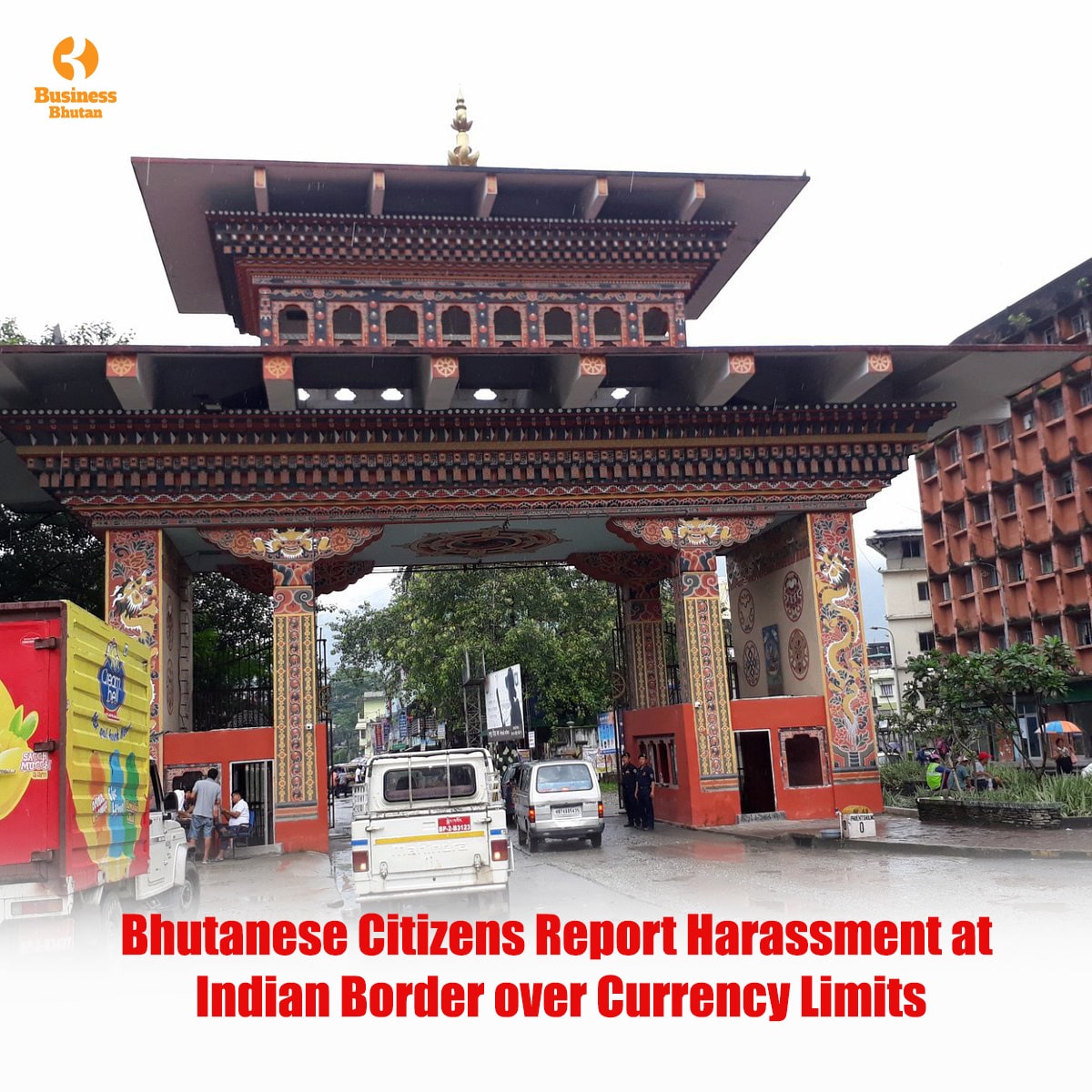
Bhutanese citizens are reporting increased instances of harassment by Indian border personnel at several India-Bhutan crossing points, particularly in the Jaigaon-Phuentsholing region, following a recent crackdown prompted by the seizure of counterfeit Indian currency.
The heightened scrutiny was reportedly triggered after an individual was caught entering Bhutan from Assam with fake Rs 500 notes. In response, Bhutanese authorities, including the Royal Monetary Authority (RMA), moved to tighten foreign exchange regulations within the country. However, Indian border security personnel—primarily from the Sashastra Seema Bal (SSB)—are allegedly using the incident to justify imposing arbitrary restrictions on Bhutanese travelers, many of whom are carrying Indian currency well within legal limits, according to Indian media reports.
According RMA regulations, Bhutanese citizens are permitted to carry up to Rs100,000 for medical travel, Rs 80,000 annually for educational purposes, and Rs 50,000 annually for private travel, with a per-trip limit of Rs 25,000. Despite these clear regulations, multiple Bhutanese travelers have reported being restricted to carrying no more than Rs 20,000—far below the official thresholds. In some cases, individuals have allegedly had their currency confiscated at the border without proper documentation or explanation.
The issue has particularly affected patients traveling to Indian hospitals and students enrolling in educational institutions across the border. “It is extremely distressing,” said a Thimphu resident whose relative was denied entry while on the way to a hospital in Siliguri. “We are abiding by the rules, but we are being treated like criminals.”
In addition to the currency-related issues, Bhutanese citizens purchasing essential household items in India report being stopped and interrogated at the border. Indian traders transporting goods from Bhutan are also reportedly facing delays and increased scrutiny, disrupting the previously seamless cross-border flow of goods and contributing to shortages and price increases in Bhutanese markets.
These challenges are compounded by the absence of a fully functional digital payment interface between the two countries. While the RuPay card was introduced during Indian Prime Minister Narendra Modi’s 2014 visit to Bhutan, the Unified Payments Interface (UPI)—India’s widely used real-time digital payment system—has yet to be fully integrated into Bhutan’s financial infrastructure. As a result, Bhutanese citizens remain heavily dependent on cash while transacting in India, leaving them more vulnerable to restrictive enforcement.
Rights advocates and observers argue that while the counterfeit currency incident is a serious concern, it should not serve as grounds for blanket suspicion against ordinary Bhutanese travelers. “Using an isolated criminal act to justify the harassment of legal travelers undermines bilateral goodwill and violates basic principles of fairness,” said a legal analyst based in Phuentsholing.
Despite growing public outcry and calls for clearer coordination between the financial and security agencies of both nations, no formal resolution has been announced. In the meantime, Bhutanese citizens continue to seek fair, safe, and respectful treatment while traveling across the border in accordance with established legal provisions.
Tashi Namgyal from Thimphu