

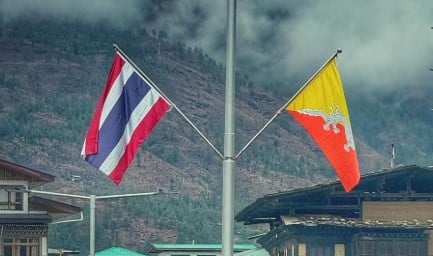
The relationship also brings together two development philosophies: Bhutan’s Gross National Happiness and Thailand’s Sufficiency Economy Philosophy
As Thailand’s Prime Minister, His Excellency Anutin Charnvirakul, accompanied by his spouse, Mrs. Thananon Charnvirakul, visits Bhutan from October 30 to November 1, 2026, the engagement offers an opportunity to reflect on a relationship built on royal friendship, mutual respect and decades of diplomatic exchanges.
Since establishing diplomatic relations on November 14, 1989, Bhutan and Thailand have maintained close ties rooted in shared Buddhist traditions, respect for monarchy and growing cooperation across economic and social sectors. Regular exchanges between their leaders and royal families have helped transform this goodwill into practical collaboration. Over the years, bilateral engagement has expanded to include trade, investment, tourism, education, healthcare, agriculture and human resource development.
One significant milestone was the official visit of Bhutan’s Prime Minister Dasho Tshering Tobgay to Thailand in November 2013. The visit focused on strengthening economic and trade relations and resulted in the signing of an Agreement on Trade and Economic Cooperation. It provided fresh impetus to bilateral engagement and opened opportunities for broader collaboration.
Prime Minister Tshering Tobgay returned to Thailand in August 2014 to chair the 70th session of the United Nations Economic and Social Commission for Asia and the Pacific. The visit also provided an opportunity to engage with Thailand’s leadership and discuss matters of mutual interest. Thai officials subsequently visited Bhutan for celebrations marking the 25th anniversary of diplomatic relations.
The royal families have played a particularly important role in strengthening relations between the two countries. Their exchanges reflect not only institutional ties but also a shared reverence for monarchy and deep Buddhist and cultural connections.
In 2016, Princess Maha Chakri Sirindhorn of Thailand visited Bhutan under her Agriculture for School Lunch Project. The initiative supported agricultural programmes in six Bhutanese schools and provided scholarships for Bhutanese teachers to pursue training and higher studies in Thailand. The visit demonstrated how royal engagement could translate into meaningful cooperation in education and agriculture.
The following year, His Majesty King Jigme Khesar Namgyel Wangchuck and Her Majesty Queen Jetsun Pema Wangchuck travelled to Thailand to attend the royal cremation ceremony of the late King Bhumibol Adulyadej, who passed away in October 2016.
Their Majesties’ presence was a profound gesture of solidarity and respect, reflecting the close bonds between the two royal families and Bhutan’s regard for the late Thai monarch.
In July 2018, Thailand’s then Prime Minister General Prayut Chan-o-cha visited Bhutan at the invitation of Prime Minister Tshering Tobgay. Discussions covered bilateral relations, regional cooperation, science and technology, and efforts to combat transnational crime. Both sides also reviewed cooperation in education, public health, agriculture and skills development.
The exchange of leadership visits gained renewed momentum in 2024, when the two countries celebrated 35 years of diplomatic relations. Prime Minister Tshering Tobgay visited Thailand from June 25 to 28 at the invitation of his Thai counterpart, Srettha Thavisin. Their discussions focused on trade, investment, tourism, education, renewable energy and human resource development, including potential investment opportunities in Gelephu Mindfulness City (GMC).
In March 2025, Thai Foreign Minister Maris Sangiampongsa made the first official visit to Bhutan by a Thai foreign minister. He met Bhutanese leaders and received an audience with His Majesty The King, further strengthening high-level diplomatic engagement.
A defining moment in bilateral relations followed in April 2025, when King Maha Vajiralongkorn and Queen Suthida of Thailand undertook a state visit to Bhutan from April 25 to 28. It was the first state visit to Bhutan by a reigning Thai monarch and the Thai King’s first state visit abroad since ascending the throne.
Their Majesties met Bhutan’s King and Queen, visited spiritual and cultural landmarks and attended programmes celebrating the friendship between the two countries. An exhibition on Gelephu Mindfulness City also featured in the programme, reflecting Thailand’s interest in Bhutan’s development ambitions and emerging economic opportunities.
The historic visit elevated bilateral relations and reaffirmed the importance both countries attach to their longstanding friendship.
Beyond royal and diplomatic engagements, cooperation has expanded through scholarships, technical assistance, healthcare support, tourism promotion and agricultural programmes.
Thailand has provided training opportunities for Bhutanese officials and professionals through its international cooperation programmes. Both countries have also explored opportunities to expand trade, investment and connectivity.
Tourism remains an important area of potential cooperation. Under the concept of “Two Kingdoms, One Destination”, Bhutan and Thailand have promoted opportunities for joint tourism initiatives, cultural exchange and greater movement of visitors between the two countries. Their relationship also brings together two distinctive development philosophies: Bhutan’s Gross National Happiness (GNH) and Thailand’s Sufficiency Economy Philosophy (SEP).
Despite emerging from different national experiences, both place importance on balanced development, sustainability, self-reliance and community wellbeing. This common ground provides opportunities to exchange experiences in public policy, rural development, environmental conservation and inclusive economic growth.
As Prime Minister Anutin Charnvirakul arrives in Bhutan, the history of royal friendship and leadership exchanges provides a strong foundation for the next chapter of bilateral relations.
Tashi Namgyal, Thimphu