

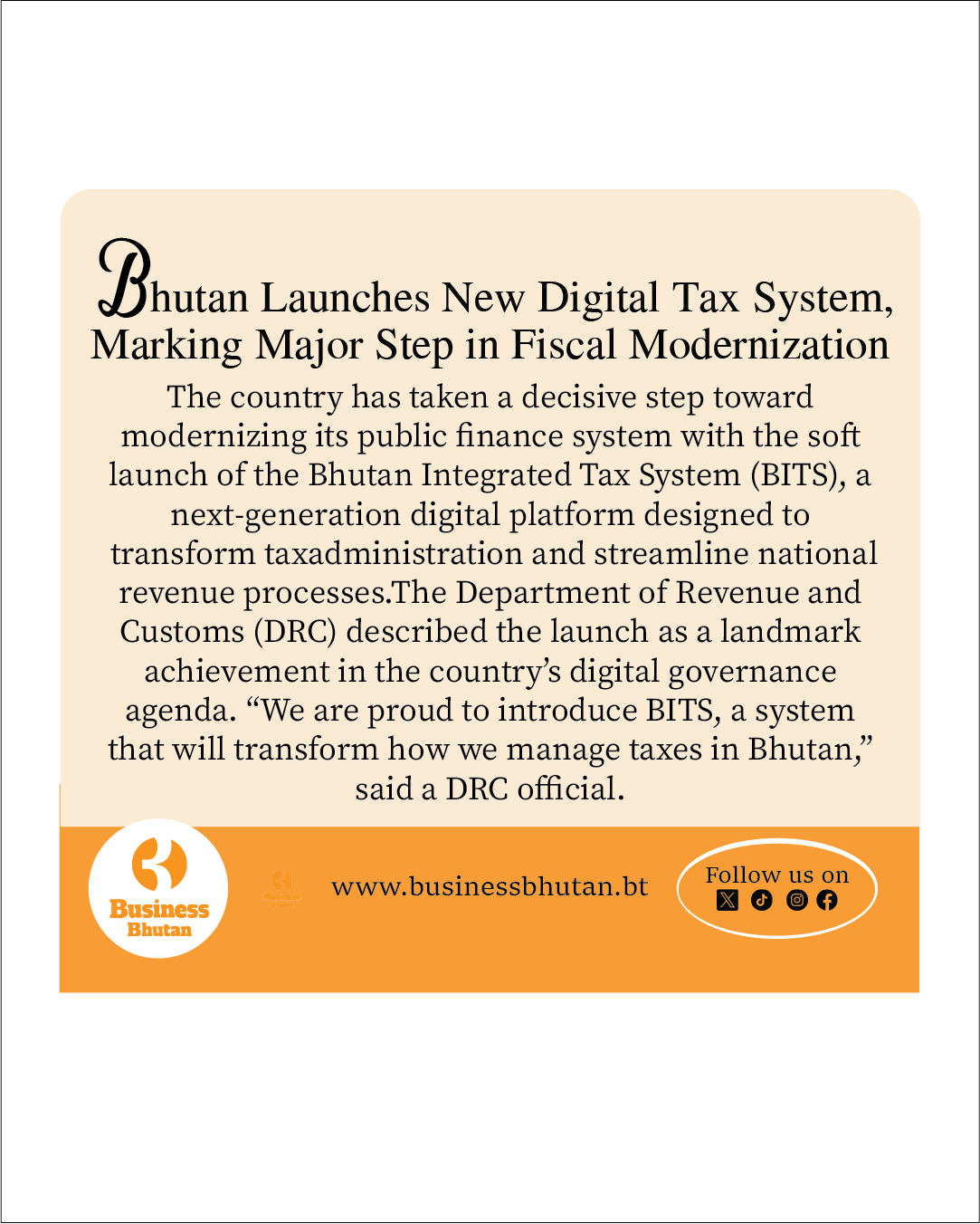
The country has taken a decisive step toward modernizing its public finance system with the soft launch of the Bhutan Integrated Tax System (BITS), a next-generation digital platform designed to transform tax administration and streamline national revenue processes.
The Department of Revenue and Customs (DRC) described the launch as a landmark achievement in the country’s digital governance agenda. “We are proud to introduce BITS, a system that will transform how we manage taxes in Bhutan,” said a DRC official. “This digital platform will make tax collection more efficient, accurate, and taxpayer-friendly.”
BITS replaces the decade-old Revenue Administration Management Information System (RAMIS). Developed by New Zealand–based Data Torque Limited in partnership with Bhutan’s GovTech Agency and the Ministry of Finance, the new system is hosted on Bhutan’s secure digital infrastructure. Officials emphasized that data sovereignty and national security were central to the development process.
The soft launch marks the formal transition of BITS from development to operational use. “This ceremony represents not just a technology handover but the beginning of a new era in Bhutan’s tax administration,” the official added.
BITS consolidates multiple tax categories—including Income Tax, Goods and Services Tax (GST), and Excise Tax—into a unified platform. The integration is expected to reduce administrative fragmentation, increase transparency, and improve taxpayer compliance.
“With BITS, taxpayers will have access to real-time information, enabling them to file taxes online with ease,” said the DRC. A key component is the new self-service portal, which allows users to complete filings, access statements, and track obligations without visiting tax offices. Intelligent validation tools are expected to reduce errors and ensure accuracy in assessments.
Automation is also a major feature. Routine calculations and processes will now be handled by the system, improving efficiency and freeing tax officials to focus on complex compliance matters. Businesses, in particular, are expected to benefit from faster turnaround times and more predictable service delivery.
Integrating Artificial Intelligence
The DRC is preparing to introduce artificial intelligence capabilities within BITS, beginning with an AI-powered chatbot that will assist taxpayers with routine queries. “This chatbot will not only improve service delivery but also support staff training,” said a senior official.
In the long term, AI will be applied to risk profiling and compliance management, helping the department identify potential tax risks more effectively while maintaining high service standards. “Our goal is to build a digital environment that is both intelligent and user-centric,” the official said.
A Phased Rollout Toward Full Implementation
Bhutan’s tax modernization initiative is structured in three phases. The first phase covers GST and Excise Tax. The second phase, expected in August 2026, will automate income tax processes, while the third and final phase, scheduled for December 2026, will integrate property tax and other non-tax components.
“This phased approach allows us to build capacity steadily and ensure system stability,” the DRC said. “It also allows us to incorporate feedback and make continual improvements.”
BITS will become fully operational on 1 January 2026. Ahead of this transition, nationwide training sessions will be conducted for tax officials, businesses, and individual taxpayers. Regional support centres and a dedicated help desk at the DRC headquarters will assist users during the rollout.
“Our goal is a smooth, seamless transition to the new platform,” the DRC official said. “We want taxpayers to experience less hassle and greater convenience as Bhutan embraces digital tax administration.”
Sherab Dorji
FromThimphu