

Bhutan has refuted reports circulating in Indian border towns that it has imposed restrictions on the sale of fuel to vehicles with Indian registration numbers, clarifying that no such directive has been issued.
Recent reports published by sections of Indian local media, particularly in areas bordering Phuentsholing, claimed that Bhutanese fuel stations had begun limiting fuel sales to Indian vehicles amid concerns over global fuel price volatility. The reports quickly spread across border communities, raising anxiety among Indian residents who frequently cross into Bhutan for cheaper fuel.
One such report, published by Millennium Post on March 11, suggested that in light of rising geopolitical tensions in the Middle East and increasing LPG prices, Bhutan had introduced caps on fuel sales. The article claimed that four-wheeled vehicles were restricted to purchasing fuel worth Nu 1,000, while two-wheelers were limited to just one litre.
However,officials in Bhutan have firmly denied these claims. An official from the Department of Trade under the Ministry of Industry, Commerce and Employment (MoICE) said the government is aware of the reports but confirmed that no restrictions have been introduced.
“The department has not issued any such directives,” the official said, dismissing the claims as unfounded.
The report, filed from Alipurduar district in West Bengal, also stated that the alleged restrictions had disappointed residents of nearby areas such as Jaigaon and Banarhat, where many rely on Bhutan for more affordable fuel. It further suggested that locals feared a complete ban on Indian vehicles refuelling in Bhutan if the situation worsenedHowever,ground-level accountsfrom border towns present a more nuanced picture.
Ayan Naidu, a tourism operator based in Alipurduar, said he had come across similar reports circulating on local media platforms in Jaigaon but was skeptical of their authenticity.
“Bhutan and India share a deep and longstanding relationship, both diplomatically and at the people-to-people level,” he said. “I was confident that the Royal Government of Bhutan would not impose such restrictions without any official communication.”
Naidu added that he had urged local media outlets to verify the information before publishing, noting that misinformation could create unnecessary concern among businesses and travellers.
“At the same time, if such restrictions were to be imposed, it would certainly affect our business,” he said, highlighting the dependence of border-area tourism on smooth cross-border movement.
Similarly, Sarad Pradhan, a tour operator from Jaigaon, said he was unaware of any official restrictions despite the rumours circulating widely.
“I have heard the discussions, but there has been no confirmation. As far as I know, fuel sales are continuing as usual,” he said.
The confusion appears to stem from longstanding dynamics along the Bhutan–India border, where differences in fuel pricing often influence cross-border movement.
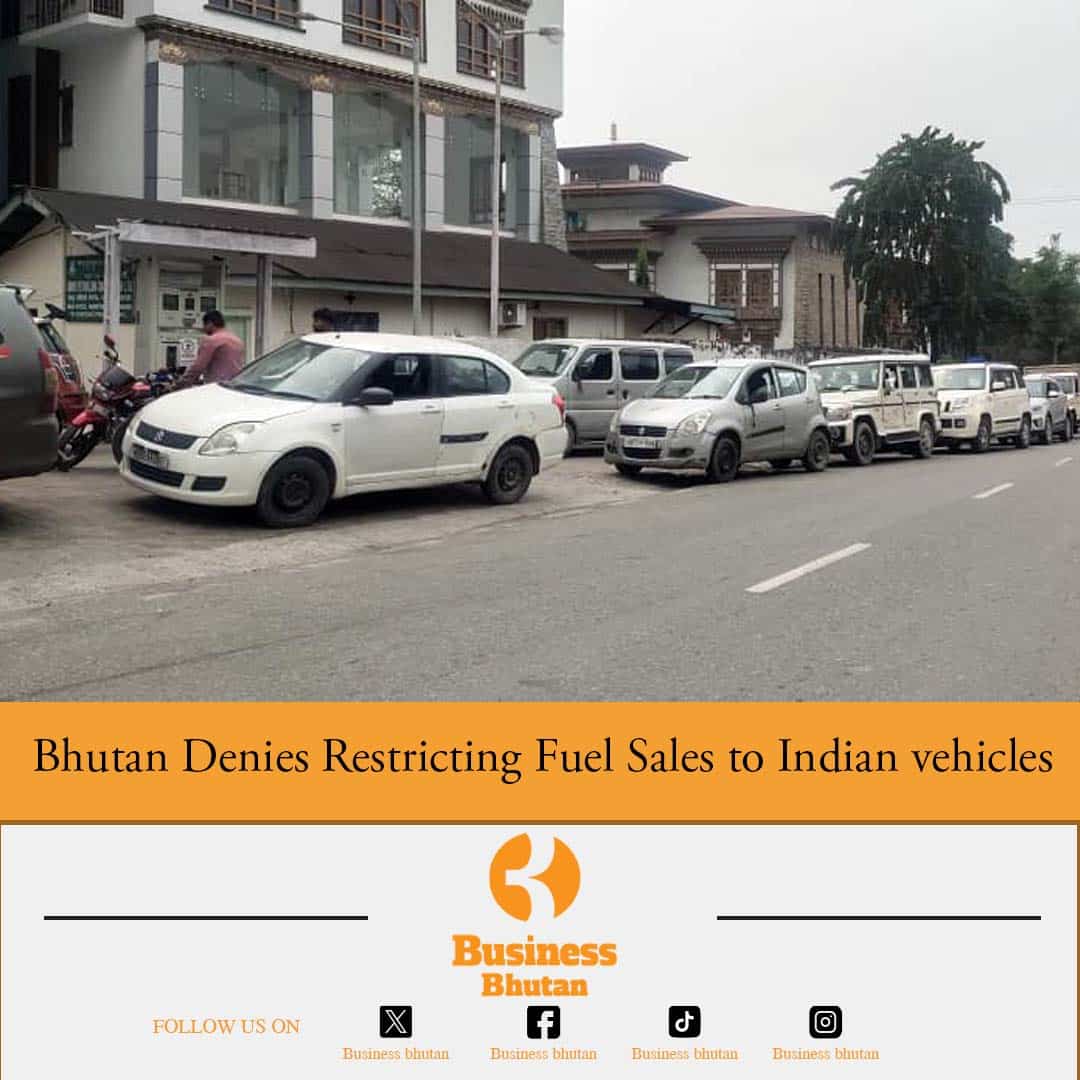
Fuel prices in Bhutan are generally lower than in India, prompting many Indian vehicle owners to cross into towns such as Phuentsholing and Samtse to refuel. This has led to frequent congestion at Bhutanese fuel stations, particularly during peak hours.
In some cases, authorities and local residents have observed Indian vehicles carrying large quantities of fuel, sometimes beyond immediate consumption needs. There have also been concerns about informal resale of fuel across the border, although no formal data has been released on the scale of such practices.
The steady influx of vehicles has contributed to long queues at fuel stations, occasionally disrupting traffic flow in busy commercial areas. For local residents, this has become an everyday challenge, especially in key border towns.
Despite these operational pressures, Bhutanese authorities have not announced any policy changes restricting fuel sales to foreign vehicles.
Officials say that any such measures, if considered in the future, would be communicated through formal channels and implemented transparently.
Meanwhile, the episode highlights the speed at which unverified information can spread across closely linked border communities, where economic interdependence is high and even minor policy shifts can have immediate impacts.
For now, authorities in Bhutan have reassured the public and stakeholders that there are no restrictions on fuel sales to Indian vehicles, urging media outlets and the public to rely on official sources for accurate information.
Sangay Rabten
From Thimphu