

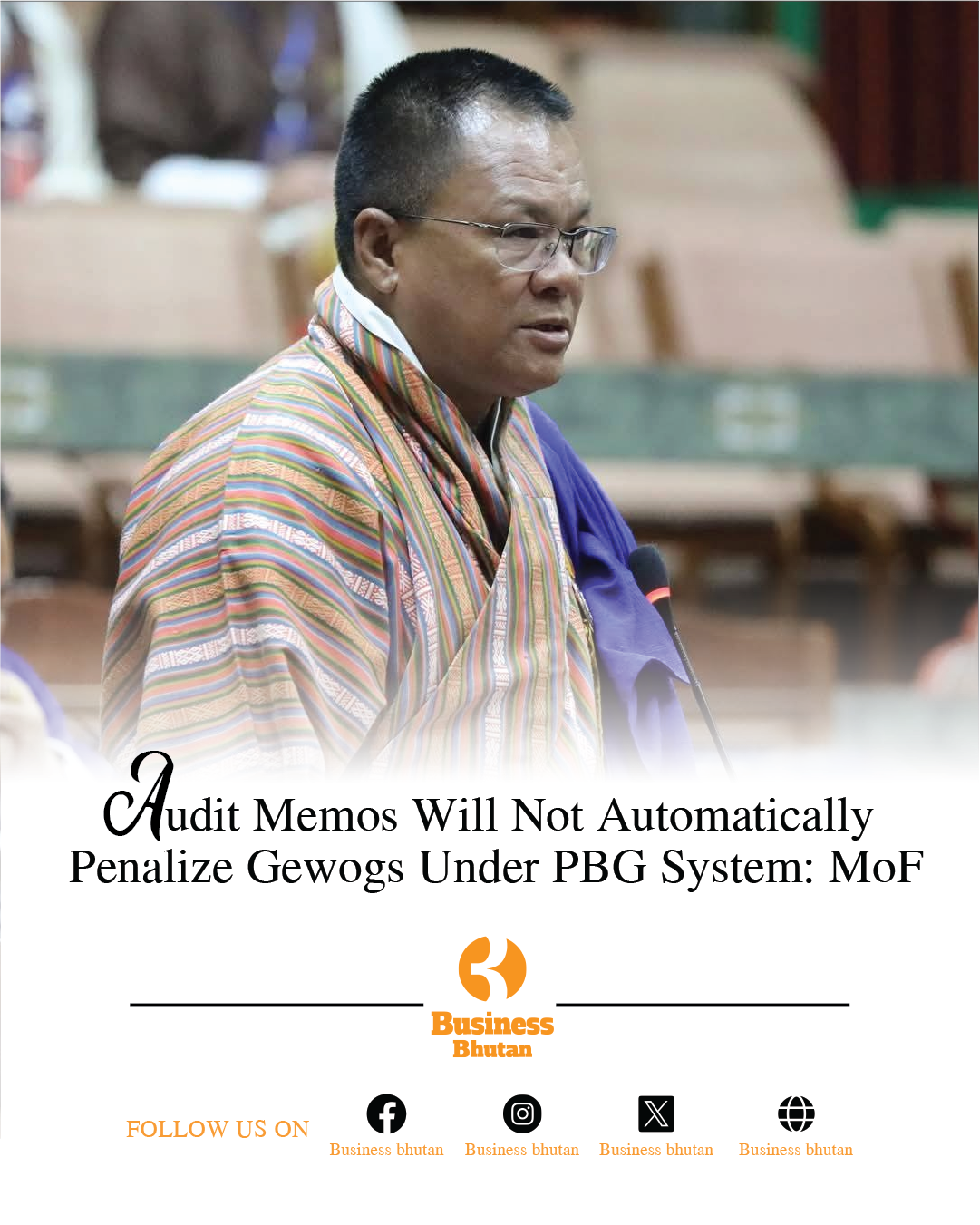
The Ministry of Finance (MoF) has instructed that Gewogs will not be automatically penalized under the Performance-Based Grant (PBG) system simply because audit memos exist, easing growing concerns among local governments that audit observations could negatively affect their performance scores and budget allocations.
Finance Minister Lekey Dorji clarified that audit observations under the PBG framework are designed to promote financial accountability, transparency, and stronger internal controls, rather than to function as punitive measures. According to the minister, the assessment focuses on how Gewogs respond to audit findings, not merely on whether audit memos are present.
“Gewogs are not expected to resolve all audit observations within a single assessment period in order to earn performance points,” the minister said. He said that positive scores are awarded when gewogs demonstrate credible and timely efforts to address audit issues, such as initiating corrective actions, responding to audit queries, and coordinating with relevant agencies. “It is the failure to act on audit observations—not their existence—that results in point deductions,” the Minister said.
The clarification comes after Member of Parliament (MP) Lamdra Wangdi raised concerns that some Gewogs are being unfairly judged and losing access to grants because of audit findings related to work done by private contractors or cooperatives. Some local governments expressed worry that they were being held accountable for issues beyond their direct control.
Reiterating the government’s commitment to decentralization, the minister said that Bhutan’s Constitution and the Local Government Acts empower local governments to identify, prioritize, and implement their own development initiatives. These are carried out through Annual Work Plans aligned with Local Government Key Result Areas (LGKRAs) and the objectives of the 13th Five Year Plan (FYP).
He said that resource allocation to local governments is guided by the 13th FYP outlay and the Resource Allocation Framework (RAF). The RAF applies objective criteria such as population size, poverty levels, geographic area, and overall development needs to ensure an equitable, predictable, and fair distribution of public resources. Annual budget ceilings are finalized based on the overall fiscal envelope and national financial capacity.
Within their allocated Capital Block Grants, Gewogs are given flexibility to prioritize and re-prioritize expenditures in response to emerging local needs, as long as spending remains aligned with LGKRA objectives. To balance this flexibility with accountability and efficiency, the Performance-Based Grant mechanism was introduced as an incentive-based approach to improve public service delivery and the effective use of limited resources.
Addressing concerns related to the 30 percent performance-based fund withholding, the minister said that this portion of funding is made accessible within the first quarter of the financial year. This arrangement, the minister said, ensures that local governments have sufficient upfront resources to implement planned activities while still maintaining accountability standards. He also noted that the Annual Grant Guidelines 2024 clearly outline delegated budget authority, roles, and responsibilities to reduce ambiguity in fund management.
The minister reiterated that the ministry remains committed to strengthening local financial management capacity. Ongoing efforts include training and technical support in budget formulation, execution, accounting, and financial reporting. As fiscal decentralization deepens, the MoF will continue reviewing and refining budget delegation mechanisms to improve efficiency, transparency, and accountability at the local level.
The PBG system has been implemented from the 2025–26 financial year, and early indications suggest that it could play a significant role in improving fiscal discipline and development effectiveness at the gewog level.
Nidup Lhamo
from Thimphu