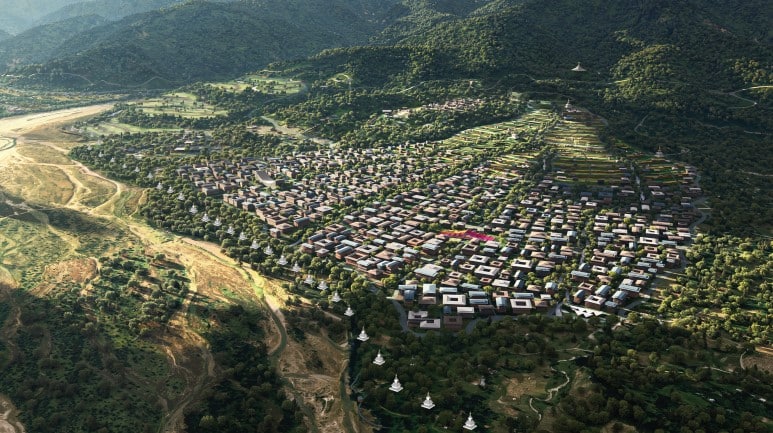


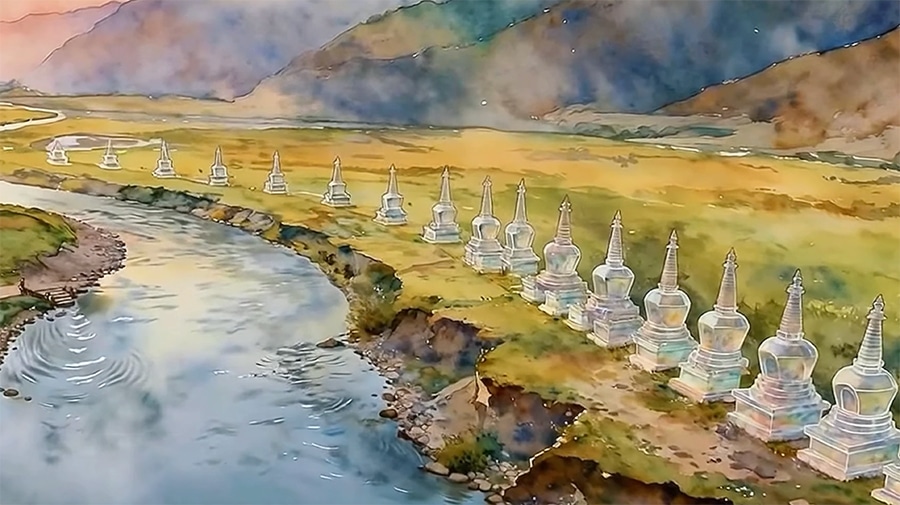
From the first light of morning to the careful strokes of an artisan’s blade, thousands of hands are coming together for a historic offering at Gelephu Mindfulness City.
The sun has just risen, spreading its first rays across the landscape of Gelephu Mindfulness City (GMC). While much of the country is beginning its day, Pema, a volunteer from Wangduephodrang, is already preparing for work. He is one of thousands who have come to contribute their time and energy to the raising of the 108 Jangchub Chortens on November 1.
There is no ceremony to mark the beginning of his day. He prepares quietly, knowing that there is work to be done and that every helping hand matters. For Pema, the significance of being here lies not in how much he can accomplish alone, but in being part of something that belongs to the country as a whole.
A short distance away, Kharka Biswa from Tsirang prepares for a different kind of work. He sharpens his blade, checking its edge before returning to the pavements surrounding the chortens. As an artisan, his contribution will be measured in the precision of his hands, the patience of his work and the marks he leaves behind in stone.
Each stroke must be deliberate. Each detail requires attention. When the work is complete, the pavement will become part of the landscape through which people approach the chortens, carrying with it the quiet imprint of the person who shaped it.
Pema gives his time. Kharka gives his craft. Neither contribution is the same, yet both are part of the preparations for November 1.
As the morning advances, the scene at GMC grows busier. Volunteers move between work areas, materials are prepared, tools are carried and tasks are shared. Some work with their hands, others coordinate activities or help with the arrangements that allow the undertaking to continue. There are conversations, brief exchanges of instructions and moments of rest before the next task begins.
The people gathered here have come from different parts of Bhutan. They speak different languages, practise different professions and belong to different generations. Some have spent decades working for their families and communities; others are young enough to be experiencing such a national undertaking for the first time.
As they prepare for the day, their differences become less important than the work before them.
Ngawang Penjore, an elderly volunteer from western Bhutan pauses to catch his breath, looking across the construction site with the perspective of someone who has witnessed the country change over many years. For him, the chortens represent the continuation of a spiritual heritage he hopes his grandchildren will inherit.
Nearby, Sangay Thinley, a young volunteer from Zhemgang discovers what it means to contribute to a national project beyond the familiar routines of home, school or work. The experience offers a chance to learn through service and to stand alongside people whose lives may otherwise have followed very different paths.
Likewise, Durga Maya, a woman from remote Sarpang has travelled with other volunteers, bringing the same determination to contribute. Whether she is helping with physical work, preparing food, organising materials or assisting with coordination, her effort forms part of the collective undertaking.
For people from Lhotshampa, Sharchop and Ngalop communities, the preparations offer an opportunity to participate in an event that carries national and spiritual significance. Each volunteer arrives with a personal story, a reason for coming and an understanding of what the occasion means to them.
Some have come out of devotion. Others feel a sense of duty, gratitude or pride in contributing to a historic moment. For many, the experience is a combination of these feelings. Their stories are different, but they converge in the same place.
As the hours pass, the work continues under the rising sun. The physical demands are real. Hands grow tired, tasks take longer than expected and the work requires patience. But there is also a quiet satisfaction in seeing progress, knowing that what was unfinished in the morning is closer to completion by the afternoon.
For Kharka, the process of carving offers its own rhythm. The blade meets the surface, a small section takes shape, and the work moves forward one careful stroke at a time. It is a reminder that a project of this scale depends not only on grand plans, but also on the discipline of people who carry out their responsibilities with care.
For Pema, the value of the day lies in the knowledge that he has given something of himself to the undertaking. His contribution may not be singled out when the chortens are raised, but he will know that he was present, that he worked and that he played a part.
This is the human story unfolding behind the preparations for the 108 Jangchub Chortens.
His Majesty The King’s vision for Gelephu Mindfulness City seeks to bring Bhutanese values and wellbeing into an ambitious development initiative. The raising of the chortens adds a spiritual dimension to that vision, bringing people together through service, faith and a shared aspiration for peace and prosperity.
The significance of the undertaking, however, is also found in its ordinary moments: a volunteer rising early, an artisan sharpening his blade, an older person making the journey to contribute, and a young person discovering the value of working alongside others.
These are small acts, but together they tell a larger story about how a national undertaking takes shape through the efforts of individuals.
By late afternoon, the work areas will have seen hours of labour. Some volunteers will return to their accommodation or homes, while others will prepare to begin again the next morning. The preparations will continue until the historic day arrives.
On November 1, attention will turn to the raising of the 108 Jangchub Chortens. People will gather, prayers will be offered and the occasion will become a shared memory for those present. But the story of that day will have begun much earlier, in the quiet determination of people like Pema and the careful craftsmanship of people like Kharka Biswa.
When the chortens rise, they will stand as visible symbols of spiritual aspiration. Behind them will remain the unseen contributions of thousands of people whose time, labour and skills helped prepare the way.
And somewhere among them will be Pema, who began his day at sunrise, and Kharka, whose blade left its mark on the pavement.
Their names may not be known to everyone who visits the chortens. Their individual contributions may not be recorded on plaques. But they will have been part of the story: a story of ordinary Bhutanese coming together, each offering what they could, for a moment that belongs to the nation.
Tashi Namgyal, Thimphu