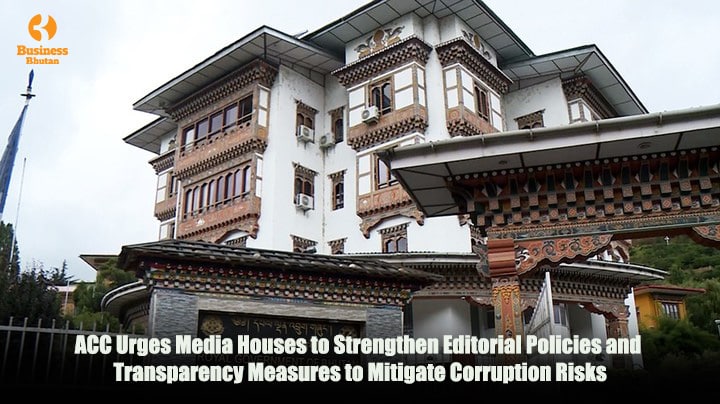
The Anti-Corruption Commission (ACC) has issued a comprehensive set of recommendations aimed at enhancing integrity, ethical standards, and transparency within Bhutan’s media sector. These recommendations follow the release of the Assessment of Corruption Vulnerabilities and Integrity in the Media Sector, conducted by the ACC’s Department of Prevention and Education in May 2025.
The assessment identified key risks and systemic vulnerabilities that could undermine public trust and media credibility. In response, the ACC has called for the implementation of clearer editorial policies, stricter transparency protocols, and strengthened capacity-building efforts.
Clear Editorial Policies and Independence
One of the ACC’s primary recommendations is for media houses to adopt and enforce robust, written editorial policies or guidelines. Many outlets currently lack formal documentation to guide journalistic practice. The ACC stresses that such policies are crucial to safeguarding editorial independence, mitigating external influence, and providing structured procedures for handling sensitive or high-stakes issues.
To support compliance, regular training and sensitization sessions for journalists and editorial staff are encouraged. The ACC also urges the Bhutan InfoComm and Media Authority (BICMA) to play a more proactive role in monitoring media content, ensuring adherence to ethical standards and minimizing misinformation.
Transparency in Paid Content and Gifts
To combat deceptive practices, the ACC recommends that media outlets clearly label all paid content, advertorials, and native advertising with terms like “Sponsored” or “Paid.” This measure would help maintain reader trust and prevent blurred lines between editorial and promotional content. The ACC further proposes that BICMA introduce and enforce regulations mandating strict compliance with labeling standards.
Transparency regarding gifts and benefits received by media personnel is also highlighted. The ACC encourages media houses to establish formal gift disclosure systems, requiring journalists to declare any gifts, hospitality, or other benefits received from sources, advertisers, or public officials. These systems are intended to prevent undue influence and reinforce the credibility of journalists.
Managing Conflicts of Interest
While some media organizations informally acknowledge conflicts of interest, the absence of formalized procedures remains a concern. The ACC recommends that media houses institutionalize conflict of interest declarations across all decision-making areas, including editorial, human resources, and procurement. Proper documentation and follow-up on these declarations will help mitigate bias and enhance public confidence in media operations.
Long-Term, Competency-Based Training
The ACC identifies a pressing need for long-term, skills-based training tailored to the realities of Bhutan’s media landscape. Existing short-term training—often dependent on stakeholder programs—fails to adequately prepare journalists for challenges such as investigative reporting, ethical dilemmas, and external pressure. In-depth training modules focused on ethics, integrity, and professional resilience are essential to building a more competent and accountable media workforce.
Information Sharing and Adherence to SOPs
The ACC underscores the importance of adhering to the Standard Operating Procedure (SOP) for sharing public information with the media. Both government agencies and media organizations must comply with this SOP to ensure consistent, transparent information flow. This is vital to reducing dependence on unofficial or potentially biased sources, which can fuel misinformation or manipulation.
Collective Responsibility
Implementing these reforms will require coordinated efforts from multiple stakeholders. These include media houses, BICMA, the Department of Media, Creative Industry & Intellectual Property (DoMCIIP), the Bhutan Media Foundation (BMF), the Journalists’ Association of Bhutan (JAB), and the Bhutan Centre for Media and Democracy (BCMD).
A Stronger Media for a Stronger Democracy
As Bhutan’s media landscape continues to evolve, the ACC’s recommendations are designed to foster a culture of transparency, ethics, and professionalism. By strengthening internal governance, improving accountability mechanisms, and building the capacity of media professionals, these measures aim to ensure that the media remains a credible watchdog and a cornerstone of Bhutanese democracy.
Sangay Rabten from Thimphu