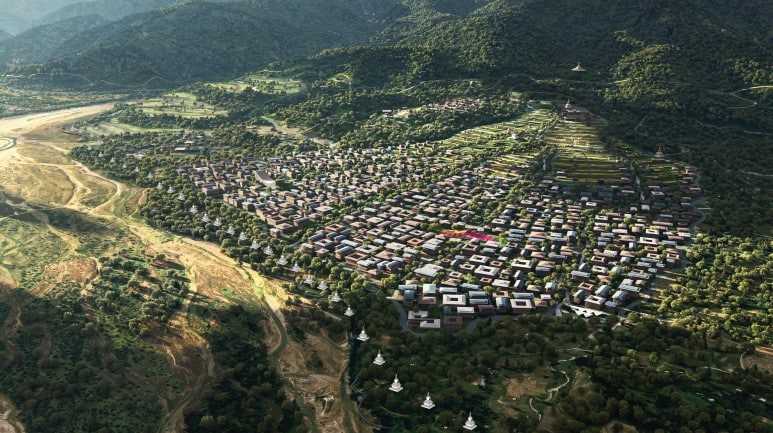


On July 8, 2025, His Majesty The King and Her Majesty The Gyaltsuen, accompanied by Their Royal Highnesses Gyalsey Jigme Namgyel Wangchuck and Gyalsey Ugyen Wangchuck, graced a ceremony to mark the start of construction work on Gelephu International Airport (GIA). This marked the beginning of one of Gelephu Mindfulness City’s (GMC) most important projects.
In many developing countries, balancing the need of land for public infrastructure with the rights of landowners often leads to disputes and delays. In contrast, the people of Gelephu have demonstrated a spirit of solidarity and a deep sense of responsibility, setting an example for the world to see.
Asni Kumar Chamlaguy, who willingly gave up 12 decimals of his land, expressed his sentiments happily. “As an individual, my small plot would have done little for me on its own,” he said. “But if it can help realize a noble vision for the country, then its true value is far greater here than in my hands.”
He added that the GMC is not merely a project for today, but an investment in the wellbeing and prosperity of future generations. “Contributing a small piece of land is the least I can do for something that will benefit our children and grandchildren long after we are gone,” he said. “It is a sacrifice, yes and a sacrifice made with hope.”
In an era when rural industrialization in many countries has often sparked social tensions and conflicts over land, families like that of Ausa Subba and Sham Kumar Subba stand out for their wholehearted support. Together, their family has willingly offered three plots of land, totaling more than an acre.
“The GMC is not just for His Majesty. It is for our children and for generations yet to come,” said Ausa Subba. “When our King works tirelessly and selflessly to build a stronger, more secure future for all of us, the least we can do is stand by him and do our part. Giving up our land is a small contribution compared to the vision it will help fulfill.”
Chimi Dema, originally from Samdrup Jongkhar, had invested in a 20-decimal plot near the planned airport site and built her family home there just three years ago. When the call came for land acquisition, she did not hesitate to dismantle the house she had so recently completed.
“I have no regrets at all,” she said. “My family received fair and timely compensation for the land and the house. More importantly, we feel proud to know that our small sacrifice contributes to something far bigger than ourselves. To be part of a project that will benefit the whole nation is more meaningful than holding onto one house.”
Deepak Chettri, a 50-year-old organic farmer who had been leasing government land at Bhur, did not let the project disrupt his livelihood for long. As soon as the land acquisition was confirmed, he immediately arranged for replacement land in Samtse so he could continue his organic farming without delay.
“This project is for the future of our children,” Deepak said. “If giving up this land today helps build something that will benefit them tomorrow, then it is worth every effort. I am even ready to offer my own private land if it is needed for the next phase. It is the least I can do to support His Majesty’s vision for our country.”
He added that he considers it a privilege to contribute in whatever way he can, and is already looking forward to establishing his new farm and continue supply fresh organic produce to local communities.
Dorji Wangchuk, who also owned land within the designated airport area, shared the same unwavering commitment as his fellow landowners. For him, the decision to part with his land came easily when weighed against the greater purpose it would serve.
“There is no greater way for us, ordinary citizens, to stand behind His Majesty’s visionary project than by offering what we can,” Dorji said. “If giving up my land helps bring this vision to life, then it is a sacrifice I make gladly. I pray that this dream will be fulfilled and that it will bring lasting benefits for our children and for the generations yet to come.”
The Gelephu International Airport (GIA) will be Bhutan’s southern gateway and a vital hub anchoring the development of the innovative Gelephu Mindfulness City. Far more than an infrastructural milestone, it symbolizes Bhutan’s balanced approach to growth, connectivity, and sustainability.
The airport’s 3,000-meter Category I, Code 4E runway will accommodate Airbus A321 and Boeing 737 aircraft from the outset, ensuring robust regional connectivity. Its design allows for future upgrades to handle larger widebody aircraft, supporting increased international travel and cargo traffic.
Architecturally, the terminal will reflect Bhutan’s diverse natural heritage, drawing inspiration from the country’s four major forest ecosystems: evergreen oak, cool broadleaf, warm broadleaf, and subtropical forests. This will create a space that embodies Bhutan’s ecological values while showcasing the nation’s cultural richness.
Initially, the airport is expected to handle around 1.3 million passengers annually, with capacity to scale up to 5.5 million as demand grows. Environmentally, the project demonstrates a strong commitment to sustainability, integrating a box culvert system beneath the runway to maintain the Paitha River’s natural flow, and incorporating solar and wind energy along with passive ventilation systems.
Beyond connectivity, the airport promises substantial economic benefits. Construction and operations will create jobs and training opportunities, building local capacity in aviation services. The airport’s cargo facilities will expand Bhutan’s export potential, connecting local producers to wider markets.
Culturally, the terminal will celebrate Bhutanese craftsmanship through intricate woodwork, textiles, and traditional architectural motifs. Landscaped areas will feature native flora, creating serene spaces that reflect Bhutan’s natural beauty and foster a sense of calm for travelers.
Sangay Rabten from Thimphu