

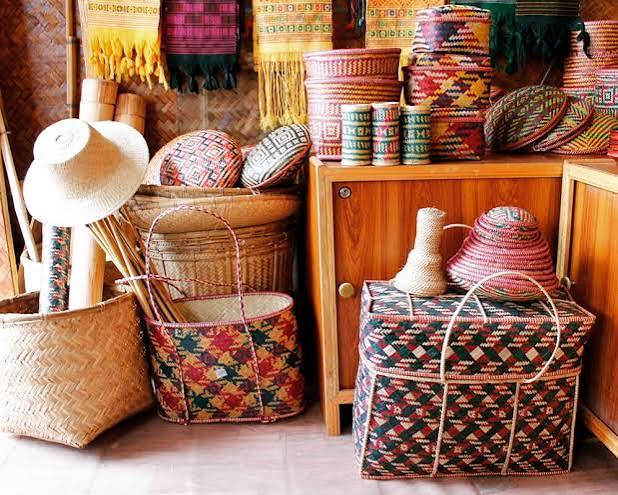
Bhutan may be selling its cultural heritage to tourists while increasingly stocking its craft shops with products made elsewhere.
A new study of the country’s craft retail sector has found that imported and mass-produced products are occupying a significant share of shelves in key tourist markets, raising concerns that Bhutanese artisans could gradually lose ground in an industry built around the country’s cultural identity. The study, A Study of Bhutan’s Craft Retail Sector: Challenges, Practices, and the Path to a Dynamic and Sustainable Industry, surveyed 31 craft retailers in Thimphu and Paro, two of Bhutan’s major tourist destinations and important centres of craft retail.
The extent of import dependence varies considerably across product categories. Bamboo and cane products are entirely locally made, while wood, yathra, souvenirs and several other categories remain predominantly local. However, metal and ceramic products show a much stronger dependence on imports. Among retailers selling metal products, 72 percent stocked only imported goods, while the remaining 28 percent stocked a combination of local and imported products. None of the surveyed retailers dealt exclusively in locally produced metal crafts. The situation is even more pronounced in ceramics. Eighty-three percent of retailers stocked only imported ceramic products, while just 4 percent sold exclusively locally made ceramics.
The textile sector also raises concern. Despite Bhutan’s long-established weaving tradition, only 16 percent of retailers stocked exclusively local textiles, while 81 percent stocked both local and imported textiles.
The study suggests that retailers are responding to market realities rather than simply choosing foreign products over local ones. The limited diversity of locally available products was identified as the leading reason for relying on imports, accounting for 27 percent of responses. The higher price of local crafts was the second-largest factor, at 26 percent. Another 19 percent cited difficulties in obtaining desired products when needed, while 13 percent pointed to unreliable or inconsistent local supply.
This creates a structural problem for the domestic craft industry. A retailer cannot afford empty shelves or limited choices, particularly in a tourist market where customers expect a wide range of products. If locally produced crafts are more expensive, difficult to source or unavailable in sufficient quantities, imported alternatives become the more commercially attractive option.
The challenge becomes more serious when imported products are presented as Bhutanese. The study found that 30 percent of retailers said the misrepresentation of imported products as locally made occurs frequently, while another 17 percent said it is an ongoing practice. An equal 30 percent said such misrepresentation does not occur.
The findings raise an important consumer-protection issue, particularly in a tourism economy where visitors often purchase handicrafts because they believe they are buying authentic Bhutanese products.
Demand for authenticity clearly exists. Eighty-four percent of retailers said customers sometimes or frequently ask about the origin of products. Yet consumers have limited independent means of verifying whether the product in front of them was actually made in Bhutan. This creates a gap between what the market values and what the market can guarantee.
The study also highlights the role of tourism-related commercial practices in determining the final price of crafts. Ninety-four percent of retailers surveyed said they pay commissions to tour guides for directing tourists to particular shops. Commission rates range from 10 to 25 percent of sales, with 20 percent the most common rate.
The study identifies mass-produced imported crafts as the most frequently cited specific challenge, accounting for 21 percent of responses. Other concerns include low and erratic demand, inadequate product certification and unreliable local supply.
However, the report does not suggest that Bhutan can or should eliminate imports across the board. For products such as textiles, clay and thangkas, Bhutan already possesses traditional skills and production capabilities that could potentially be strengthened. In contrast, replacing imported metal and ceramic products entirely may be less realistic because of limitations in raw materials and manufacturing capacity. The appropriate response, therefore, is not blanket protection but targeted support for areas where Bhutanese producers can realistically become more competitive.
The study recommends establishing a national craft quality certification and standardisation system, requiring clear disclosure of product origin and strengthening enforcement against misrepresentation. It also calls for investment in artisan skills, product diversification, production efficiency and costing.
These measures could help address the problem at both ends of the market: ensuring consumers know what they are buying while enabling local producers to offer products that retailers can reliably source at competitive prices.
The stakes extend beyond the livelihoods of individual artisans. Bhutan’s handicrafts are part of the country’s cultural identity and contribute to the experience it offers international visitors. If tourists increasingly purchase imported products believing them to be Bhutanese, the country risks creating a paradox in which its cultural image attracts the customer, but the economic benefits of the sale flow elsewhere.
The challenge is therefore not to shut Bhutan’s craft shops off from foreign products. It is to ensure that imports compete fairly, product origins are transparent and genuine Bhutanese craftsmanship has the skills, supply chains, certification and market access needed to compete.
Without such reforms, imported crafts could continue to occupy more space on Bhutanese shelves—not because Bhutanese craftsmanship has lost its cultural value, but because the domestic industry has not yet developed the commercial strength to compete with what is cheaper, more varied and more readily available.
Tashi Namgyal, Thimphu