

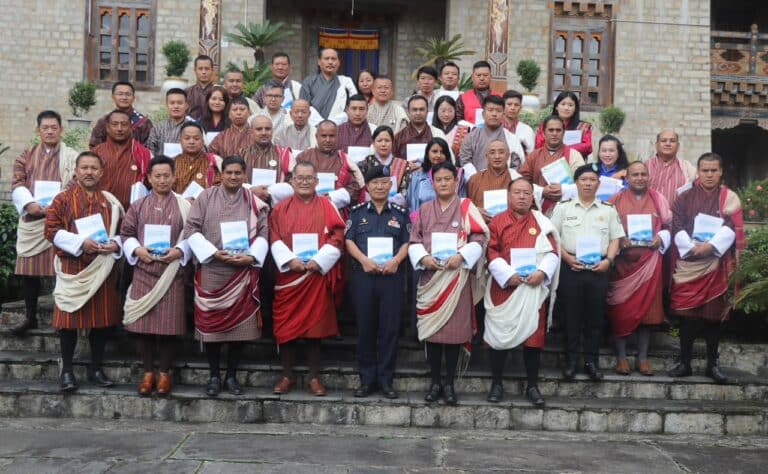
In a major step toward strengthening disaster preparedness and climate resilience, Tsirang Dzongkhag officially launched its Disaster Management and Contingency Plan, providing a comprehensive roadmap to guide emergency preparedness, response and recovery efforts across the district.
The launch, in the attendance of gups, regional heads, sector heads and officials from various agencies, marked the culmination of nearly a year of consultations, field assessments and coordinated planning involving multiple stakeholders.
Spanning 204 pages, the plan is designed to serve as a practical and operational framework for managing disaster risks in one of Bhutan’s most agriculturally important dzongkhags.
Dzongkhag officials said the initiative comes at a critical time as climate change continues to increase the frequency and intensity of natural hazards across the country.
“As Bhutan’s agricultural heartland, Tsirang is increasingly vulnerable to climate-related risks such as erratic rainfall, windstorms, landslides, flash floods and other natural disasters,” a Dzongkhag official said during the launch. “This plan provides clear guidance to institutions, local governments and communities on how to prepare for, respond to, and recover from emergencies.”
One of the key highlights of the plan is the development of 60 thematic maps covering all 12 gewogs and Damphu town.
The maps identify evacuation sites, water sources, critical infrastructure, vulnerable populations, transportation networks and emergency service facilities, enabling authorities to make quicker and more informed decisions during disasters.
According to officials, the geospatial information will help emergency responders identify high-risk areas and mobilize resources more effectively when disasters strike.
“The maps provide detailed information that can significantly improve coordination during emergencies,” an official involved in the plan’s preparation said. “Having this information readily available can save valuable time and ultimately save lives.”
The contingency plan also outlines detailed response procedures for a wide range of disaster scenarios, including earthquakes, flash floods, forest fires, windstorms, disease outbreaks and other emergencies.
The document clearly defines the roles and responsibilities of various agencies, helping ensure a coordinated and timely response during crises. Beyond emergency response, the plan places significant emphasis on disaster risk reduction and community preparedness.
Among the community-based initiatives included are training local artisans in disaster-resilient construction techniques, promoting safer building practices and enhancing household electrical safety measures.
Officials said such preventive interventions are critical in reducing vulnerabilities before disasters occur.
“Disaster management is not only about responding when emergencies happen,” another official said. “It is equally about building resilience beforehand so that communities can withstand and recover more quickly from shocks.”
Residents have welcomed the initiative, particularly as many communities have experienced increasing weather-related challenges in recent years.
Karma Tshering, a farmer from Kilkhorthang gewog, said changing weather patterns have become a growing concern for rural households.
“In the past, we could predict the seasons much better, but now the weather has become very unpredictable,” he said. “Heavy rains, landslides and windstorms can damage crops and roads. Having a proper plan gives us confidence that help will reach communities faster when needed.”
Similarly, Sonam Choden, a resident of Damphu town, said public awareness and preparedness are just as important as infrastructure.
“Many people do not know what to do during emergencies,” she said. “If communities are trained and informed beforehand, it can prevent panic and reduce losses.”
Local leaders also stressed the importance of involving communities in disaster preparedness efforts, stating that effective disaster management depends on strong cooperation between authorities and residents. “Government agencies alone cannot manage every emergency,” one of a Gup said. “Community participation is essential. This plan provides a platform for everyone to work together to protect lives and property.”
Officials emphasized that while disasters cannot always be prevented, their impacts can be significantly reduced through effective planning, coordination and preparedness.
With climate change expected to intensify weather-related hazards in the coming years, the newly launched Disaster Management and Contingency Plan is expected to play a crucial role in safeguarding lives, livelihoods and development gains across Tsirang.
The Dzongkhag hopes the initiative will help build a safer, more resilient and better-prepared Tsirang, ensuring that communities are equipped to face future challenges while protecting the district’s economic and agricultural foundations.
Tashi Namgyal, Thimphu