

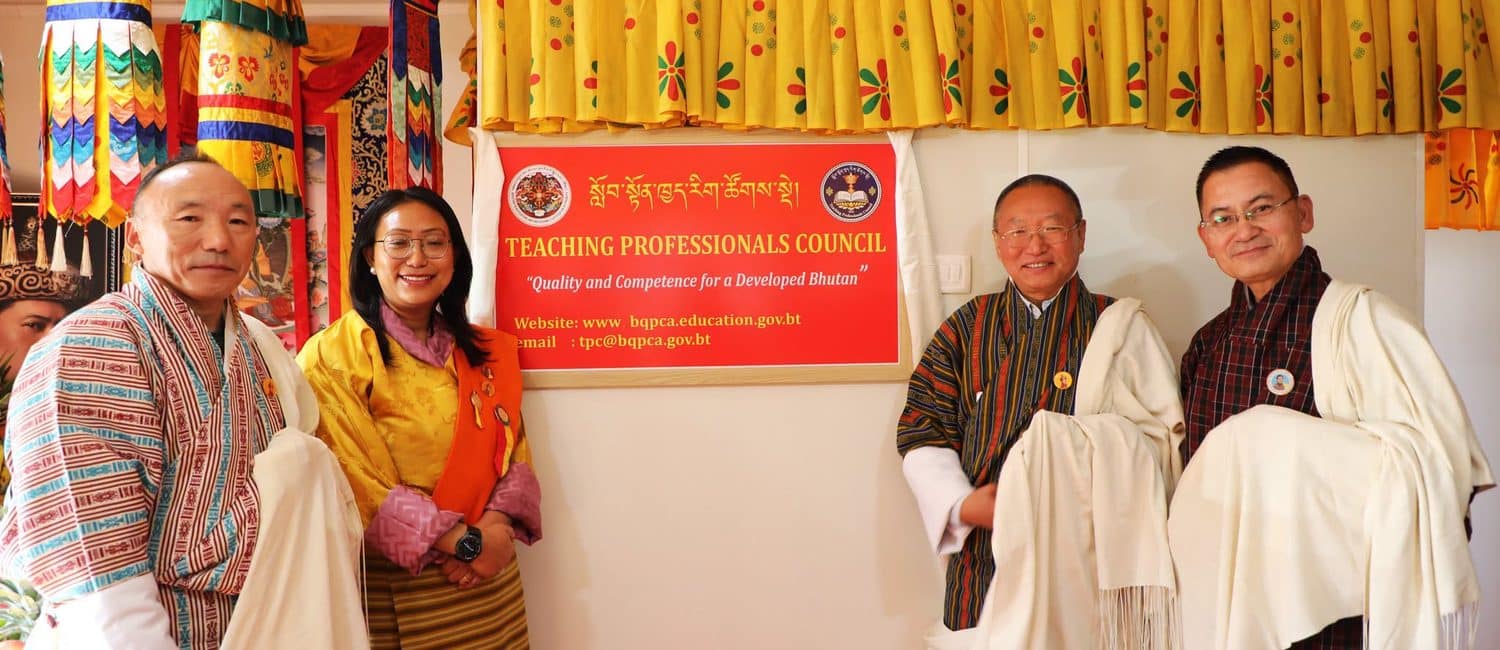
Teachers will have a more structured system for professional registration, certification and continuous training under the newly launched Teaching Professionals Council (TPC), which aims to strengthen professional standards and improve the quality of teaching and learning in Bhutan.
Established under the Bhutan Qualifications and Professionals Certification Authority (BQPCA), the council will introduce a framework to recognise teachers’ professional competencies and provide opportunities for them to upgrade their knowledge and teaching practices throughout their careers. BQPCA Director Dr Ugyen Tshewang said the introduction of the council was one of the major transformations in the education sector, given the important role teachers play in educating future generations.
Bhutan has more than 9,000 teachers and around 150,000 students in its education system, he said. He said teachers had not always received adequate opportunities for professional upgrading, training and capacity building. The continuing professional development (CPD) framework is expected to address this by providing more systematic opportunities for teachers to strengthen their competencies and professionalism.
One of the immediate benefits, he said, would be funding allocations under the CPD framework to support teachers’ professional development and capacity building.
Executive Specialist and TPC Head Yesh B. Ghaley said the council aims to maintain consistent professional standards among teachers across the country, contributing to a more standardised education system.
He said professional development activities in the past were not always followed by systematic monitoring and evaluation. After teachers attended workshops and training programmes, follow-up assessments were not consistently carried out to determine whether they had benefited from the training or applied what they had learned in their teaching.
The council aims to strengthen the professional development system by placing greater emphasis on teachers’ competencies and their effectiveness in the classroom.
The council’s work will rest on three main pillars: professional registration, competency-based certification and CPD.
Registration will provide formal recognition of teachers through a standardised and quality-assured system. Certification will recognise their demonstrated competencies and professional growth through four levels: Beginning, Proficient, Accomplished and Distinguished.
Dr Ugyen Tshewang said teachers would be required to register and obtain professional certification under the new system, similar to professionals in other regulated fields.
The system is intended to give parents and the public greater confidence in teachers’ professional competence, while strengthening the quality of teaching and learning.
Teachers will also be guided by the Bhutan Professional Standards for Teachers (BPST), which outlines the professional knowledge, skills and values expected at different stages of their careers.
Developed from 2017 and in place since 2019, the BPST comprises seven standards and 37 focus areas. These cover responding to diverse learning needs, creating effective learning environments, applying subject and pedagogical knowledge, planning and teaching, assessing students’ progress, professional development and engagement, and upholding Bhutanese values.
The standards are currently under review to reflect changes in the national curriculum, particularly its alignment with Cambridge standards. The CPD framework is also undergoing further review, with technical inputs from the Cambridge team, according to BQPCA.
The Executive Specialist and TPC Head said teachers would be expected to practise the revised standards once the review is completed. He said the council also aims to develop professionally competent, effective and motivated teachers who take pride in their work.
Dr Ugyen Tshewang said the council was not intended merely to regulate teachers but also to recognise, support and strengthen the teaching profession.
It also aspires to improve the credibility, portability and international recognition of Bhutanese teaching professionals through internationally benchmarked standards and practices. The council is drawing on experiences from Australia, New Zealand and the United Kingdom while adapting them to the Bhutanese context.
The TPC was established on August 20, 2025. Since then, it has developed registration guidelines, a CPD Framework, a Code of Conduct and Ethics, and a 10-year Strategic Roadmap.
The Royal Civil Service Commission has approved 10 staff positions for the council, including the Head of Council position at Executive Specialist Level 3, equivalent in salary grade to a Department Head. The TPC is the fifth professional council under BQPCA, joining the Engineering Professionals Council, Medical and Health Professionals Council, Higher Education Quality Council, and Technical and Vocational Education and Training Quality Council. BQPCA derives its authority from the Civil Service Reform Act of 2022.
Education and Skills Development Minister Yeezang De Thapa said the establishment of the council was long overdue. She highlighted the importance of continuous professional development in strengthening teachers’ competencies, supporting career progression and improving professional practice.
The establishment of the council advances His Majesty The King’s vision for transforming the education system, as articulated in the Royal Kasho of December 17, 2020.
BQPCA said the council’s success would depend on continued collaboration among the Ministry, educational institutions, school leaders, teachers and other stakeholders.
Nidup Lhamo, Thimphu