

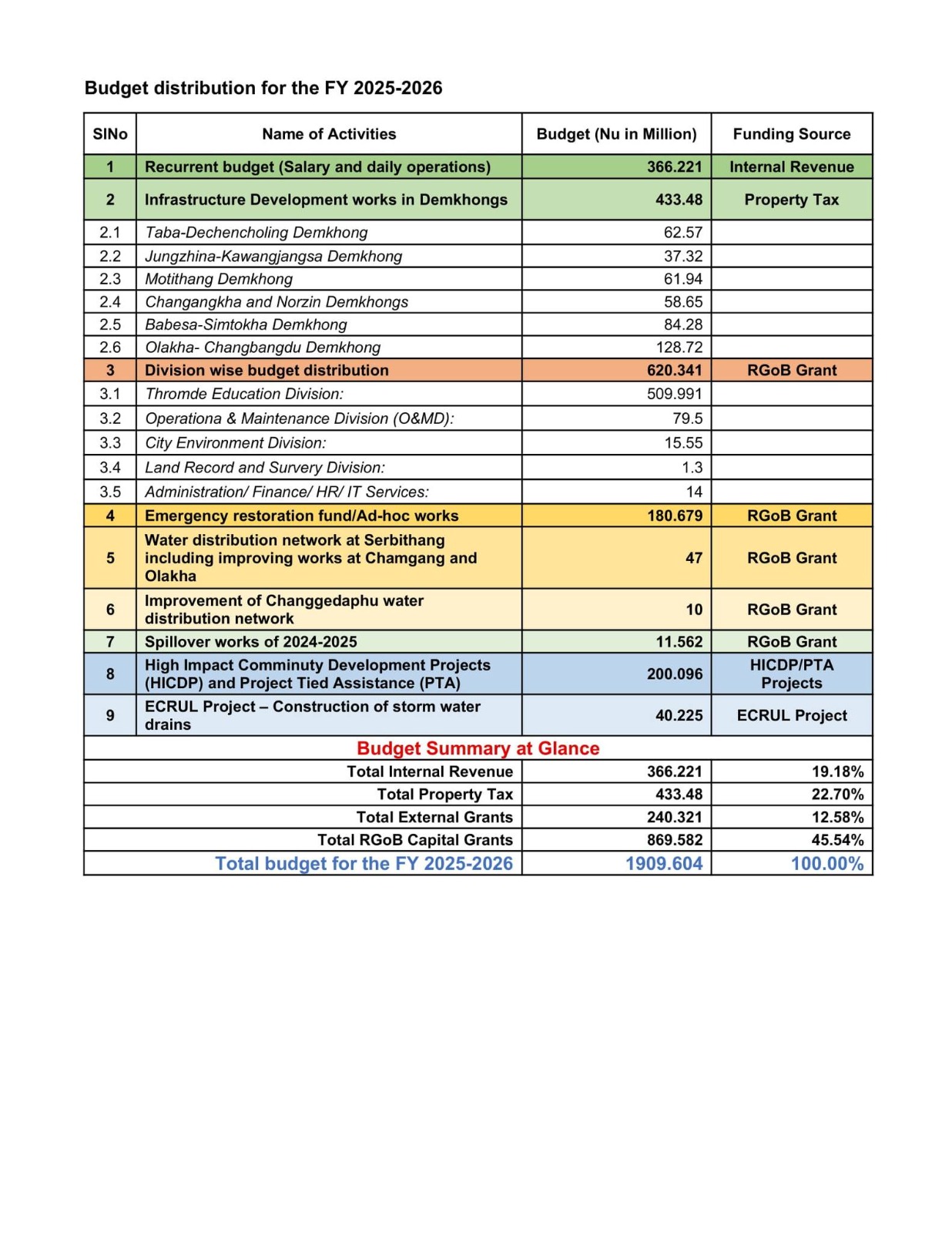
Thimphu Thromde has officially approved a total budget of Nu 1,909.604 million (M) for the fiscal year 2025–26, reflecting the city’s ongoing commitment to urban development, essential municipal services, and community-oriented projects. The budget demonstrates a careful balancing act between expanding infrastructure, enhancing service delivery, and ensuring financial prudence, while also addressing the growing demands of a rapidly expanding urban population in Bhutan’s capital.
According to senior Thromde officials, the budget has been designed to consolidate past investments and address emerging urban challenges systematically and sustainably. “Thimphu continues to experience steady population growth and increasing service demand,” said one official. “This budget aims to strengthen what has already been achieved while responding to the needs of a city that is evolving rapidly in terms of both population and service requirements.”
A total of Nu 366.221M, representing just under 20 percent of the overall budget, has been allocated for recurrent expenditures. These include salaries for municipal staff and routine operational costs necessary to sustain the day-to-day functioning of the Thromde. By financing these recurrent costs largely from internal revenue, officials have emphasized the importance of fiscal discipline and reducing reliance on external funding for routine municipal operations. This approach underscores the Thromde’s long-term commitment to financial sustainability while maintaining essential public services.
Infrastructure development at the demkhong, or constituency, level remains a key focus area in this year’s budget. A sum of Nu 433.48M, derived primarily from property tax revenue, has been earmarked for local infrastructure projects across the city. Major allocations include significant funding for Olakha–Changbangdu, Babesa–Simtokha, Motithang, and Tab–Dzhencholing demkhongs, among others. According to officials, these allocations are intended to address the unique needs of each demkhong, including the construction and maintenance of roads, drainage systems, public spaces, and other basic municipal services. By emphasizing demkhong-level planning, the Thromde seeks to ensure that development is inclusive, equitable, and responsive to the priorities of local communities.
Division-wise allocations, supported by Royal Government of Bhutan grants, amount to Nu 620.341M, with the Thromde Education Division receiving the largest share of Nu 509.991M. This substantial allocation highlights the city’s continued investment in education infrastructure, school maintenance, and related support services. Education officials pointed out that urban migration has significantly increased student enrolment in Thimphu, creating mounting pressure on schools and educational facilities. Sustained funding, they emphasized, is essential to maintain quality and ensure that access to education remains equitable for all urban residents.
Other divisions also received allocations to strengthen operational capacity and improve service delivery. The Operation and Maintenance Division has been provided with Nu 79.5M to support ongoing maintenance of roads, drainage systems, and municipal infrastructure. The City Environment Division has received Nu 15.55M to enhance urban environmental management, while administrative, finance, human resources, and information technology services have been allocated Nu 14M to bolster institutional efficiency and support effective governance. These targeted investments aim to ensure that Thimphu’s municipal systems function smoothly and remain responsive to the evolving needs of the city.
Recognizing the unpredictability of natural and urban challenges, the FY 2025–26 budget also sets aside Nu 180.679M as an emergency restoration and ad-hoc works fund. This provision will allow the Thromde to respond quickly to urgent repair needs arising from monsoon-related damage, landslides, or other unforeseen events. Officials described this fund as a crucial mechanism for maintaining continuity of services and minimizing disruption to residents during emergencies.
Water security continues to be one of the city’s most pressing concerns, particularly during dry seasons when demand often exceeds supply. To address this challenge, the budget includes Nu 47M for upgrading the water distribution network in Serbithang and surrounding areas, and an additional Nu 10M for improvements to the Changdaphu water distribution system. A Thromde engineer noted that these investments are essential to improving distribution efficiency, reducing supply disruptions, and ensuring that the city’s rapidly growing residential areas have reliable access to safe water.
Ensuring continuity of ongoing projects is another priority reflected in the budget. Nu 11.562M has been allocated to complete spillover works from the previous fiscal year, preventing delays in infrastructure projects and maintaining the momentum of development initiatives. High Impact Community Development Projects and Project-Tied Assistance initiatives have been allocated Nu 200.096M, supporting targeted interventions at the community level. These projects aim to enhance the quality of life for residents by addressing local needs, fostering participation, and promoting inclusive development across Thimphu.
The budget also demonstrates a strong focus on climate resilience and disaster preparedness. Nu 40.225M has been set aside under the Enhancing Climate Resilience of Urban Landscapes Project to construct stormwater drainage systems. With the city experiencing more intense and frequent rainfall events in recent years, officials emphasized that investment in stormwater management is no longer optional. Proper drainage systems are vital for reducing flood risks, protecting infrastructure, and ensuring the safety and well-being of residents.
In terms of funding sources, the FY 2025–26 budget draws heavily on RGoB capital grants, which account for 45.54 percent of the total allocation. Property tax revenue contributes 22.70 percent, while internal revenue makes up 19.18 percent, reflecting the Thromde’s commitment to strengthening its own financial base. External grants account for 12.58 percent of the budget. Officials have highlighted that, while capital grants remain essential for funding large-scale infrastructure projects, developing the Thromde’s internal revenue base is crucial for long-term fiscal sustainability and reducing dependence on external sources.
Historically, Thimphu Thromde’s budgets have consistently prioritized urban infrastructure expansion, municipal service delivery, and resilience-building in response to rapid urbanization. Past budgets have focused on road improvements, drainage systems, water supply upgrades, waste management, and investments in education and municipal services. The growing population, particularly in core urban areas, has necessitated sustained investments in both new infrastructure and the maintenance of existing facilities. The FY 2025–26 budget builds on these earlier efforts, aiming to consolidate ongoing projects while addressing emerging challenges such as water security, stormwater management, and climate resilience.
A senior Thromde official emphasized that this year’s budget is not about starting projects from scratch but about strengthening what has already been built and ensuring that infrastructure and services continue to meet the demands of a growing city. By focusing on consolidation and strategic expansion, the Thromde seeks to ensure that Thimphu’s urban systems remain robust, efficient, and adaptable to future growth.
In summary, the FY 2025–26 budget is structured around three core priorities: strengthening urban infrastructure, improving service delivery, and enhancing community resilience. Investments in roads, drainage, water supply, and public spaces aim to maintain and enhance the city’s urban infrastructure. Funding for education, city environment, operations, and administrative services ensures efficient and equitable municipal service delivery. Finally, allocations for climate resilience, emergency works, and high-impact community projects are designed to enable Thimphu to respond effectively to natural disasters, climate challenges, and the pressures of rapid urbanization.
Prudent financial management remains a central principle guiding the Thromde’s budgetary decisions. By balancing capital investments, recurrent expenditures, and contingency funds, the FY 2025–26 budget ensures that municipal resources are allocated efficiently and in alignment with national development priorities. Officials stressed that as Thimphu continues to grow, maintaining infrastructure, ensuring reliable services, and addressing community needs will remain central to the city’s development strategy.
The FY 2025–26 budget reflects both continuity and foresight. It consolidates past achievements, addresses current urban challenges, and provides flexibility to respond to future uncertainties. By aligning financial planning with strategic urban priorities, Thimphu Thromde aims to sustain development, enhance the quality of life for residents, and build a city that is resilient, well-managed, and capable of adapting to the demands of the twenty-first century.
Tashi Namgyal
From Thimphu