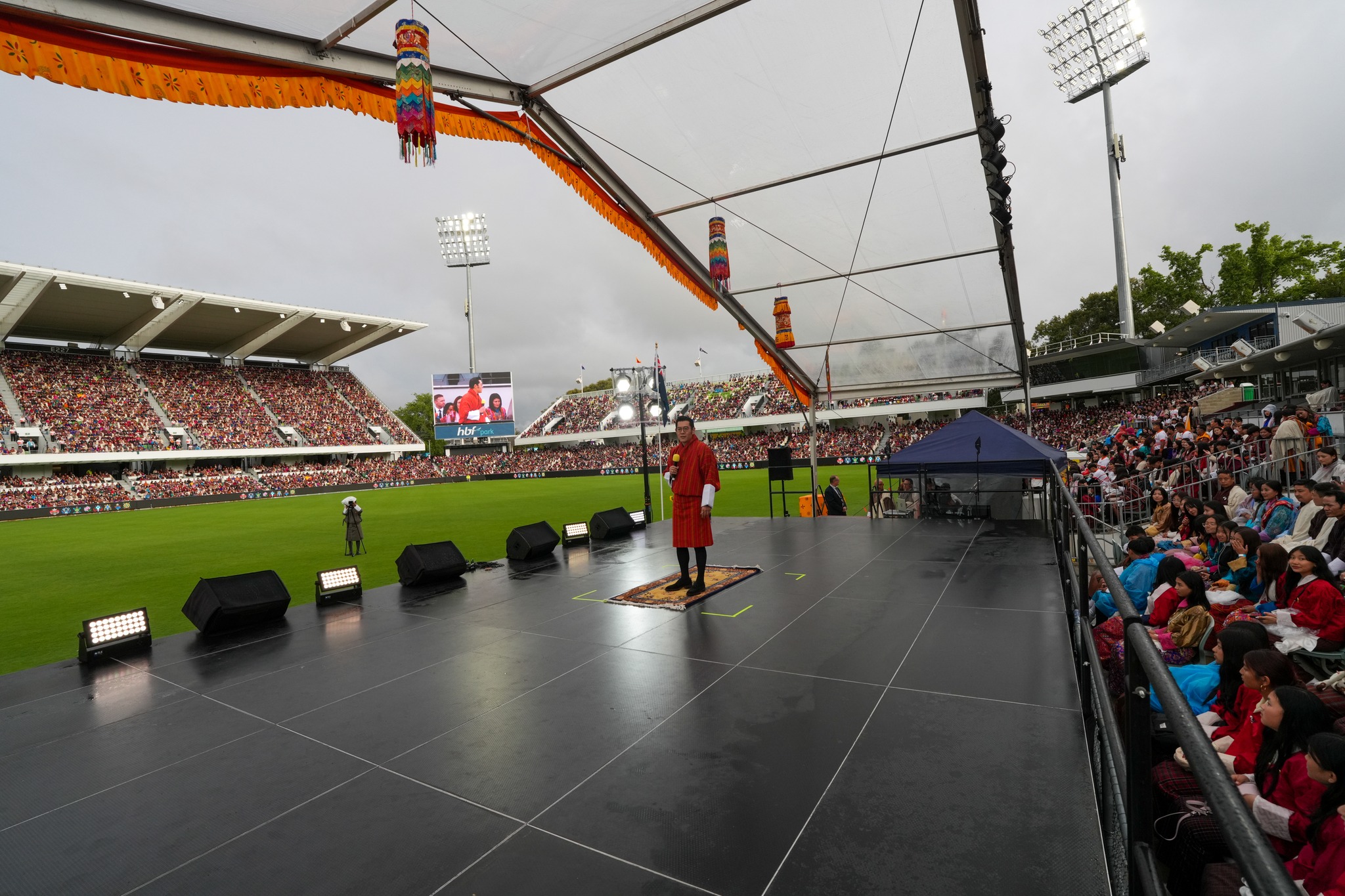
In a packed stadium in Perth, His Majesty the King spoke words that carried the weight of a thousand unspoken emotions: “I wish I could hug all of you.” Just eight words, but each one was laden with love, compassion, empathy, hope, and unwavering trust for his people living so far from home. It was a moment that transcended distance, where the King and his family had journeyed to the other side of the world for one sole purpose—to meet his people, to be with them. It was an act of empathy so profound, one could feel the depth of his connection to each and every soul present.
His Majesty was not alone on this extraordinary Royal Tour. At his side were Her Majesty the Gyaltsuen, their Royal Highnesses the Gyalseys, and Gyalsem, each of them embodying the essence of a united family, bound by love for their people. Their presence wasn’t for the sake of ceremony or mere formality—it was something far deeper, something profoundly meaningful. It reflected His Majesty’s unwavering belief that his people, now scattered across continents, longed not just for the sight of their King, but for the warmth and presence of the entire Royal Family.
This journey was not about titles or royal obligations. It was an expression of the deep bond between the King and his people, a bond that transcends borders, distances, and circumstances. To see the whole Royal Family together was a source of comfort, a reminder that even though the Bhutanese community in Australia was far from their homeland, they were never far from the thoughts and hearts of their leaders.
Their presence touched the hearts of everyone present, for it symbolized more than just a visit—it was a statement of unity, a message of love that echoed beyond the stadium walls. This was a family who had traveled across the world to be with their people, to stand by them, and to reassure them that no matter how far they had journeyed from home, they were never alone.
For those living far from Bhutan, it was an overwhelming moment. To witness not just their King but his entire family standing before them was a gesture that went beyond protocol. It was an offering of the deepest kind of care—a royal family that understands the value of presence, the comfort of togetherness, and the power of showing up for their people, no matter the distance.
In the quiet moments of planning for this monumental visit, His Majesty’s intent was clear and resolute—it was not a diplomatic mission, nor a state visit bound by formalities and obligations. It was, in its purest essence, a journey to meet his people. From the very beginning, the people of Bhutan living in Australia were at the heart of the Royal Visit.
Unlike the typical royal tours or state visits, where packed schedules of official meetings and formal ceremonies dominate the agenda, this visit was strikingly different. Apart from a few necessary official calls, such as meeting the leaders of Australia, there were no high-profile conferences, no lengthy negotiations behind closed doors, no memorandum of understandings (MoUs) being signed to commemorate new agreements. His Majesty’s focus lay elsewhere, in a place much more personal, much more intimate—the hearts and lives of his people.
This was a visit crafted with love, a visit where time—the most precious commodity—was devoted entirely to the Bhutanese community. No distractions, no political engagements, just pure, undivided attention to his people. It was a rare and touching gesture, one that spoke volumes about the depth of His Majesty’s commitment to his people.
And as the days of the Royal Visit unfolded, it became clear that this was not just a fleeting moment of royal duty. It was a deeply personal mission, one driven by a profound love for his people—a love that transcends borders, time, and the pressures of leadership. His Majesty’s time in Australia was not spent in boardrooms or grand halls; it was spent in the arms of his people, in the smiles and tears of those who had waited so long to see him, to feel the reassurance that even from across the world, their King holds them close in his heart.
This visit was a testament to the unique bond between the Bhutanese King and his people, a bond that defies the constraints of time and geography. It was not about politics or policies; it was about love. Love for a people who, though far from home, remain inseparable from the fabric of their nation. It was about a King who traveled across the globe, not to forge alliances, but to remind his people that they are never forgotten, that no matter where life’s journey takes them, they will always have a place in the heart of their King.
The atmosphere everywhere was charged with a palpable intensity. The air itself seemed to hum with unspoken feelings, and for many, the weight of the moment was too much to contain. Tears flowed freely, streaking down faces that had longed for this reunion, for the sight of their King and his family after years of separation. But it wasn’t just the people who were overcome with emotion. Even His Majesty, their steady and unshakable leader, could not hold back his tears. The sight of him—so often the embodiment of strength and resilience—now visibly moved, touched something deep within the hearts of those watching. His vulnerability mirrored their own, creating a profound connection between the King and his people in a way words could never fully express.
Yet, in this shared moment of vulnerability, a lingering question arises—especially for those living in Australia, so far from the homeland that still holds their hearts. Why did His Majesty, who has faced countless challenges and led his people through times of joy and hardship, become so emotional? What was it that brought him, a figure so revered and composed, to this tender, tear-filled moment?
We cry for many reasons. Some tears are born of joy, others of grief. Some stem from relief, while others arise from longing. In that packed stadium, as His Majesty stood before his people, the tears that filled his eyes seemed to hold all of these emotions and more. Perhaps it was the overwhelming joy of seeing his people, so far from Bhutan, still holding on to their culture, their identity, and their love for their King. Perhaps it was the realization of the sacrifices these Bhutanese have made—their struggles, their triumphs, their loneliness in a foreign land—and the knowledge that, despite the distance, they remain as connected to him and their homeland as ever.
In that moment, His Majesty’s tears told a story—of longing, of connection, of an unbreakable bond between a King and his people. And as his tears fell, they bridged the distance between Bhutan and Australia, reminding every Bhutanese there that they are not forgotten, that their King sees them, feels for them, and loves them, no matter where life’s journey may take them.
In a moving anecdote, His Majesty recalled a flight where Bhutanese passengers seemed uneasy, hesitant to admit they were bound for Australia. It was a moment that captured the inner conflict faced by many who seek opportunities abroad. His Majesty’s message was clear—there is no shame, no guilt in seeking better prospects. Bhutanese people need to grow, learn, and ultimately give back to their country.
Yet, some in Australia have lived under the shadow of guilt, labeled as absconders. His Majesty’s words have now erased those stigmas. The Royal Visit made it abundantly clear: all Bhutanese, regardless of their profession, social status, or location, are equal. They are citizens of one nation, and they share a common bond—a King who loves them, who understands their journey, and who stands with them across every mile.
His Majesty said that people might think Bhutanese are in Australia to enjoy and that they are happy. “How can this be possible when you are here to work, leaving your children behind with the hope that you will be able to give them the best of everything. For me, if you are able to help your parents and the country, then I am happy and grateful. Once, I was afraid, but now I am not, as we have plans in place. I believe that your time here is the best investment, both for you and for your future. Later, when you return to your country, your contributions toward a collective future and your efforts to build a stronger Bhutan will go a long way,” His Majesty said. Several messages are communicated through those few sentences.
His Majesty has returned home. Bhutanese in Australia have also gone back to their workplaces, their colleges, their everyday lives. But something has changed, something profound. The visit left behind a trail of significant moments—moments that may have seemed fleeting, but in truth, carried the weight of a shared dream, a shared commitment to building the Nation, no matter where one resides.
As the dust settles and the echoes of His Majesty’s words fade into the routine of daily life, there’s a sense that this visit was not just an event, but a turning point. Time will be the ultimate judge of what happens next, of how these moments will ripple out into the future. But in those precious days, something was ignited—a spark of unity, of hope, of responsibility—that now rests in the hearts of every Bhutanese who heard his call.
It’s easy to return to the rhythm of life, to the demands of work and study, but there is a quiet understanding that the journey to build the Nation together has only just begun. His Majesty’s visit wasn’t merely a meeting; it was a message, a reminder that no matter the distance, no matter the circumstances, every Bhutanese has a role to play in shaping the future. What happens next is uncertain, but the love and vision shared during those moments will undoubtedly leave their mark on the path ahead.
By Ugyen Tenzin/Tashi Namgyal, Thimphu