

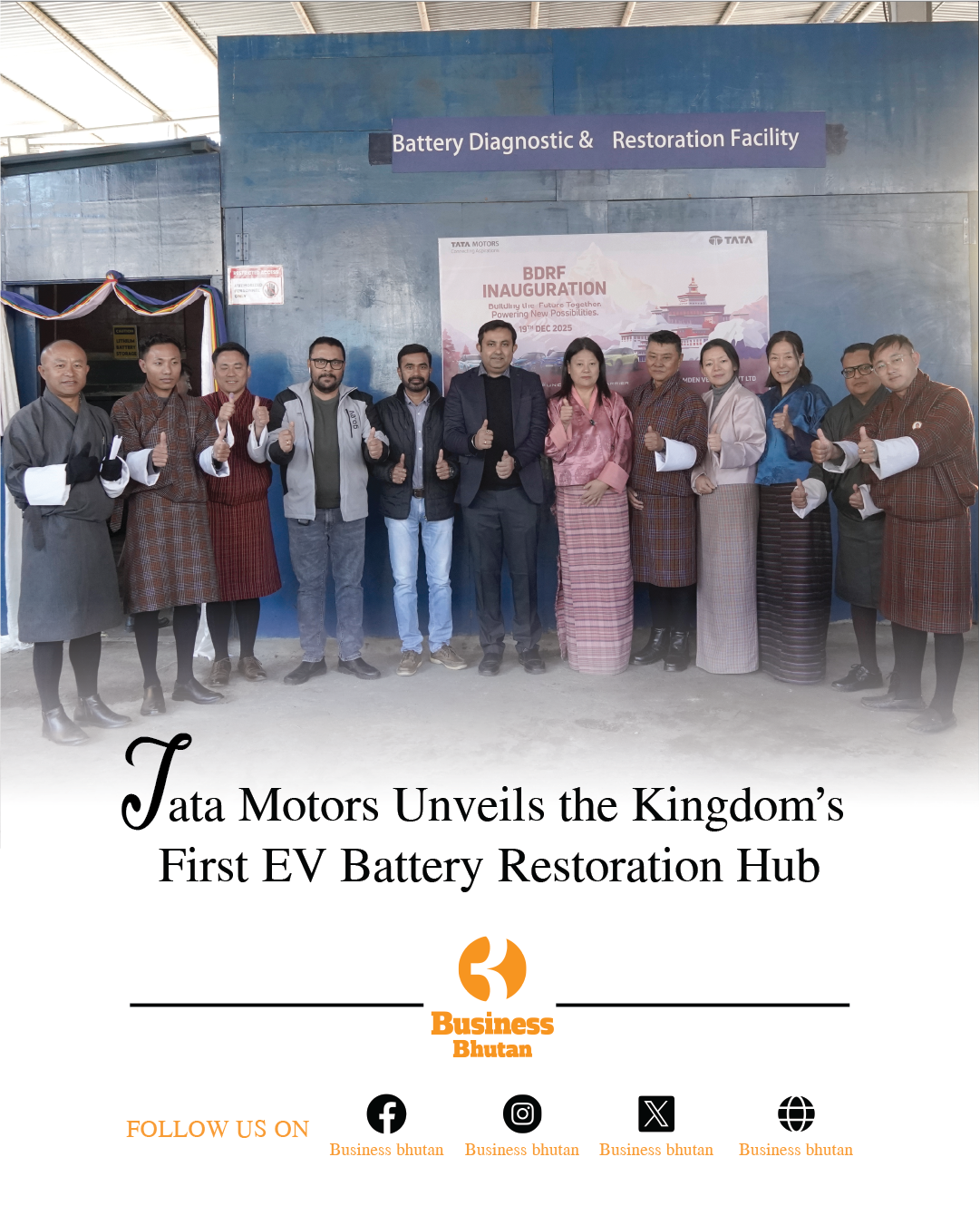
Bhutan’s journey toward a cleaner, electrified future took a decisive leap forward on December 19, 2025, as Tata Motors Passenger Vehicles Ltd. inaugurated the country’s first-ever Electric Vehicle Battery Diagnostic and Restoration Facility (BDRF) in Thimphu. More than a technical milestone, the launch signals a turning point in Bhutan’s electric mobility ecosystem—one that places long-term confidence, local capability, and sustainability firmly at its core.
For EV owners across the country, the message is clear: the future of electric mobility in Bhutan is no longer dependent on distant service centers or overseas expertise—it is being built at home.
The state-of-the-art BDRF has been designed to deliver global-standard, cell-level battery diagnostics and restoration services, offering TATA.EV customers advanced aftersales support previously unavailable in Bhutan. Developed with technical expertise from Tata AutoComp Systems Limited (TACO), the facility significantly reduces vehicle downtime while lowering long-term ownership costs—two critical factors in accelerating EV adoption.
By bringing sophisticated battery health assessment, diagnostics, and repair capabilities closer to customers, Tata Motors has strengthened the foundation of trust required for electric mobility to thrive.
Inside the facility, cutting-edge equipment ensures precision and safety at every stage. A high-voltage Pack Cycler enables controlled charging and discharging before battery packs are opened or refitted. A Module Charge–Discharge Cycler evaluates individual modules for capacity, health, and recovery potential, while a Cell Equalizer corrects voltage imbalances to restore performance. A Leak Testing system ensures battery packs are securely sealed, protecting them from moisture and extending their operational life.
Together, these systems make the BDRF a critical nerve center for Bhutan’s EV ecosystem.
Speaking at the inauguration, Sumanta Bhattacharjee, Deputy General Manager of Tata Motors Passenger Vehicles Ltd., emphasized the company’s long-term commitment to Bhutan’s green mobility vision.
“The commissioning of the BDRF in Bhutan reflects our focus on building local capabilities while introducing advanced EV service infrastructure. It is an important step in supporting sustainable mobility in the country,” he said.
Equally significant is the investment in local human capital. According to Kabir Biswa, General Manager (Passenger Vehicles) at Samden Vehicles Private Limited, Tata Motors’ authorized distributor in Bhutan, local technicians have already been trained to deliver advanced battery diagnostics and restoration services within the country.
This means faster turnaround times, lower repair costs, and greater convenience for EV owners—making electric mobility not just cleaner, but more practical and affordable.
The Bhutan facility follows the successful deployment of a similar BDRF in Nepal, a model that has already proven the value of localized EV battery support. By replicating this tested approach, Tata Motors continues to expand a reliable and resilient EV service network across the SAARC region.
For complex cases requiring deeper analysis, Bharat Kumar, General Manager (Service) at Tata AutoComp Systems Limited, noted that advanced diagnostics can also be conducted remotely through video-based expert consultations—ensuring uninterrupted support and minimal delays.
The inauguration ceremony, held at Samden Vehicles’ main workshop in Thimphu, was attended by senior officials from Tata Motors Passenger Vehicles Ltd., Tata AutoComp Systems Limited, and Samden Vehicles—underscoring the strategic importance of the initiative.
With the launch of Bhutan’s first EV Battery Diagnostic and Restoration Facility, Tata Motors has done more than introduce new infrastructure. It has strengthened confidence in electric mobility, empowered local expertise, and reinforced Bhutan’s position as a regional leader in sustainable transport.
As Bhutan accelerates toward a low-carbon future, this facility stands as a powerful symbol: the engines of change are electric—and the power to sustain them is now firmly within the country’s reach.
Sangay Rabten
From Thimphu