

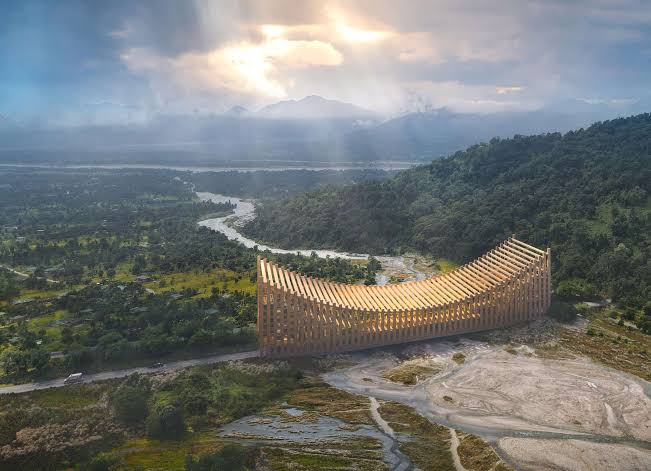
The Project will provide housing for relocated families on 13.7 acres, with private developer required to finance, build and operate the complex for 30 years
The Gelephu Mindfulness City Authority (GMCA) has invited bids for the design, construction and operation of a 256-unit housing project intended primarily to accommodate households relocated as part of the development of Gelephu Mindfulness City (GMC).
The project will be developed under a Design-Build-Operate (DBO) concession model on approximately 13.7 acres of land provided on lease by GMCA and is classified as a priority social-infrastructure undertaking.
Under the arrangement, GMCA will provide the land, while the selected concessionaire will be responsible for designing, financing, constructing, operating and maintaining the development. At the end of the concession, the land will be transferred back to GMCA free of encumbrances.
The project is required to provide at least 15,000 square metres of residential built-up space, comprising 100 three-bedroom units, 100 two-bedroom units and 56 co-living units. The co-living component consists of 48 Type A units and eight Type B units, each with a minimum individual area of 17 square metres and shared living and kitchen facilities. The minimum unit size is 60 square metres for 2 BHK units and 80 square metres for 3 BHK units.
In addition to the residential units, developers may propose up to 2,500 square metres of commercial space, including convenience retail, cafés or food services, a crèche, pharmacy and other neighbourhood services. The commercial component is intended to support residents while improving the financial viability of the project, although it cannot undermine the development’s primary residential purpose.
Private financing, long-term concession
One of the defining features of the project is that the developer must arrange the financing required for construction. The RFP permits a maximum of 70 percent debt financing, with the indicative financing structure set at 70:30 debt-to-equity.
GMCA has approved indicative senior-debt terms of 8.5 percent annual interest over 30 years, matching the proposed 30-year operations period. The RFP, however, does not prescribe a fixed capital expenditure figure. Instead, bidders must propose the total project CAPEX and demonstrate how the project can be financially sustained through residential rentals and permitted commercial activities.
To improve revenue certainty for the private operator, GMCA will guarantee occupancy equivalent to 70 percent of the residential units, or 179 of the 256 units, during the first 10 years of operations. If actual occupancy falls below the guaranteed level, GMCA will compensate the concessionaire for the rental shortfall up to that level.
The developer will propose monthly rental rates for each category. Rentals may increase by a maximum of 5 percent annually. In return, the concessionaire must pay GMCA 3 percent of the project’s gross turnover each operating year, excluding occupancy-guarantee payments made by GMCA.
Seven-month construction window
The project has an unusually tight construction schedule. The procurement schedule sets December 1, 2026 as the construction commencement date and requires full commissioning of all 256 units by June 30, 2027—giving the successful developer only seven months from construction commencement to completion.
The broader design and construction phase is capped at eight months from the signing of the concession agreement, including design, approvals and financial close. The project will then enter a 30-year operations and maintenance period from 2027 to 2057.
To meet the deadline, GMCA is allowing bidders to choose their construction technology, including conventional reinforced concrete, pre-engineered buildings, light-gauge steel framing, precast, modular or hybrid systems. However, the chosen technology must demonstrate structural safety, durability, quality control and the ability to meet the seven-month construction programme.
Traditional architecture and essential infrastructure
The project must combine contemporary construction with traditional Bhutanese architectural elements, including traditional paintwork, while ensuring durability and compliance with the latest Bhutan Building Code and Bhutan Building Rules.
The development must also include children’s play areas, landscaped spaces, internal roads, footpaths, street lighting, parking, security systems, CCTV, waste segregation and recycling facilities, and barrier-free access. At least 5 percent of units must be designed to accessibility standards.
Infrastructure requirements include a minimum water supply capacity of 135 litres per capita per day, with the developer required to provide at least 48 hours of on-site water storage. Backup power must be capable of supporting essential services within 30 minutes of a grid failure, while sewage must be treated on site and stormwater infrastructure designed for a one-in-25-year rainfall event. Fibre-ready ducting must also reach every unit.
Bids due September 30
The procurement process begins with a pre-bid conference on September 7, followed by a September 11 deadline for clarification requests. Proposals must be submitted by September 30, 2026, while technical evaluation is scheduled for October 5, financial evaluation for October 9 and announcement of the preferred bidder for October 19.
Contract signing and financial close are targeted for October 30, followed by concept-design submission on November 13 and final design approval by November 20. Construction is then scheduled to begin on December 1.
The scale, financing structure and compressed construction period make the project a significant test of the private sector’s ability to deliver large-scale housing quickly while meeting GMC’s architectural, social, environmental and long-term operational requirements.
Tashi Namgyal, Thimphu