

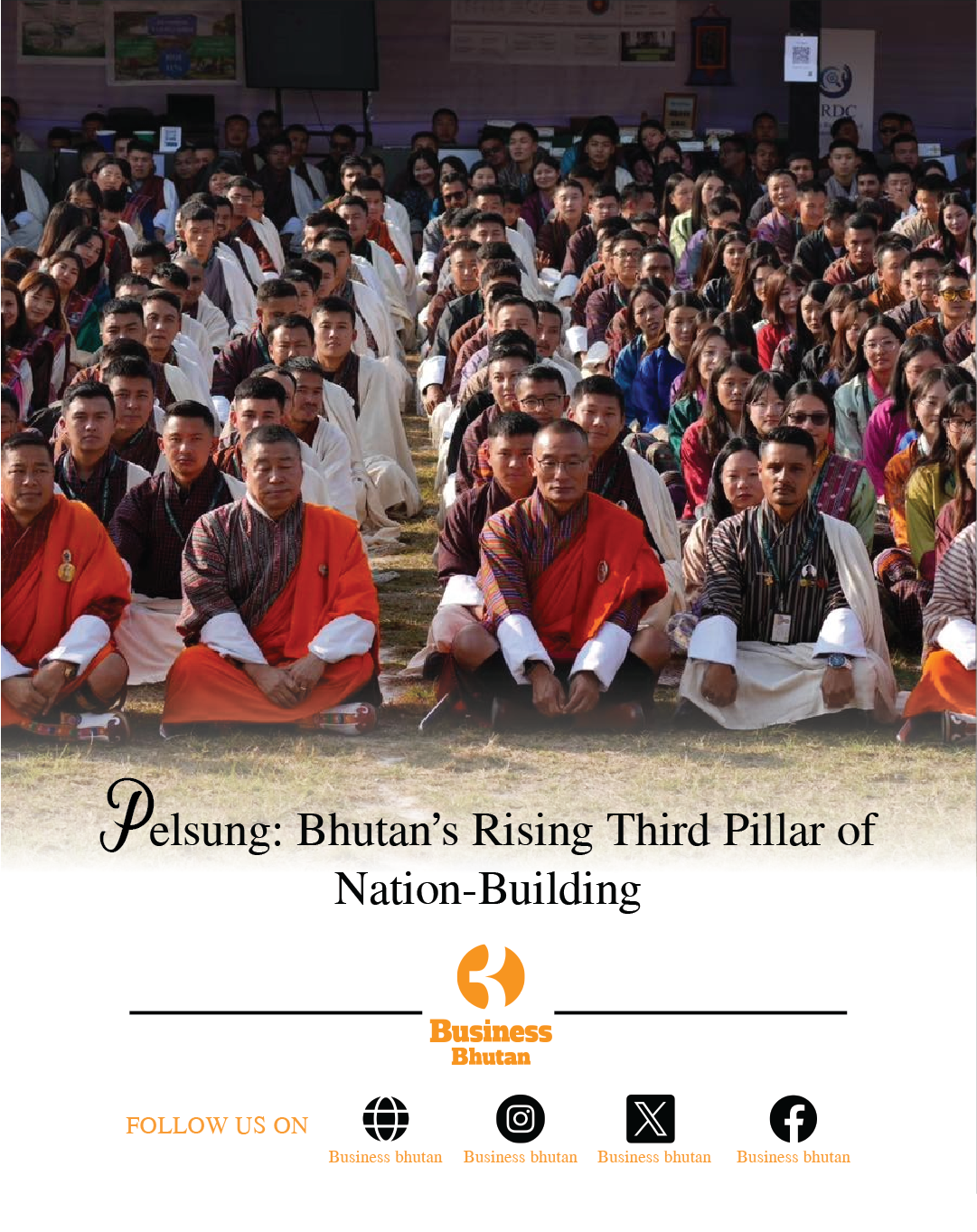
Bhutan has officially turned a new page in its nation-building journey with the graduation of the first cohort of Pelsups, heralding the rise of a dynamic force now recognized as the third pillar of national service. Standing alongside the Desuung—the Guardians of Peace—and Gyalsung—the builders of character—Pelsung is poised to safeguard Bhutan’s economic future and shape the country’s next generation of leaders.
After an intensive three-month immersion at the heart of the developing Gelephu Mindfulness City (GMC), 324 Pelsups have been formally inducted as “Guardians of Prosperity.” Introduced in 2025 by His Majesty the King, the Pelsung program was designed to mobilize Bhutanese youth to shadow global experts, learn high-stakes problem-solving, and become the future stewards of the GMC.
“Pelsung was not about recognition; it was about responsibility,” said Yoga Prasad Chapagai, a senior engineer and member of the first cohort. “It offered a rare opportunity to serve at a critical moment. The most valuable aspect was learning to function under uncertainty and pressure, mirroring the reality of building something as complex as GMC.”
Chapagai emphasized that the program instilled a mindset of nation-building rather than focusing on individual projects. “It bridged discipline, innovation, and service, showing how Bhutanese values can guide engagement with global expertise,” he said. “We are honored to carry this responsibility forward wherever we serve.”
The program’s leadership is clear about its strategic importance. Phub Dorji, interim executive director of Pelsung, described it as a national coordinating mechanism—a strategic “stop-gap” that fills professional voids while generating both human and innovation capital for the GMC. Ideas nurtured by Pelsups are channeled into the Innovation Lab at GMC, refined, and transformed into practical solutions that strengthen the city’s long-term development.
The vision is bold: these youth are not being trained as ordinary civil servants but as future CEOs and innovators. International experts may lay the city’s foundational infrastructure, but the long-term stewardship is entrusted to Pelsups. Selected from Bhutan’s brightest—including 18 Master’s degree holders and two PhDs—the first cohort represents a new social contract. “If Desuung protects our peace and Gyalsung builds our character, Pelsung safeguards our economic future,” said Sonam Tandin Phurba.
Graduation showcased the Pelsups’ innovative projects, which will serve as the intellectual and economic backbone of Bhutan’s first Special Administrative Region. From high-tech environmental monitoring systems to digital heritage preservation initiatives, these projects are moving directly into the GMC Innovation Lab, ready to support the city’s operational framework.
As of now, the first 324 Pelsups are no longer trainees—they are active pioneers shaping Gelephu’s future. The second cohort is currently in training, while a third batch is set to begin next month, highlighting the program’s role as a pipeline for talent, innovation, and leadership. By February 2026, these first 120 pioneers will be fully embedded in the city’s operational systems.
His Majesty the King emphasized the purpose behind Pelsung: “Everything we are doing today is for our youth—so that they will be better versions of us, better prepared, smarter, and more hardworking. It falls on us to build that future, and on them to protect it and take it to greater heights. That is why Pelsung was created.”
Pelsung embodies a vision for capable, confident, and creative Bhutanese youth equipped to thrive in high-stakes environments such as GMC, the 10X Bhutan initiative, and global arenas. It combines discipline, resilience, and entrepreneurial thinking, offering participants a sandbox to experiment, learn quickly, and act decisively. Through hands-on “build” tracks, innovation-focused pathways, and specialized “sustain” tracks, Pelsups are prepared to meet immediate operational needs while positioning themselves as tomorrow’s leaders.
At a critical juncture in Bhutan’s national evolution—marked by rapid urbanization, shrinking youth demographics, and the urgent need for capable innovators—Pelsung stands as a transformative engine of human capital. It is not merely a program; it is a launchpad for a generation ready to carry Bhutan’s prosperity forward.
With the Pelsung program, Bhutan is sending a powerful message: the nation’s future will be built not only on infrastructure and policy but on a generation of youth who are disciplined, innovative, and unafraid to lead.
Nidup Lhamo
From Thimphu