

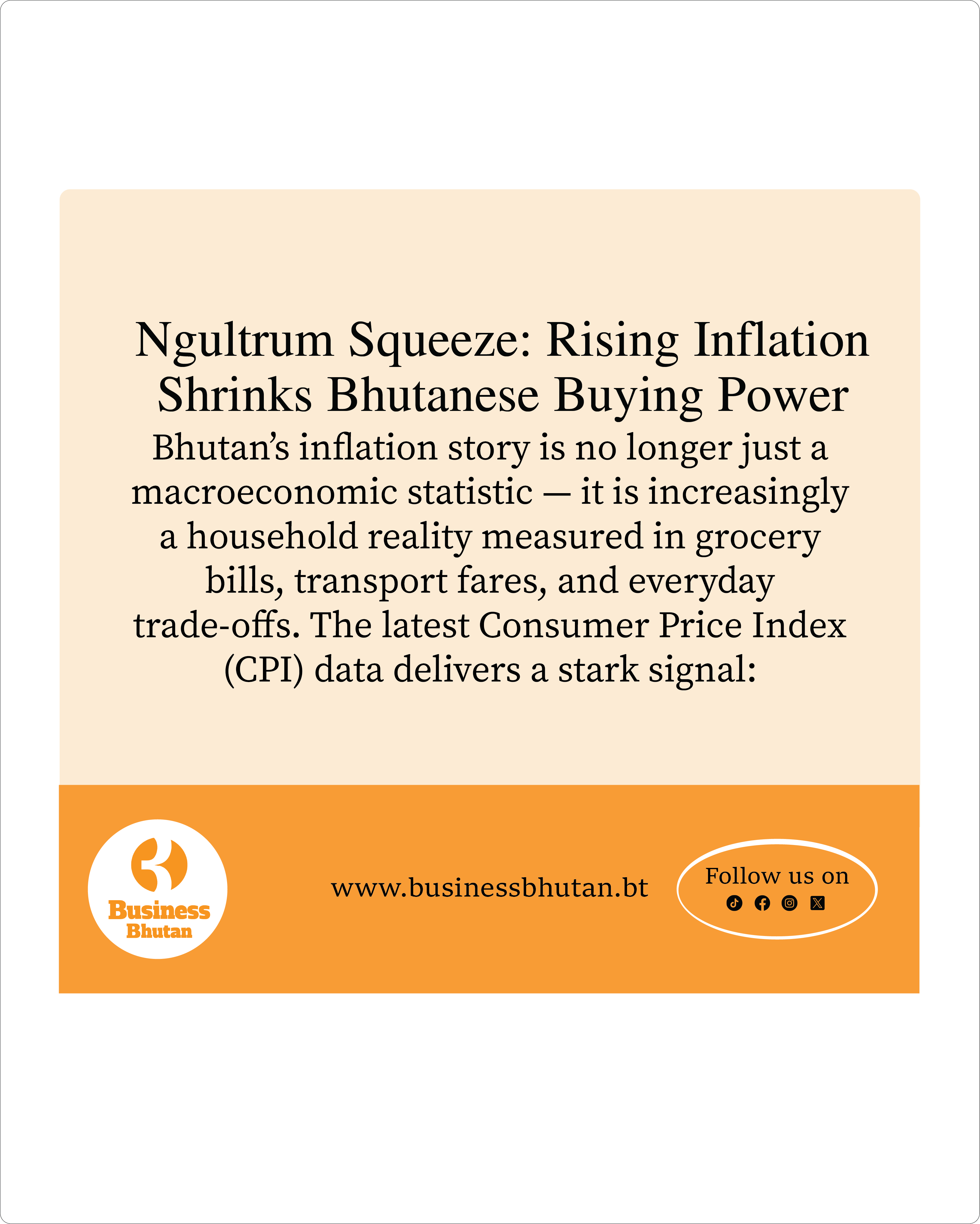
Bhutan’s inflation story is no longer just a macroeconomic statistic — it is increasingly a household reality measured in grocery bills, transport fares, and everyday trade-offs. The latest Consumer Price Index (CPI) data delivers a stark signal: the Ngultrum’s buying power has eroded significantly over the past decade. As of December 2025, Nu100 buys roughly what Nu53.5 could purchase in December 2012. That single figure captures more than a technical decline in currency value; it reflects a slow, cumulative squeeze on consumer strength that is reshaping spending habits, market behaviour, and economic confidence across the country.
Speaking about it, an economic expert said that for the average Bhutanese household, inflation is felt less in percentages and more in daily decisions. “Essentials — food, clothing, healthcare, and transport — consume a growing share of income. Even when wages rise nominally, they often struggle to keep pace with the steady upward drift in prices. The result is a subtle but persistent decline in real purchasing power.” This, he said, would make, families adjusting budgets, delaying non-essential purchases, and seeking lower-cost alternatives. Over time, these behavioural shifts become embedded in household financial planning.
Explaining about the erosion of the Ngultrum’s buying power since 2012and how inflation compound, he said that a 3.26% decline in purchasing power over the past year may appear manageable in isolation. “But layered on top of more than a decade of price increases, it contributes to a meaningful change in living standards. Consumers are effectively required to spend more simply to maintain the same quality of life. For middle- and lower-income households — where a larger proportion of earnings goes toward necessities — the pressure is especially pronounced.”
This changing consumer landscape carries direct implications for Bhutan’s domestic markets. Retailers and service providers operate in an environment where customers are increasingly price-sensitive. “When essential spending rises, discretionary spending often contracts. Restaurants, apparel stores, hospitality businesses, and non-essential service providers may see softer demand as households reallocate budgets toward groceries, utilities, and healthcare. Even modest pullbacks in discretionary spending can ripple through local economies, slowing sales growth and tightening business margins.”
The expert underlined that for businesses, inflation presents a delicate balancing act. “Input costs — from transportation and imported goods to wages and utilities — tend to rise alongside consumer prices. Companies must decide how much of these increases to pass on to customers. Passing through too much risks dampening demand; absorbing costs compresses profit margins. Smaller enterprises, which often operate with limited financial buffers, may feel the strain most acutely. In this sense, inflation becomes both a consumer challenge and a business sustainability issue.”
Moving to a different area, he also touched on market psychology and how it shifts in an inflationary environment. “When households perceive their money is losing value, spending patterns evolve. Some consumers accelerate purchases to avoid future price increases, while others adopt a defensive stance, prioritising savings and essential consumption,” he explained. “In Bhutan’s case, the steady nature of inflation — rather than a sudden spike — tends to encourage cautious budgeting rather than panic buying. Still, the long-term effect is a more conservative consumer base that evaluates spending through the lens of value and necessity.”
The expert further highlighted another critical dimension – saving. “Inflation quietly erodes the real value of money held in cash or low-yield accounts. For households attempting to build financial security, this presents a dilemma: traditional saving methods may not preserve purchasing power over time. While Bhutan’s financial landscape offers limited investment avenues compared to larger economies, the underlying principle remains — consumers become more aware that money must grow, not merely sit idle, to maintain value.”
According to him, the broader economy reflects these household-level adjustments. “Consumption is a key driver of domestic economic activity. When purchasing power weakens, overall demand growth can moderate. This does not necessarily signal economic distress, but it does influence the pace and composition of growth. Sectors tied closely to essential goods may remain resilient, while discretionary industries experience greater volatility.”
Inflation also has social implications. Rising living costs can widen perceived inequality if income growth is uneven across sectors. Public sentiment becomes closely tied to price stability, particularly for food and services that form the backbone of daily life. Maintaining confidence in the currency — and in the broader economic system — becomes as much a psychological priority as a financial one.
Further, he stated that Bhutan’s inflation environment remains moderate by global standards. “A 3.26% annual erosion of purchasing power is not indicative of runaway inflation or currency instability. However, the cumulative impact underscores why steady price growth matters. Inflation’s power lies in its persistence: small annual increases compound into significant long-term changes in how money functions in everyday life.”
For the average Bhutanese, the takeaway is not alarm but awareness. Inflation encourages smarter budgeting, price comparison, and prioritisation of essential spending. It also highlights the importance of income growth, productivity, and economic diversification to sustain living standards. Households that adapt — by tracking expenses, seeking value, and planning ahead — are better positioned to navigate gradual price shifts.
For markets and policymakers, the CPI data serves as an early-warning dashboard. Stable, predictable inflation allows businesses to plan investments and pricing strategies with confidence. It also enables policymakers to calibrate measures that protect purchasing power without stifling growth. Ensuring supply efficiency, especially for essential goods, remains central to keeping inflation contained.
Ultimately, the shrinking buying power of the Ngultrum is not just a statistic — it is a lens through which Bhutan’s evolving economic reality becomes visible. Inflation quietly redraws the boundaries of what households can afford, how businesses operate, and how markets respond. While the pace remains manageable, the long arc of price increases reminds consumers and companies alike that economic resilience depends on adapting to a currency that, year by year, stretches a little less far than it once did.
Sherab Dorji
From Thimphu