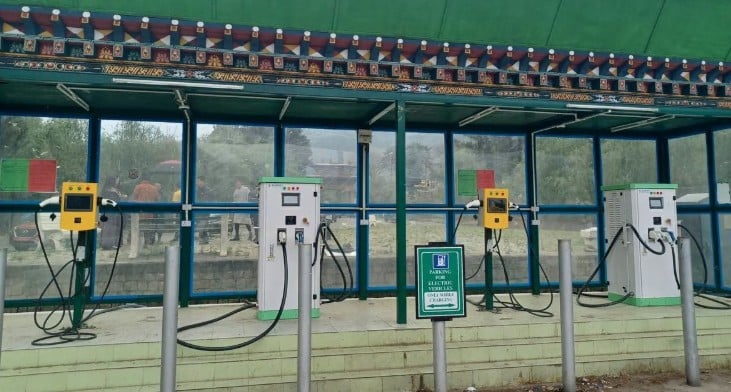
Data-driven masterplan identifies priority locations in 13 dzongkhags while calling for expansion at saturated stations
Bhutan is set to expand its public electric vehicle charging network, with a new masterplan identifying priority locations across the country based on current demand, road connectivity, population, existing charging coverage and proximity to electricity infrastructure.
The EV Charging Infrastructure Masterplan, prepared by the Department of Surface Transport, proposes a phased expansion of charging infrastructure while cautioning against indiscriminate installation of new stations in areas where existing facilities remain underutilised.
The plan comes as Bhutan’s public charging network has expanded to 41 stations across all 20 dzongkhags, supported by 74 charging machines. As of May 2026, 1,397 electric vehicles were registered in the country.
The masterplan is based on 18 months of electricity billing data, from January 2025 to June 2026, combined with a GIS-based multi-criteria analysis to determine where additional infrastructure would have the greatest impact.
The analysis found that demand is rising rapidly but remains highly concentrated geographically. Electricity consumption at public EV charging stations increased by 78 percent during the assessment period, from Nu 434,464 in January 2025 to Nu 773,409 in June 2026.
Thimphu accounted for 53 percent of national EV charging electricity consumption, followed by Chhukha at 17 percent and Paro at 10 percent. Together, the three dzongkhags accounted for 80 percent of charging activity, leaving the remaining 17 dzongkhags with 20 percent.
The masterplan recommends that expansion should address both immediate capacity shortages and emerging demand along major transport corridors.
The first tier focuses on locations where charging demand is already high and additional capacity is needed to reduce queuing and prevent service disruptions.
In Thimphu, proposed capacity expansion locations include Buddha Point parking, the open gym near the Ministerial Enclave, Memorial Chorten and Babesa truck parking.
In Chhukha, the proposed locations are the BCTA compound, the Chhukha bypass junction and the mini dryport/truck parking area.
For Paro, the plan identifies Chuzom, Paro International Airport, the area near the archery ground and Chele La Pass.
The plan also proposes capacity expansion at Relangthang near Gurung Restaurant and near the vegetable market in Sarpang under the Tsirang grouping, as well as at Bajo town in Wangduephodrang.
The masterplan specifically recommends replacing the existing CHAdeMO chargers at Memorial Chorten and Chuzom with dual-gun CCS2 chargers, reflecting the growing dominance of CCS2-compatible vehicles in Bhutan.
The second tier targets dzongkhags where demand is strong but charging infrastructure remains dependent on a single station.
In Samtse, proposed locations include near the BPC or gewog office at Sipsoo and near Panbari School, while in Sarpang, the plan identifies areas near Kaja Throm, the existing station and the football ground. In Punakha, a new station is proposed near Thinleygang, around Phenday Restaurant.
The objective is not simply to add more chargers but to reduce the risk of a single charging station becoming a critical point of failure in areas where demand is already increasing.
A third tier focuses on locations with relatively lower but rising demand and areas where geographic coverage remains limited.
The proposed locations are near Kanglung Zangtopelri/Narphu Town in Trashigang; near the public football ground in Samdrupjongkhar; Tingtibi near the tri-junction or near the Bank of Bhutan in Zhemgang; Nganglam near the taxi parking in Pemagatshel; Sengor near Kuenzang Hotel in Mongar; Yotongla Pass in Bumthang; Damji near Dema Restaurant in Gasa; and Bitekha near Nguyen Homestay in Haa.
These locations are intended to close charging gaps along highway corridors and support future EV adoption before demand becomes critical.
The masterplan’s suitability model considered seven factors, with EV distribution carrying the highest weight at 32 percent, followed by road-network accessibility at 22 percent and population at 15 percent. Existing EV charging coverage accounted for 12 percent and transformer proximity 11 percent.
The study also used a 20-kilometre service-area threshold to identify sections of the road network outside practical access to existing charging stations.
The masterplan recommends a different approach for Trashiyangtse, Dagana, Lhuentse and Trongsa. Rather than installing additional chargers over the next 24 months, the priority should be to ensure existing stations are fully operational and monitor demand before considering further investment.
Of the 41 stations analysed, 11 were classified as high-utilisation, 10 as moderate, 13 as low and seven as having negligible consumption.
The masterplan also recommends that new stations use at least 120 kW DC fast chargers with two CCS2 connectors, while 11–22 kW AC chargers should complement DC chargers at Tier 1 sites.
Implementation is proposed in three phases, with Tier 1 given the earliest priority, followed by Tier 2 and then Tier 3 as part of a longer-term network expansion programme. The approach marks a shift from expanding charging infrastructure based simply on geographic gaps towards a demand-led national charging network, balancing immediate congestion with future EV adoption and highway connectivity.
Tashi Namgyal, Thimphu