Transition towards Repayment and Restructuring gegins
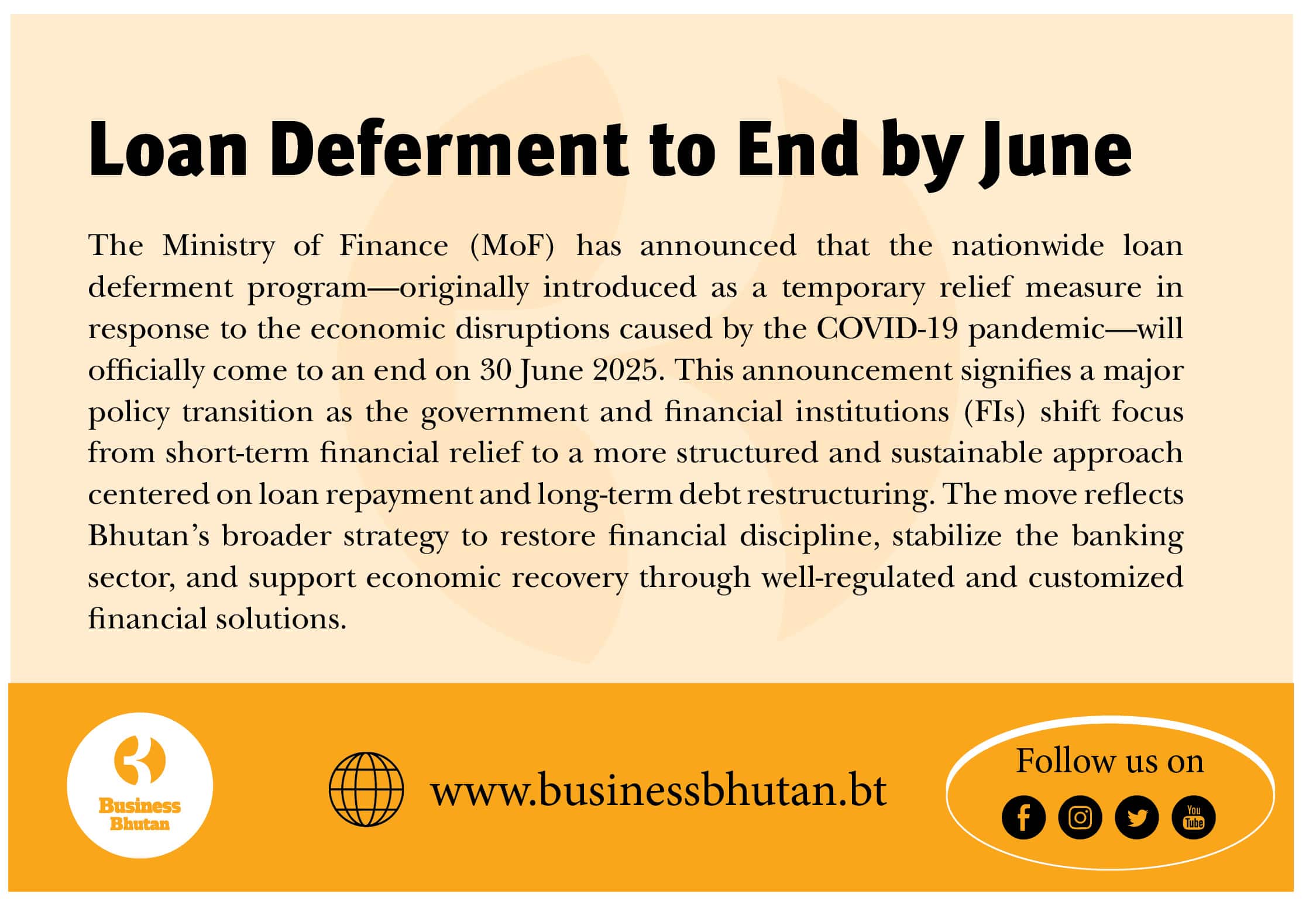
The Ministry of Finance (MoF) has announced that the nationwide loan deferment program—originally introduced as a temporary relief measure in response to the economic disruptions caused by the COVID-19 pandemic—will officially come to an end on 30 June 2025. This announcement signifies a major policy transition as the government and financial institutions (FIs) shift focus from short-term financial relief to a more structured and sustainable approach centered on loan repayment and long-term debt restructuring. The move reflects Bhutan’s broader strategy to restore financial discipline, stabilize the banking sector, and support economic recovery through well-regulated and customized financial solutions.
This policy transition is the result of extensive consultations between the Royal Monetary Authority (RMA) and various financial institutions to ensure a coordinated and carefully managed shift from emergency relief to long-term financial stability.
Speaking during the 16th Meet-the-Press session, the Minister for Industry, Commerce and Employment (MoICE), Namgyal Dorji—on behalf of the Ministry of Finance—emphasized that the primary objective of this move is to re-establish financial discipline across the banking and credit system. At the same time, he assured that the government remains committed to supporting sectors that continue to face financial stress, particularly those that were hardest hit during the pandemic. The minister underscored that this balanced approach seeks to strengthen the overall health of the financial sector while ensuring that vulnerable industries are not left behind during the recovery process.
“We have requested the RMA to give particular attention to the tourism sector,” the Minister said, noting that out of the total Nu 30 billion in deferred loans, Nu 13.8 billion is linked to tourism, primarily in hotel and hospitality businesses. The government has asked the central bank to consider interest rate reductions for these loans.
According to the Ministry of Finance (MoF), approximately 505 borrowers have been identified as eligible for targeted support once the nationwide loan deferment program concludes at the end of June 2025. While the blanket deferment of loans will no longer be available, these affected borrowers will still have access to customized restructuring options, which will be developed in mutual agreement with their respective financial institutions.
To facilitate a smooth transition from deferment to repayment, a three-month grace period will be provided after the program ends. During this transitional phase, financial institutions will work closely with each borrower to assess their financial situation and finalize appropriate repayment or restructuring plans. This approach is designed to ensure that support continues for those who genuinely need it, while also promoting accountability and a gradual return to normal financial operations.
In parallel, the Royal Monetary Authority (RMA) has instructed banks to conduct a thorough assessment of the possibility of reducing their minimum lending rates. The banks are required to submit their findings to the RMA for evaluation, as part of broader efforts to ease borrowing costs and support economic recovery, especially in sectors still struggling to regain stability
Structured Restructuring Options
To address repayment challenges, especially within the tourism industry and three-star hotels, the RMA will allow FIs to implement loan restructuring measures in accordance with the Rules and Regulations on Loan Restructuring 2022.
The seven standard restructuring tools include: interest-only payments (up to 2 years); payment moratoriums (upto 2 years); capitalization of accrued interest; extension or rescheduling of loan maturity terms; loan top-ups (with adequate collateral); loan splitting; and conversion to term loans.
Financial institutions may also propose innovative restructuring solutions, provided such proposals are approved by their respective boards and sanctioned by the RMA.
Shift towards Long-Term Stability
The Finance Ministry emphasized that this policy shift is aimed at long-term financial sustainability rather than short-term relief. The new approach empowers financial institutions to manage distressed assets through well-defined regulatory frameworks while encouraging creativity and flexibility under the RMA’s oversight.
“This marks a new phase in Bhutan’s post-pandemic economic recovery,” the Ministry stated. “It balances prudence with compassion—offering structured solutions to borrowers while protecting financial system stability.”
As Bhutan moves beyond pandemic-era interventions, this shift signals the beginning of a more resilient and regulated phase of financial sector recovery, anchored in sustainability, accountability, and inclusive support mechanisms.
Sherab Dorji from Thimphu