

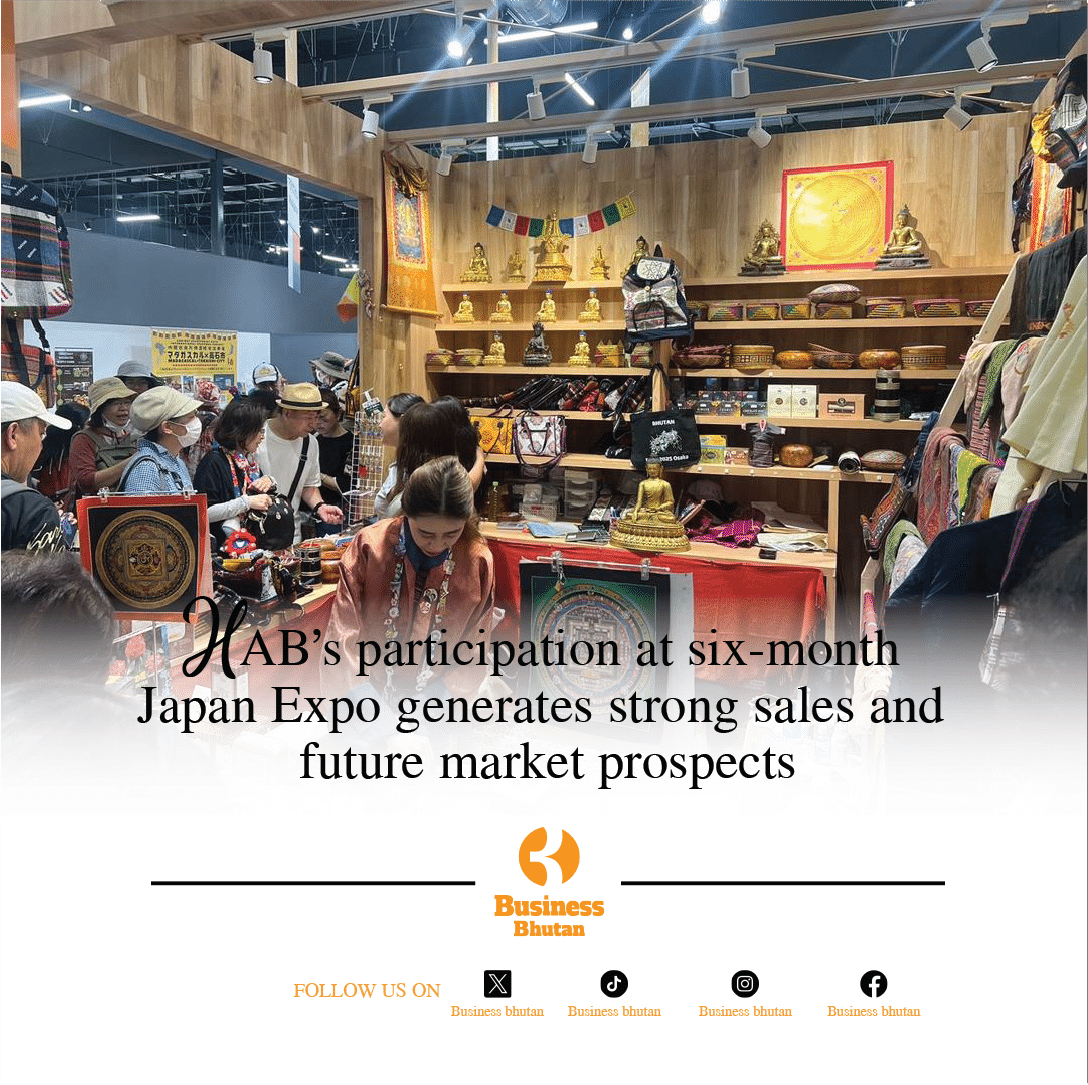
The Horticulture Association of Bhutan’s participation in the six-month international Expo in Japan has concluded on a highly positive note, both financially and diplomatically, with Bhutanese exhibitors recording steady product sales, promising business leads, and strong interest from Japanese and international visitors alike.
According to the Bhutanese delegation, represented by the Horticulture Association of Bhutan (HAB), the Expo drew overwhelming responses for its distinctive cultural presentation and the thematic focus on Gross National Happiness. The Bhutan Pavilion stood out for its serene design, eco-friendly products, and interactive displays, which left a lasting impression on visitors and potential business partners.
While the primary goal of Bhutan’s participation was to promote its culture and sustainable products rather than immediate profit-making, the event proved financially rewarding.
Participating Bhutanese businesses collectively reported encouraging revenue from sales and partnership agreements, making the Expo profitable overall. Each exhibitor noted steady sales growth throughout the six-month period, particularly from repeat Japanese customers and bulk buyers interested in organic and handcrafted items.
The President of the HAB, Tshering Wangchuk, noted that the Expo “opened meaningful trade channels for Bhutanese products” and helped participating entrepreneurs gain confidence in the Japanese market.
Among the products showcased, handicrafts, incense, herbal teas, and traditional textiles emerged as the most popular items, particularly among Japanese consumers, who appreciated the craftsmanship and eco-friendly materials. Bhutan’s emphasis on natural and handmade goods resonated well with Japan’s culture of simplicity and sustainability.
However, the project coordinator, Tashi Phuntsho said that products that required special import certification, such as certain food items and herbal medicines — experienced lower sales due to regulatory restrictions.
Visitor feedback was overwhelmingly positive, with many praising the authenticity, natural quality, and sustainable packaging of Bhutanese products. There were no significant complaints, though a few buyers inquired about international certifications and labeling requirements, indicating areas for improvement for future exports.
The Expo also opened doors to potential long-term collaborations. Follow-up discussions are currently underway with several Japanese distributors interested in importing Bhutanese herbal teas, incense, and textile products. These partnerships could enhance Bhutan’s export base and provide sustained income for rural producers.
For the HAB and participating entrepreneurs, the Expo offered critical lessons for future international ventures for the need for consistent branding and product certification to meet global standards. Maintaining adequate stock and uniform pricing throughout long-term exhibitions were the lesson the participants learned while they got deeper insights into Japanese consumer preferences, including minimalistic design, premium quality, and transparent product information. The importance of team coordination, timely logistics, and professional presentation in representing Bhutan internationally was felt by the participants.
Overall, the Expo served as a strategic platform to promote Bhutan’s identity, products, and values on the global stage. It not only generated direct sales but also fostered people-to-people connections and built the groundwork for future export opportunities.
“The experience was both financially and culturally rewarding,” the President concluded. “It has strengthened our confidence to expand Bhutan’s presence in the Japanese and global markets through authentic, sustainable, and happiness-driven products.”
During its 184-day run, Expo 2025 Osaka attracted a total of 25,578,986 visitors, bringing together people from around the world to celebrate innovation, sustainability, and cultural diversity. Within this, the Shared Pavilion (Commons D) received approximately 3.7 million visitors, of which around 2.3 million visited the Bhutan Pavilion.
Expo 2025 Osaka Kansai officially wrapped up 13 October, marking the end of Japan’s third hosting of a World Expo. The event, held under the theme “Designing Future Society for Our Lives,” attracted over 28 million visitors from around the globe during its six-month duration. With 165 countries and international organizations participating, the expo showcased a global commitment to innovation, diversity, and cooperation.
The closing ceremony, themed “For the Futures,” celebrated the creativity and unity that characterized Expo 2025. It marked both a farewell to the event and a new beginning, featuring a ‘symphony of the Expo’ through music and dance performances. A virtual flag parade also paid tribute to the international participants and their contributions.
Attendees included representatives from national and local governments, Expo organizers, international delegates, volunteers, civil society members, media personnel, and other stakeholders who played vital roles in the event’s success.
World Expos, officially known as International Registered Exhibitions, serve as global platforms for nations to address pressing universal challenges through engaging and immersive activities centered around a common theme.
Looking ahead, the next World Expo, Expo 2030, will be hosted in Riyadh, Saudi Arabia, from October 1, 2030, to March 31, 2031. Under the theme “Foresight for Tomorrow,” the event promises to continue the tradition of fostering international collaboration and innovative solutions for the future.
Sangay Rabten, from Thimphu