

Largest cohort passes out as His Majesty The King describes Gyalsung as an extraordinary national achievement and a shared experience for generations
Gyalsung has crossed a major national milestone, with 12,707 young Bhutanese now having completed national service training following the passing out of the 2026 Batch (Cohort 2) on September 30. 2026.
The latest cohort of 2,847 young men and women is the largest single cohort trained since Gyalsung began in 2024, bringing the number of completed cohorts to six. Of the 12,707 trained so far, 6,424 are male and 6,283 are female, reflecting an almost even participation of young men and women.
The latest cohort also included 25 Bhutanese living abroad who returned to Bhutan to undergo the training, highlighting that the national service programme is reaching beyond those living within the country.
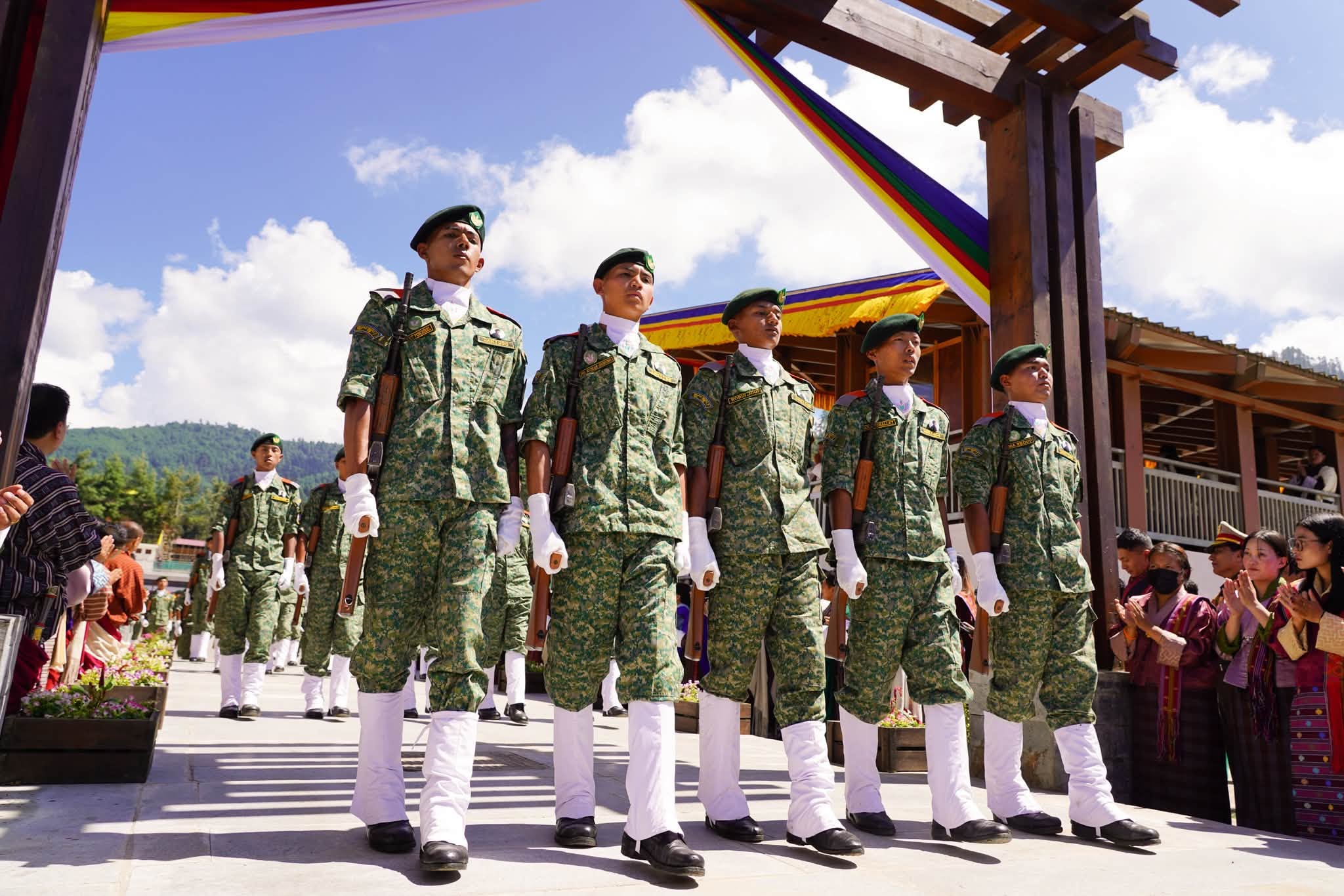
The Passing Out Parade was held simultaneously at the four Gyalsung Academies in Khotokha, Pemathang, Gyalpozhing and Jamtsholing. His Majesty The King presided over the ceremony at Khotokha in Wangdue Phodrang and addressed Gyalsups assembled across all four academies.
But for His Majesty, the significance of Gyalsung cannot be measured simply by the number of young people who have completed training.
Addressing the Gyalsups, His Majesty described Gyalsung as “one of the most extraordinary achievements of our lifetime”, made possible through the wholehearted support of the Bhutanese people.
“I see providence, determination, focus, clarity, and above all, I see how united we are,” His Majesty said.
His Majesty also spoke about Gyalsung as an experience that will extend well beyond the training period. The generations that follow today’s Gyalsups, he said, will in turn become part of Gyalsung, creating a shared experience that can connect Bhutanese across generations.
He described Gyalsung as a third family for those who pass through it, alongside the families into which they are born and the families and lifelong relationships they build through friendships, mentors and spouses.
The latest passing out therefore marks more than the completion of another training cycle. It represents the expansion of a national institution that is creating a growing community of young Bhutanese with a common experience of discipline, training, service and responsibility.
12,707 in three years
The scale of Gyalsung’s growth is evident in the numbers.
The first two cohorts in 2024 trained 3,691 Gyalsups. The two cohorts in 2025 added another 4,632, while the two cohorts completed in 2026 brought the annual total to 4,384. Together, the six cohorts account for exactly 12,707 trained Gyalsups.
The first cohort of 2024 comprised 2,001 young people and the second 1,690. In 2025, the first cohort had 2,640 and the second 1,992. In 2026, the first cohort had 1,537, while the latest cohort alone had 2,847—the largest intake to complete training so far.
The figures show that Gyalsung has moved rapidly from an institution in its formative stage into an established national service programme.
The four academies have provided the infrastructure for training cohorts from across the country, allowing young Bhutanese to undergo a common programme while living and training together.
From vision to institution
Gyalsung did not emerge as a short-term youth programme. It was conceived as part of a broader national vision.
His Majesty announced the establishment of Gyalsung—Bhutan’s National Service—in the Royal Address on the 112th National Day on December 17, 2019.
The vision was to empower Bhutanese youth to participate in nation-building and strengthen the country’s security, peace, unity, harmony and sovereignty. The Gyalsung programme also seeks to help young Bhutanese develop their potential and become productive citizens in the service of the Tsawa-Sum.
The Gyalsung Act of the Kingdom of Bhutan 2022 was adopted by Parliament on November 11, 2022, providing the legal framework for national service. The first Gyalsung training subsequently began on September 5, 2024.
Gyalsung is also rooted in the Constitution. National service is identified as a fundamental duty under Article 8.1, making the programme part of the country’s broader civic framework rather than simply another youth development initiative.
A shared national experience
One of the defining features of Gyalsung is the common experience it creates.
Young Bhutanese from different communities and backgrounds live together, train together and face the same challenges. The training includes physical conditioning, basic military training, national education and leadership development, alongside values such as integrity, accountability, loyalty and responsibility.
The programme is designed not only to impart skills but also to prepare young citizens for the responsibilities that come with adulthood and national service.
That shared experience is becoming more significant as the number of Gyalsups grows.
With more than 12,700 young Bhutanese now having completed training, Gyalsung is creating a nationwide community whose members have passed through the same formative institution.
The first cohorts are already moving into the post-training phase, where Gyalsups can participate in national service activities, skilling programmes and other assignments. Earlier cohorts, for example, have contributed to national projects and humanitarian missions.
This gives the programme a significance beyond the three-month training period.
Building a generation
The September 30 passing out also demonstrated the growing reach of Gyalsung, with Bhutanese living overseas returning to take part.
The 25 overseas-based Bhutanese in the latest cohort were part of the same training experience as thousands of young people living in Bhutan. Their participation adds another dimension to the idea of national service as a means of maintaining a connection between Bhutanese and the country.
For His Majesty, the lasting significance of Gyalsung lies in what this experience will mean decades from now.
The Gyalsups of today will become parents, mentors and leaders. Their children and grandchildren may eventually undergo the same experience. What begins as a period of training can therefore become part of the social fabric of generations.
That is why His Majesty described the latest passing out as a moment that today’s Gyalsups may one day share with their children, grandchildren and perhaps great-grandchildren.
Three years after the first training began, the numbers tell one part of the story: six cohorts, four academies and 12,707 trained Gyalsups.
The larger story is still unfolding.
As each cohort passes out, thousands more young Bhutanese join a growing national community shaped by a common experience of service.
Gyalsung has therefore moved beyond its launch phase. It is becoming an enduring institution through which successive generations of Bhutanese will encounter the ideas of service, responsibility, discipline, cooperation and national purpose.
And with 12,707 young Bhutanese already having passed through its academies, that generation has already begun to take shape.
Nidup Lhamo, Thimphu