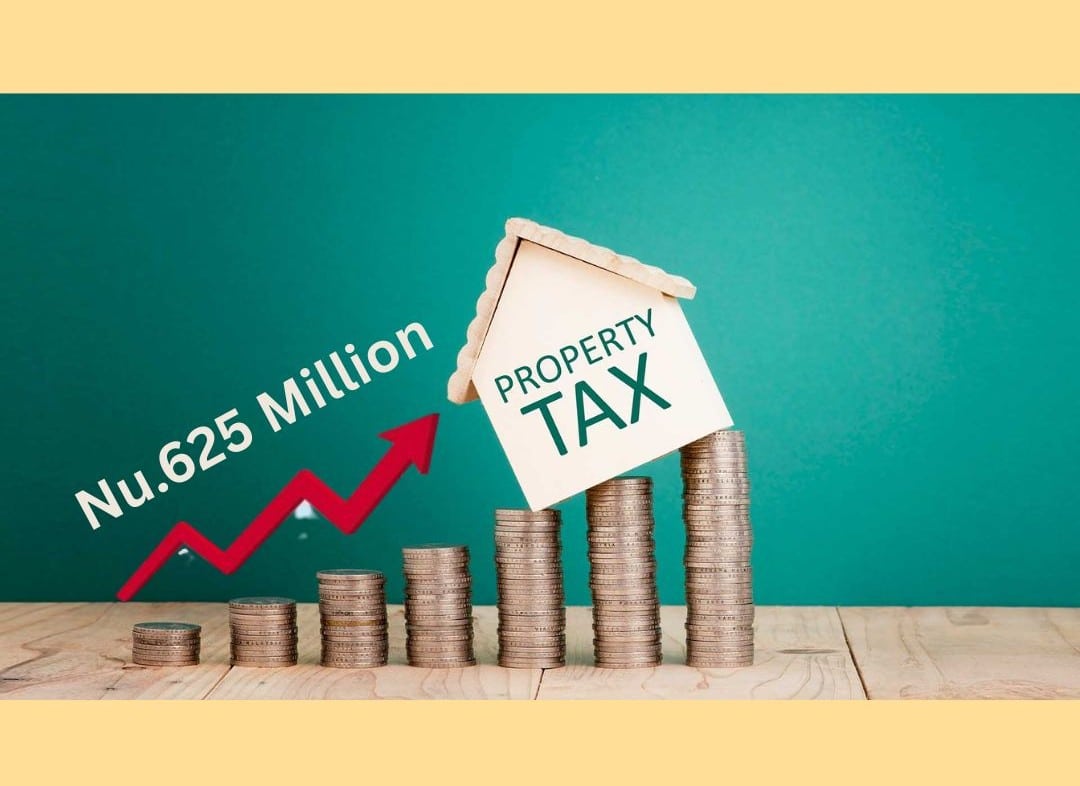
The Royal Government has collected Nu 625 million in property taxes for the income year 2024, according to the Department of Revenue and Customs (DRC). Although the figure marks a slight decrease from last year’s collection of Nu 650 million, officials have attributed the shortfall primarily to outstanding payments from more than 30,000 taxpayers.
As of the latest update, approximately 170,000 of the estimated 190,000 liable taxpayers have fulfilled their obligations, reflecting a compliance rate of 83 percent. A senior DRC official noted that a significant portion of the unpaid taxes includes individuals who have either not declared all of their properties or have yet to complete the filing process.
“About 30,000 property owners, including those who haven’t declared all their holdings, are yet to file their returns,” the official stated, adding that not all defaulters are intentionally avoiding payment. The Ministry, in collaboration with relevant stakeholders, is actively working to encourage timely compliance and facilitate the payment process.
However, the official also clarified that “willful defaulters will be dealt with in accordance with the provisions of Bhutan’s tax laws.”
Challenges in Implementation
The transition to the revised property tax regime, introduced under the Property Tax Act of Bhutan 2022, has presented several implementation challenges. Among the most pressing is the issue of inaccurate or incomplete property records, which has made assessment and collection more complex.
“Some properties were either not properly recorded or had discrepancies, making accurate tax assessments difficult,” the official explained.
Additionally, a lack of awareness about the new tax system and its filing procedures—particularly in rural areas—has hindered broader compliance. Limited access to digital platforms and low levels of digital literacy have made it difficult for some residents to file taxes, especially in remote regions.
Government Response
In response to these challenges, the Ministry of Finance has been spearheading awareness campaigns and inter-agency coordination efforts to improve the flow of information to the public. Moreover, targeted training programs have been conducted for Local Government (LG) officials, equipping them with the knowledge and tools necessary to assist rural communities in understanding and complying with the property tax requirements.
Efforts are also underway to address discrepancies in land records. “We are working closely with the National Land Commission Secretariat (NLCS) to verify and update land records, which will improve the accuracy of future assessments,” the official added.
The Ministry is also actively engaging with non-compliant taxpayers, providing guidance and support to help them navigate the process. This approach reflects an emphasis on constructive engagement, especially considering that the revised tax framework is still relatively new.
About the Property Tax Act 2022
The Property Tax Act of Bhutan 2022 replaced the decades-old Revised Taxation Policy of 1992. The new legislation introduced a standard tax rate of 0.1% on the taxable value of land and buildings, as determined by the Property Assessment and Valuation Authority (PAVA).
The Act also introduced several tax concessions aimed at protecting vulnerable groups and traditional practices. These include:
- A 50% tax reduction on cultivated land
- A 90% concession for wetlands
- A 50% concession for self-occupied traditional homes
- A 70% concession for traditional houses in protected areas
- A 90% concession for properties in highland communities
Shift from Flat-Rate System
The previous tax system relied on a flat-rate structure based on town classifications (Groups A to D), which did not reflect the actual market value of properties. For example, under the old system, commercial land in Thimphu and Phuentsholing was taxed at Nu 217.5 per decimal, while residential land was taxed at Nu 108.75 per decimal.
In contrast, the new system, which uses market-linked PAVA rates, has led to significant increases in tax obligations for many urban property owners. For instance:
- A 24-decimal plot in E4 areas such as Babesa, Simtokha, and Pamtsho, previously taxed at Nu 2,623 annually, now incurs a tax of approximately Nu 12,156—a rise tied directly to its assessed market value.
- A 10-decimal plot along Norzin Lam in the heart of Thimphu (precinct 1A) has seen an even steeper rise—from Nu 1,452 to around Nu 26,540 annually, marking an increase of over 1,500%.
Previously, under the 1992 policy, land taxes were often disconnected from real market values, leading to inequities. For example, tax paid for land in Dramtse (Mongar district) was equivalent to that in prime urban centers like Paro, despite stark differences in valuation and economic activity.
The government believes that the revised framework brings much-needed fairness, transparency, and accountability into the taxation system. Officials remain optimistic that with ongoing efforts to raise awareness, improve systems, and support compliance, the transition to the new property tax regime will contribute significantly to Bhutan’s fiscal sustainability and equitable development.
Nidup Lhamo from Thimphu