

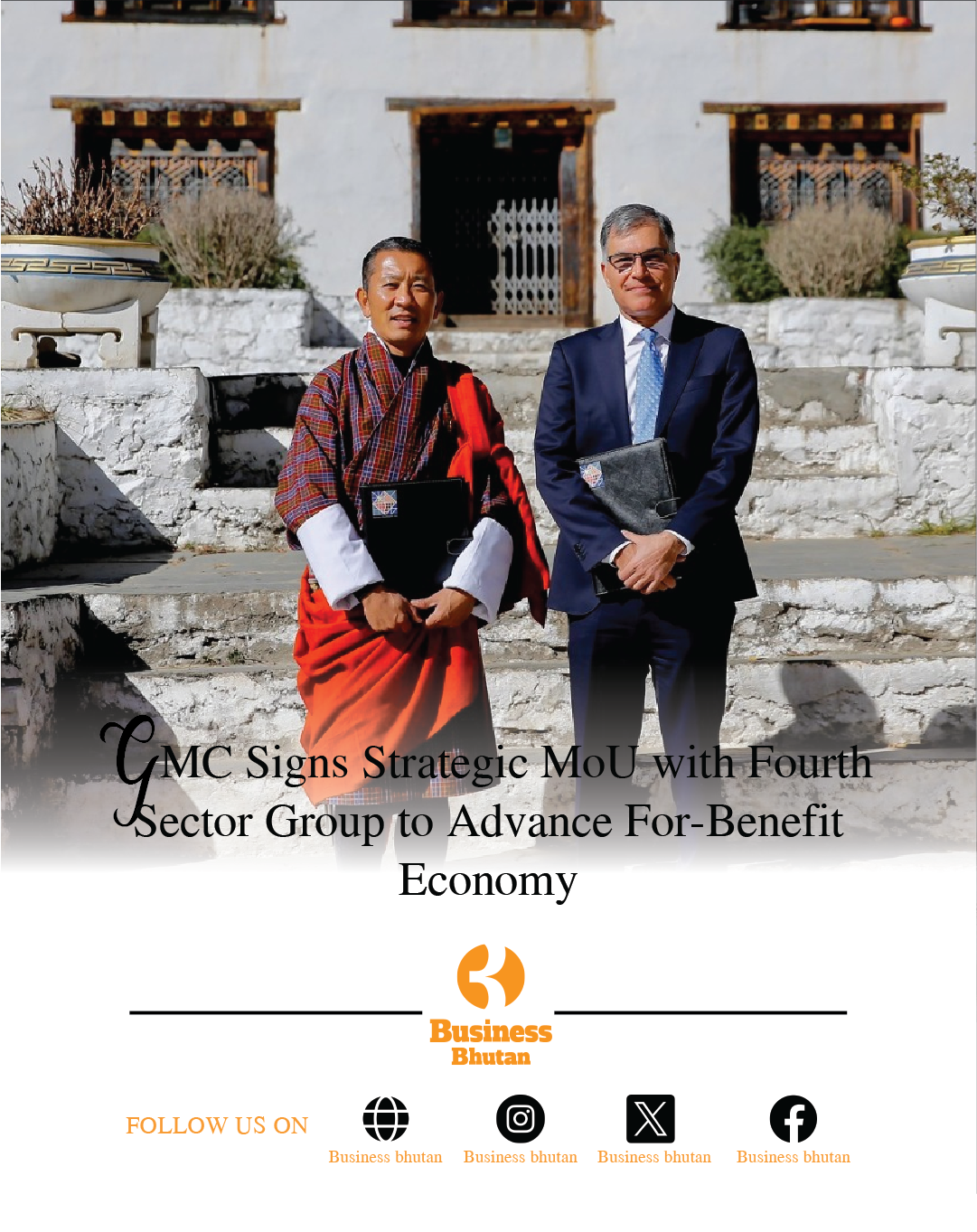
The Gelephu Mindfulness City (GMC) on December 28, 2025, announced the signing of a strategic Memorandum of Understanding (MoU) with The Fourth Sector Group (4SG), a global platform dedicated to advancing economic systems that prioritise human and planetary wellbeing.
The partnership aims to support the development of a ‘for-benefit’ economic ecosystem within the Gelephu Mindfulness City Special Administrative Region (SAR), integrating sustainability, innovation, and the principles of Gross National Happiness (GNH) to position Bhutan as a premier global hub for purpose-driven development.
A “for-benefit economic system” refers to emerging economic models that seek to balance financial profitability with positive social and environmental impacts, as opposed to solely focusing on generating profit for private owners. It is not one of the traditional, formal economic systems (market, command, mixed, or traditional).
The for-benefit approach is part of a “fourth sector” of the economy, distinct from the for-profit, non-profit, and public sectors.
One well-known example of a country whose development philosophy aligns with ‘for-benefit’ principles is Bhutan. The nation is guided by the philosophy of Gross National Happiness (GNH), which balances economic development with spiritual and social well-being, environmental sustainability, and cultural preservation.
The collaboration marks a significant step in translating Bhutan’s development philosophy into a new economic model that balances prosperity with wellbeing.
“This partnership is a direct advancement of His Majesty’s vision for Gelephu Mindfulness City as a new economic gateway for Bhutan—one that harmonises economic growth with cultural preservation and ecological stewardship,” GMC Governor Dasho Dr Lotay Tshering said at the signing ceremony.
He added that the collaboration with 4SG would help GMC create the right enabling conditions for enterprises and investors who are aligned with Bhutan’s long-term development values.
“Our partnership with The Fourth Sector Group will help us shape an ecosystem that attracts for-benefit enterprises, purpose-led innovators, and responsible investors who wish to contribute to mindful and sustainable prosperity,” the Governor said.
For-benefit enterprises form what is increasingly recognised as the fourth sector of the economy, complementing the traditional private, public, and nonprofit sectors. These enterprises are designed to generate financial returns while embedding social and environmental objectives at their core.
Unlike conventional businesses, for-benefit enterprises are structured to deliver positive outcomes for society and the environment, while creating value for all stakeholders. “The fourth sector offers a powerful framework for aligning economic activity with human wellbeing and ecological balance,” an official familiar with the initiative said. “It reflects Bhutan’s longstanding development philosophy in a contemporary economic form.”
Heerad Sabeti, Chief Executive Officer of The Fourth Sector Group, said 4SG was honoured to partner with what he described as one of the world’s most visionary national efforts to redefine development. “Through Gelephu Mindfulness City, Bhutan is pioneering a future in which human wellbeing, ecological sustainability, and mindful innovation reinforce one another,” Sabeti said. “We are honoured to work alongside Bhutanese institutions to support the emergence of a thriving for-benefit economy grounded in the country’s deep cultural and spiritual heritage.”
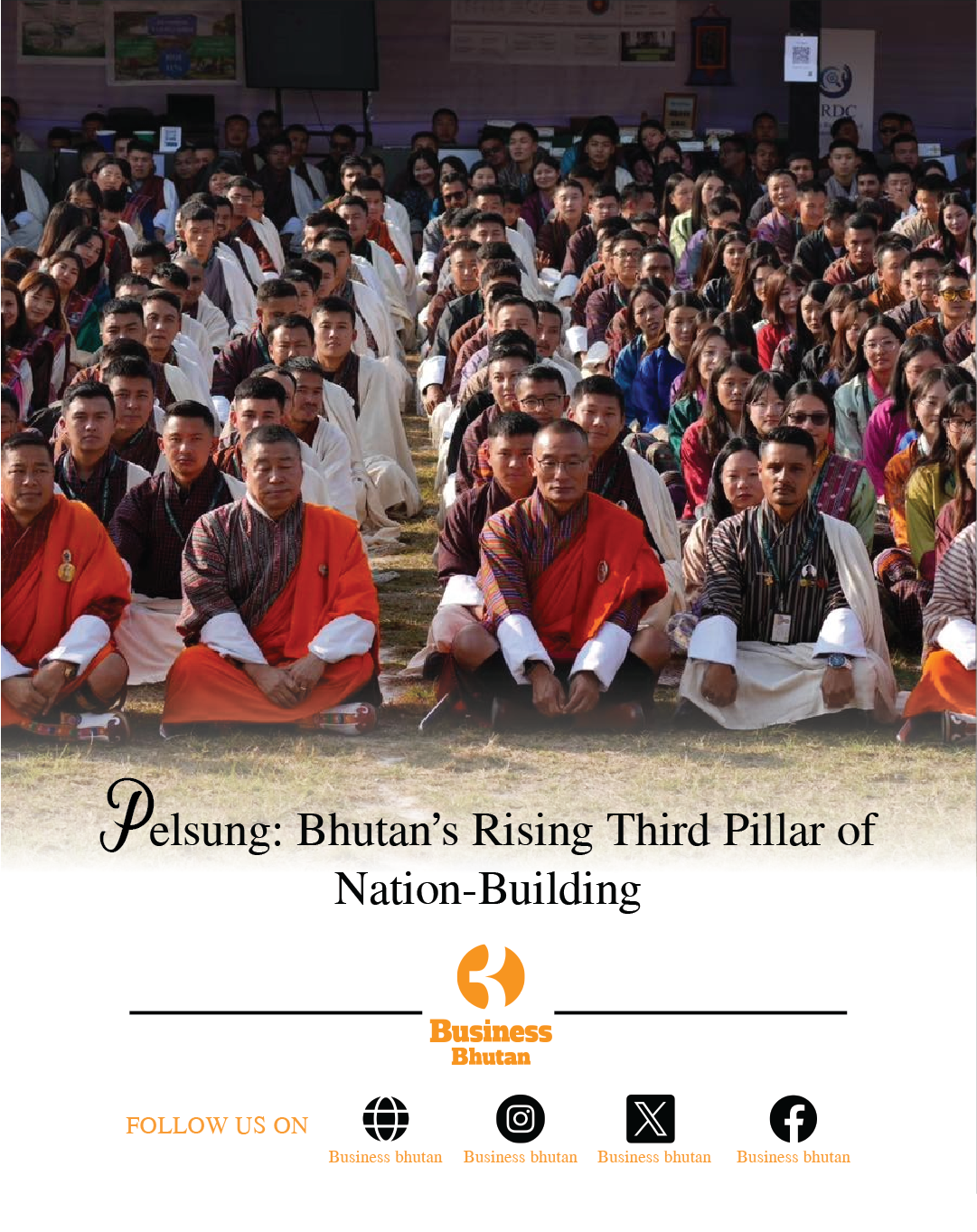
Under the MoU, 4SG will work closely with GMC to provide technical support and strategic guidance in designing GMC’s for-benefit economic ecosystem. This includes support for the Pelsung pathways, which are envisioned as structured routes for innovation, entrepreneurship, and investment aligned with Bhutanese values.
An official from GMC said the Pelsung pathways would help create a coherent innovation ecosystem that brings together the public sector, private enterprises, civil society, and global partners.
“The idea is to ensure that innovation does not occur in isolation, but as part of an integrated system that serves national priorities and community wellbeing,” the official said.
4SG will also contribute expertise toward establishing an Innovation Fund and broader innovation finance mechanisms aimed at supporting mission-driven enterprises and solutions. Officials said Bhutanese entrepreneurs, particularly youth-led and purpose-driven startups, are expected to be key beneficiaries.
“This partnership opens new opportunities for Bhutanese innovators to access finance, mentorship, and global networks without compromising national values,” a GMC official said.
In addition, the collaboration includes capacity-building and leadership development programmes for Bhutanese institutions, focusing on skills in mindful innovation, entrepreneurship, systems thinking, and for-benefit enterprise creation.
“Building local capacity is central to this partnership,” Sabeti said. “Our goal is not to import models, but to co-create solutions that are rooted in Bhutan’s context and led by Bhutanese professionals.”
The MoU also underlines policy advisory support and regulatory innovation within the GMC Special Administrative Region to create an enabling environment for for-benefit enterprises and finance.
Officials said this may include new regulatory approaches that recognise hybrid business models and encourage long-term value creation over short-term profit maximisation.
As part of its commitment, 4SG will establish a representative office in Bhutan, based in GMC, staffed by national hires. The office will serve as a hub for long-term cooperation, coordination of visiting experts, and engagement with global partners.
“This local presence signals a long-term commitment to Bhutan,” a GMC official said. “It ensures continuity, accountability, and meaningful knowledge transfer.”
The signing of the MoU marks a significant milestone in shaping GMC’s emerging economic model and reinforces Bhutan’s commitment to building a global hub for sustainable, inclusive, and for-benefit innovation.
Officials noted that the partnership is designed to evolve over time, with additional programmes and workstreams to be developed through mutual agreement as GMC advances.
“At its core, this partnership is about creating jobs, livelihoods, and opportunities that enhance long-term wellbeing for Bhutanese citizens,” the Governor said. “It is about ensuring that economic progress serves people, communities, and future generations.”
Observers said the collaboration could position Bhutan at the forefront of global discussions on alternative development pathways, demonstrating how economic systems can be redesigned to place wellbeing, sustainability, and cultural integrity at their centre.
Tashi Namgyal
From Thimphu