


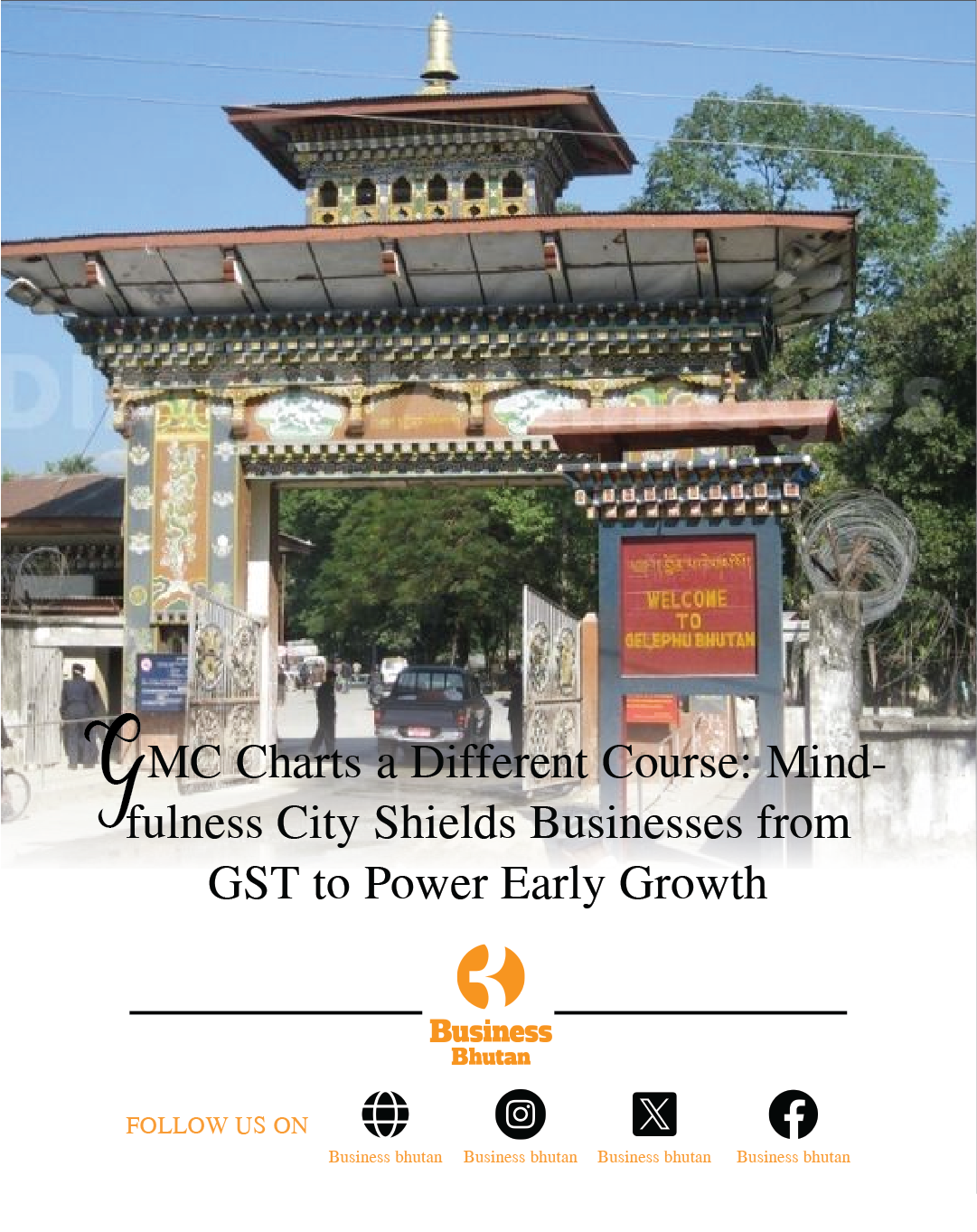
As Bhutan stepped into a new tax era with the nationwide rollout of a 5 percent Goods and Services Tax (GST) from January 1, 2026, Gelephu Mindfulness City (GMC) has taken a bold and strategic decision to chart a different path. In a move aimed squarely at protecting competitiveness and accelerating early-stage growth, GMC will continue with the existing Bhutan Sales Tax (BST) system and will not introduce GST within its jurisdiction.
The decision places GMC in a unique position within Bhutan’s evolving fiscal landscape and underscores the city’s ambition to emerge as a business-friendly, investment-ready urban hub during its formative years. The choice has been made after careful consideration to ensure that companies, businesses, and residents operating within the city are not worse off as the national tax system transitions to GST.
Under the current arrangement, GST will not be charged on sales within GMC, and businesses operating in the city will not be required to register for GST. Goods and services imported from the rest of Bhutan into GMC will be zero-rated, meaning they will not attract GST. Instead, GMC will continue to apply the existing sales tax framework, providing continuity and certainty for investors and entrepreneurs who are in the process of setting up operations.
For a city still under development, the implications are significant.
GMC is envisioned as a flagship project—an urban center built around mindfulness, sustainability, innovation, and global connectivity. However, like all greenfield cities, it faces the critical challenge of attracting early movers: businesses willing to invest before infrastructure is fully built and markets fully mature. By choosing stability over immediate tax reform, GMC is sending a strong signal that it is prioritizing ease of doing business over short-term revenue considerations.
Introducing GST at this early stage could have created additional compliance costs, administrative burdens, and uncertainty for companies that are already navigating the complexities of setting up in a new city. Continuing with BST allows businesses to focus on growth, job creation, and service delivery, rather than grappling with new tax systems during a crucial start-up phase.
“All companies and businesses operating in GMC will not be required to register for GST, and GST must not be charged on sales in GMC,” GMC officials clarified. They added that this approach is designed to ensure fairness and prevent unintended disadvantages for GMC residents and enterprises compared to the rest of the country.
At the same time, the GMC Authority has directed all companies and businesses intending to operate in the city to begin the process of registering within GMC by the first quarter of 2026, or by any other date that may be notified. This is part of establishing a clear regulatory and administrative framework that supports long-term governance while maintaining flexibility during the city’s early growth phase.
The rationale behind the decision is rooted in strategy rather than resistance to reform. GMC officials emphasized that the city is still in its infrastructure development and ecosystem-building phase, where predictability and investor confidence are paramount. Maintaining the existing sales tax regime provides continuity, reduces friction, and allows businesses to plan with greater certainty.
By temporarily disapplying GST, GMC is also enhancing its competitiveness—both regionally and internationally. As Bhutan seeks to position Gelephu as a gateway city that attracts foreign investment, global institutions, and innovative enterprises, tax simplicity and clarity become powerful incentives.
Importantly, the decision is not permanent. GMC will continue to monitor developments and assess the introduction of GST in the future, once the city’s economic base is stronger and administrative systems are fully embedded. Relevant laws will be enacted to formalize the continuation of the sales tax system and to legally disapply GST within GMC for the time being.
To safeguard consumers and businesses, a GMC Taxpayer Service Centre will be established to provide guidance, clarity, and support. The centre will serve as a one-stop platform for addressing queries related to sales tax, GST impacts, compliance requirements, and any suspected cases of unfair price increases or profiteering.
Officials urged businesses and residents to reach out to the Taxpayer Service Centre if they have concerns or require clarification, emphasizing that transparency and fairness are central to GMC’s governance philosophy.
In the broader context of Bhutan’s economic transformation, GMC’s decision stands out as a calculated and investor-centric move. While GST represents a major step toward tax modernization at the national level, GMC’s choice reflects an understanding that one size does not fit all, especially when nurturing a new city designed to anchor Bhutan’s future growth.
Sangay Rabten
From Thimphu











