

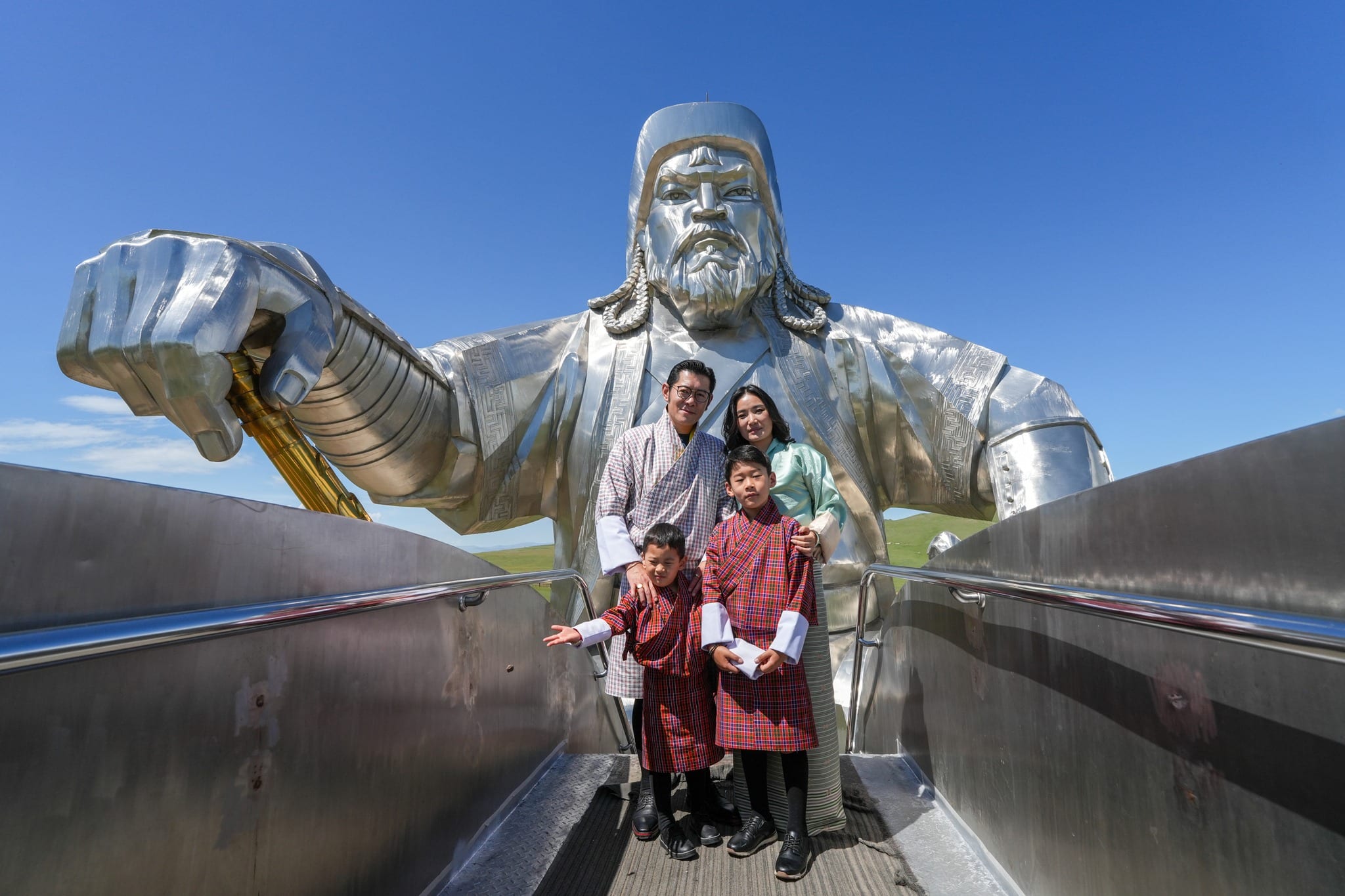
Speaking briefly to state media TV5 Mongolia of Mongolia on July 11, 2024, His Majesty King Jigme Khesar Namgyel Wangchuck spoke about the enduring legacy of the Mongol Empire and its illustrious leader, Genghis Khan. His Majesty hailed Mongolia’s resilience and spirit and expressed pride in being called a friend of Mongolia.
His Majesty highlighted that Genghis Khan’s influence is palpable in every aspect of Mongolian society—its leadership, youth, government, cities, landscapes—all pulsating with a vibrant national identity. His Majesty noted his confidence that Mongolia, with its rich heritage and promising future, will continue to thrive. “So much of Genghis Khan’s legacy is present in the DNA of the people of Mongolia. I look at the leadership, I look at the youth, I look at the government, I look at the city, I look at the landscape, and the very pulse of the nation is very strong. And I believe this country is going to have a magnificent future, and I feel proud to call myself a friend of Mongolia.”
His Majesty also graciously extended his profound gratitude to the President and people of Mongolia for their warm hospitality during the Royal visit. Accompanied by Her Majesty the Gyaltsuen and their three children, His Majesty expressed immense joy at fulfilling a longstanding dream of visiting Mongolia. In a gesture of utmost respect during the celebration of Mongolia’s revered Naadam festival, His Majesty offered ‘Tashi Delek’ to the Mongolian nation. His Majesty explained to TV5 Mongolia that “Tashi Delek” symbolizes “deep respect and admiration.”
“First of all, I want to express our heartfelt gratitude to the President and people of Mongolia for having us here. My wife (Gyaltsuen) and three children are extremely happy to be here; it’s a dream come true,” His Majesty said.
When asked about his proficiency in archery by enthusiastic reporters from the Mongolian state media, His Majesty shared that archery holds a special place as Bhutan’s national sport, much like in Mongolia. Reflecting on cultural parallels, he emphasized that archery is not just a sport but an integral part of Bhutan’s heritage and upbringing. “So very much like here in Mongolia, we respect archery. It’s a part of our culture, our custom. It’s something which we have been taught since we were very young,” His Majesty reiterated. “So it’s quite normal for us.”
Mongolia is a landlocked country located in East Asia, bordered by Russia to the north and China to the south, east, and west. It has a rich history, unique culture, and a fascinating blend of traditions that have evolved over centuries. Mongolia’s history spans back thousands of years, with its earliest known inhabitants being nomadic tribes. The Mongol Empire, founded by Genghis Khan in the early 13th century, became one of the largest contiguous land empires in history, stretching from Eastern Europe to the Sea of Japan.
Mongolia’s culture is deeply influenced by its nomadic heritage and the harsh climate of the steppes. Key aspects of Mongolian culture include nomadic traditions where traditional Mongolian life revolves around nomadic herding of livestock such as horses, sheep, goats, and camels; music and dance, where traditional music includes throat singing (khoomei), morin khuur (horsehead fiddle) music, and long song (urtiin duu). Traditional dances like the tsam dance are also significant. The cuisine is hearty and suited to nomadic life, featuring meat (especially mutton), dairy products like airag (fermented mare’s milk), and staples such as buuz (dumplings) and tsuivan (noodle dishes).
The country also holds high regard for its customs. Hospitality is highly valued in Mongolia, reflecting the importance of community and mutual support in nomadic life. Respect for elders and a hierarchical social structure are important. Offering and receiving items with the right hand or both hands is customary. Naadam is Mongolia’s largest festival, featuring traditional sports such as wrestling, horse racing, and archery.
Mongolia is a parliamentary republic with a President as the head of state and a Prime Minister as the head of government. The political system has evolved since the democratic revolution in 1990, transitioning from a single-party state to a multi-party democracy. Mongolia faces challenges such as economic diversification, sustainable development, and preserving its unique cultural heritage while integrating with the global community. Despite these challenges, Mongolia continues to embrace its rich history and culture, making significant strides in modernization while retaining its distinct identity.
Mongolia’s current President is Ukhnaagiin Khürelsükh, who assumed office on June 25, 2021, while the current Head of Government (Prime Minister) is Enkhtuvshin Ulziisaikhan.
His Majesty’s visit is a testament to the deepening ties between Bhutan and Mongolia, celebrating shared values, traditions, and aspirations for a prosperous future.
By Tashi Namgyal, Thimphu