

The Gelephu Mindfulness City (GMC) will, for the time being, remain outside Bhutan’s Goods and Services Tax (GST) framework, allowing businesses operating within the city to continue under the existing Bhutan Sales Tax system.
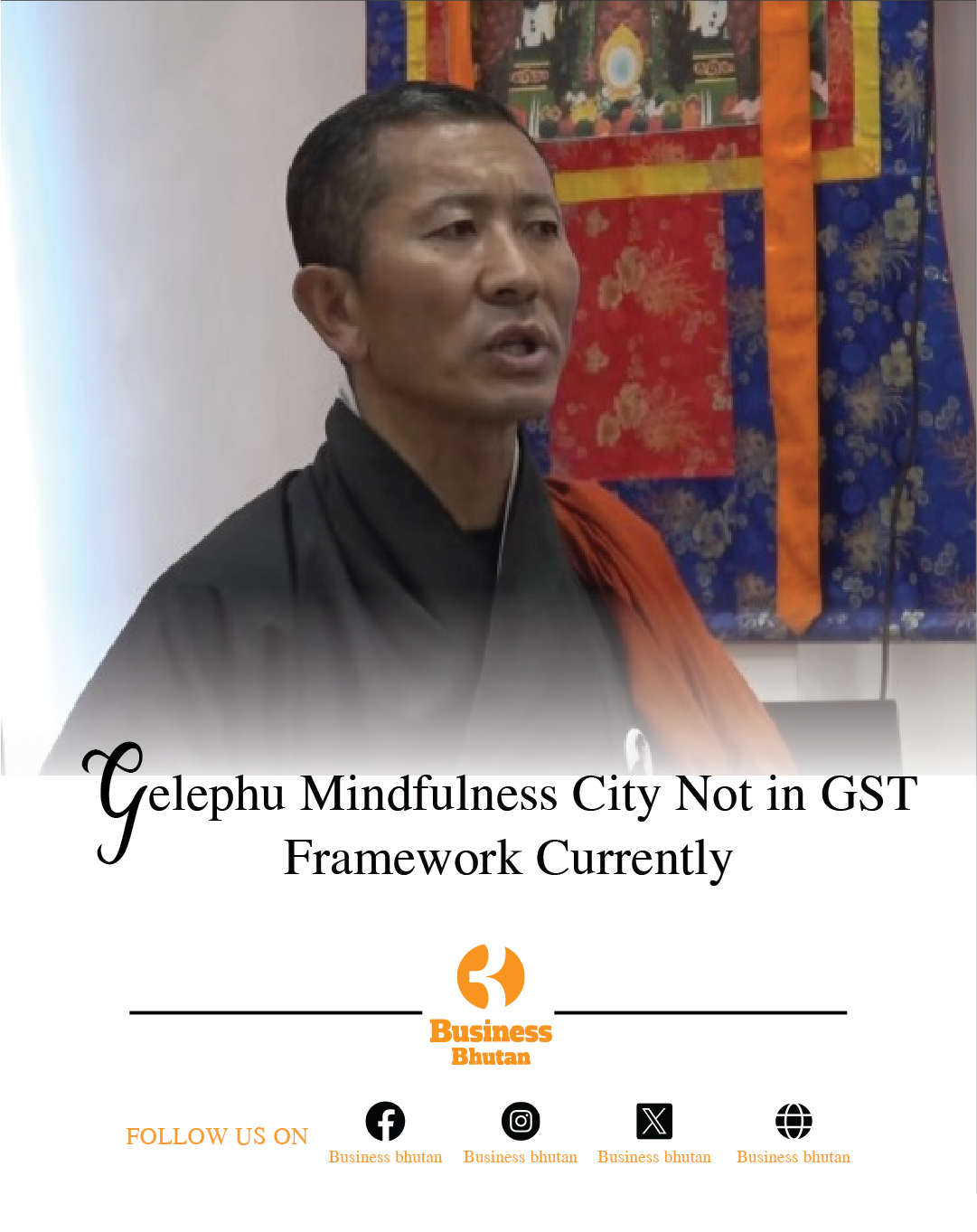
The decision, announced by GMC Governor Dasho Dr Lotay Tshering during a meeting with business representatives in Gelephu, is aimed at supporting businesses and encouraging investment during the city’s early development phase.
The Governor explained that tax laws are closely interlinked with other regulatory and institutional frameworks, many of which are still under development within the GMC. As such, maintaining the current tax structure will provide stability and clarity for businesses while the broader governance systems of the city continue to evolve.
He further emphasized that the approach is intended to create a conducive business environment and ensure a smooth transition as the city gradually establishes its regulatory architecture.
Tax systems, the Governor emphasized, do not operate in isolation. They are deeply intertwined with regulatory institutions, enforcement mechanisms, dispute resolution processes, and compliance infrastructure. In the case of GMC—envisioned as a global hub for mindful urban living, innovation, and sustainable investment—many of these systems are still under development. Introducing GST prematurely, officials believe, could create confusion, compliance burdens, and uncertainty for investors at a time when clarity is most needed.
A financial consultant based in Thimphu added that at its core, the decision reflects a “build first, tax later” philosophy. “GMC is not being treated as a conventional urban expansion but as a special development zone that must compete internationally for capital, talent, and innovation. By keeping businesses under the familiar BST regime, the city offers predictability during its formative years, reducing friction for both domestic entrepreneurs and foreign investors exploring opportunities in the region,” he said.
The Consultant noted that the approach also signals the government’s intent to prioritize investment attraction over immediate revenue collection. In its infancy, GMC’s success hinges on drawing businesses willing to take early risks. A lighter, more familiar tax environment is seen as a crucial incentive, particularly as the city establishes its identity, infrastructure, and regulatory backbone.
For GMC, the issue is not merely about exemptions or thresholds—it is about sequencing reform intelligently. There is a need to avoid a scenario where businesses face overlapping, unclear, or evolving tax obligations while regulatory institutions are still being built. Such uncertainty, could deter precisely the kind of long-term, values-aligned investors that the Mindfulness City seeks to attract.
For now, Gelephu’s exemption underscores a broader policy lesson: transformational projects require tailored frameworks, not one-size-fits-all solutions. The Mindfulness City is being positioned not just as another economic zone, but as a flagship experiment in sustainable, human-centered development. Shielding it from immediate GST obligations is part of creating the breathing space needed for that vision to take root.
In essence, Gelephu’s exclusion from GST is not about avoiding taxation—it is about getting the foundations right before scaling up. And in a project of this magnitude, timing, trust, and clarity may matter more than tax revenue in the short term.
The decision comes amid Bhutan’s nationwide GST rollout, under which most everyday goods and services are now taxed. However, even within the GST framework, exemptions remain for essential items such as rice, salt, cooking oil, sanitary napkins, wheelchairs, and critical services including education, healthcare, and select financial services. Moreover, GST applies only to businesses with an annual turnover exceeding Nu 5 million, and registered entities are required to display their GST certificates prominently.
Sangay Rabten
From Thimphu