

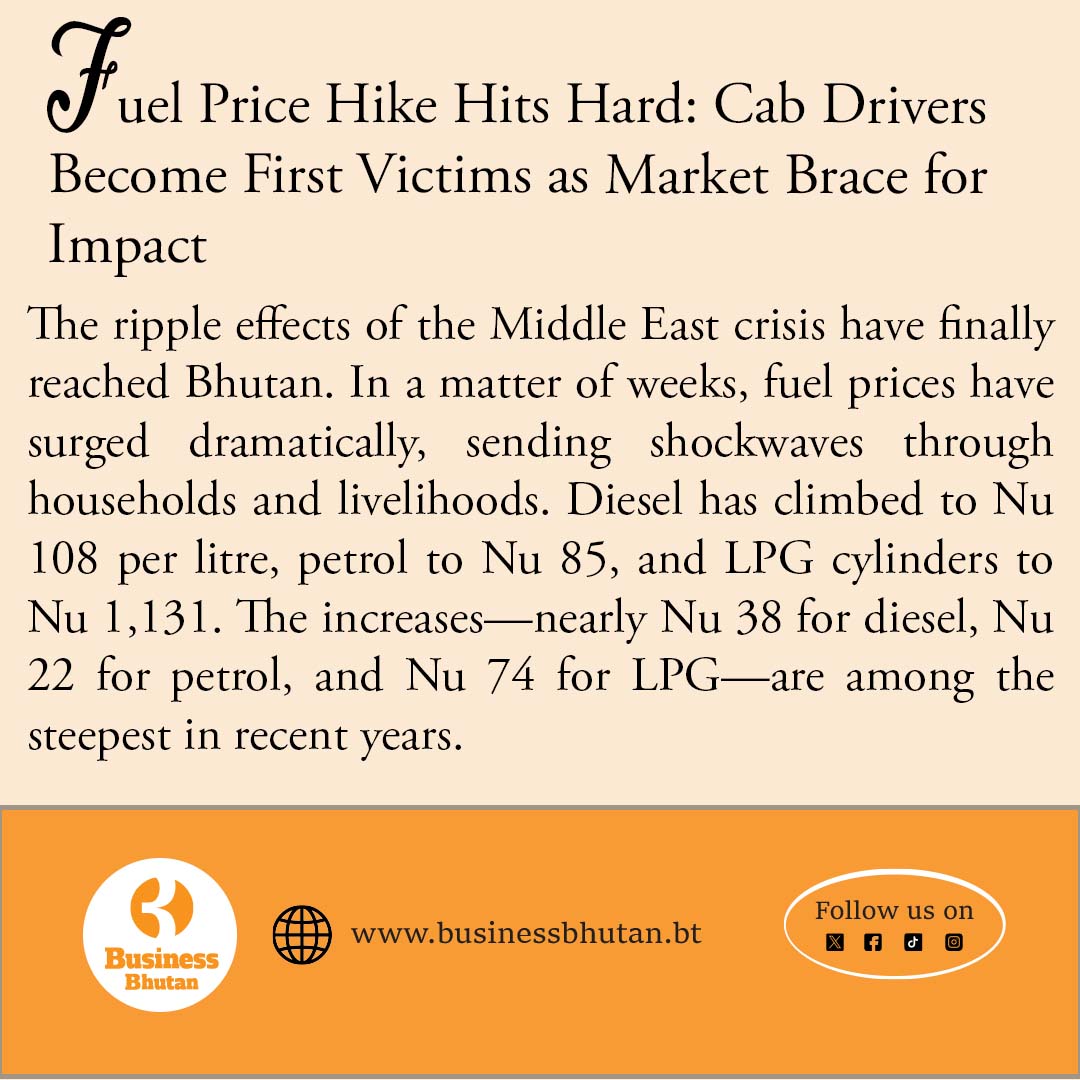
The ripple effects of the Middle East crisis have finally reached Bhutan. In a matter of weeks, fuel prices have surged dramatically, sending shockwaves through households and livelihoods. Diesel has climbed to Nu 108 per litre, petrol to Nu 85, and LPG cylinders to Nu 1,131. The increases—nearly Nu 38 for diesel, Nu 22 for petrol, and Nu 74 for LPG—are among the steepest in recent years. While it has not come up as a major issue, there are apprehensions that it would hit where it hurts most: the pockets of ordinary people. And people in the market are bracing for the impact.
This begins with taxi drivers for whom the impact has been immediate, visible, and deeply personal.
For Kalden Wangchuk, a taxi driver in Thimphu, the numbers no longer add up. “Earlier, I could save around Nu 2,000 to 3,000 a day,” he said. “Now, I can hardly save even Nu 1,000.”
What changed? Fuel. A routine refill has turned into a financial burden. Filling 19 litres of diesel now costs over Nu 2,050—up from about Nu 1,330 just weeks ago. That’s an increase of more than Nu 700 per tank. “And it’s not just fuel,” he added. “Food, rent—everything is going up. If this continues, I don’t know how we will manage.”
Like many drivers, Kalden cannot raise fares to compensate. Rates are regulated, leaving him trapped between rising costs and fixed income. Another driver, who recently shifted from Wangduephodrang to Thimphu, echoed the frustration.
“Earlier, I paid about Nu 800 to fill my tank. Now it’s around Nu 1,600,” he said. “We are earning the same, but spending double.”
For Singye Wangchuk, the change is measured in distance, not money. “Nu 1,000 worth of fuel used to last one and a half days. Now it barely lasts a day,” he said.
In simple terms, what once bought over 14 litres of diesel now fetches just about 9 litres. The road hasn’t changed—but the cost of traveling it has nearly doubled. “If prices stay this high, the government should allow fare adjustments,” he added. “Otherwise, we are just surviving.”
So far, the pain is concentrated among drivers. But economists and vendors warn that this is only the beginning. If fuel prices affect transporters, it is a matter of time before others feel the brutal hit.
At the bustling Changzamtog market, shelves remain stocked and prices appear stable—for now. Rinchen Dorji, owner of Losel Tshokhang, says he has not increased prices yet. “I am still selling from old stock,” he explained. “But if fuel prices keep rising, grocery prices will also go up—maybe Nu 5 to Nu 50 more.”
Other vendors share the same concern. Transport costs are a silent driver of inflation, and once new shipments arrive under higher fuel costs, the increase will inevitably pass on to consumers.
According to the Ministry of Industry, Commerce and Employment, the surge in fuel prices is not driven by domestic decisions but by global forces beyond Bhutan’s control. The ongoing conflict in the Middle East has disrupted oil supply routes, particularly through the Strait of Hormuz—one of the world’s most critical oil transit corridors.
As uncertainty grips global markets, oil prices have skyrocketed. Brent crude has jumped from around USD 70 to over USD 106 per barrel in recent weeks. For Bhutan, the impact is unavoidable. The country imports all its fuel from India, which in turn relies heavily on crude oil shipments passing through these volatile regions. Currency fluctuations have only added to the burden, making fuel even more expensive.
In a public advisory issued on March 19, the Royal Government clarified that the price hike is not due to new taxes or policy changes. Instead, Bhutan follows a market-linked pricing system based on actual import costs.
While this ensures transparency, it also means that global shocks are quickly felt at home. The government has acknowledged the strain on households, drivers, and businesses, and says it is exploring measures to ease the burden while ensuring a stable fuel supply.
But for those on the ground, relief cannot come soon enough. What began as a distant geopolitical conflict is now reshaping daily life in Bhutan.
Taxi drivers are already cutting back, stretching every litre, and worrying about tomorrow. Vendors are bracing for price increases. Households are watching expenses climb. The full impact has yet to unfold—but the direction is clear.
If fuel prices remain high, the effects will spread—from transport to food, from markets to homes.
“For now, the crisis is being felt most sharply behind the wheel of a taxi. But soon, it may be felt at every dining table. And at that point, the question for many Bhutanese, will no longer be whether the crisis will affect them—but how much more they can absorb,” the economic expert said.
Nidup Lhamo
From Thimphu