

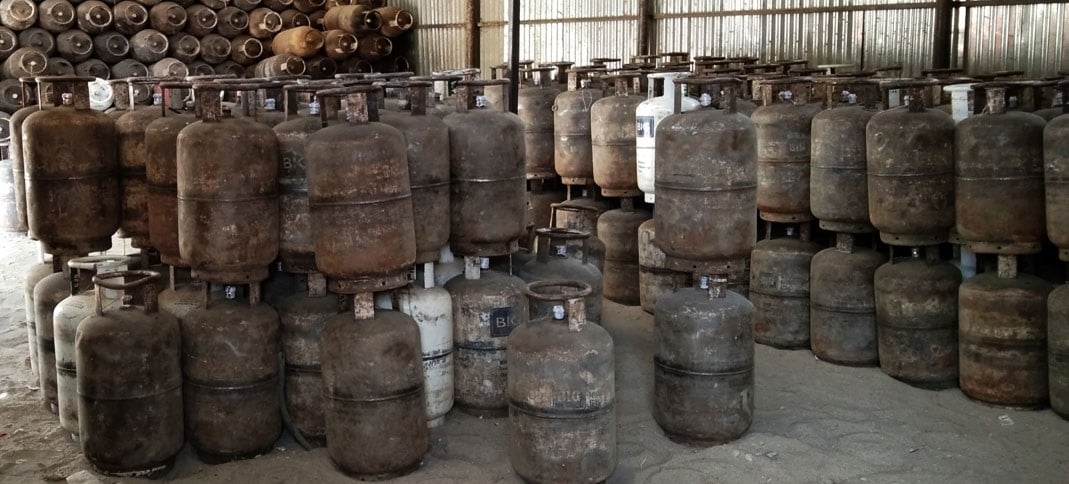
However, officials said institutional mechanisms remain in place to help ensure uninterrupted supplies
Trade officials have confirmed that Bhutan has already experienced increases in Liquefied Petroleum Gas (LPG) procurement costs following recent disruptions in global energy markets, highlighting the country’s vulnerability as it remains entirely dependent on imports from India for its LPG requirements.
Bhutan imports 100 percent of its LPG supply from India, meaning any adjustment in Indian LPG prices is transmitted directly and almost immediately to the Bhutanese market.
“Since Bhutan imports its entire LPG requirement from India, any revision in LPG pricing in India has a direct impact on the Bhutanese market,” officials from Department of Trade (DoT), stated.
Following the latest LPG price revision in India, Bhutan adjusted domestic LPG prices effective June 1, 2026, with a further revision to subsidized domestic LPG taking effect on June 8. As a result, the subsidized 14.2-kilogram LPG cylinder increased by Nu 36 per cylinder.
Data provided by the DoT shows a sharp increase in LPG procurement costs over recent months. On April 1, 2026, the import price of a subsidized 14.2 kg LPG cylinder stood at Nu 1,130, while non-subsidized cylinders were priced at Nu 1,506 and commercial cylinders at Nu 2,685. By May 1, the price of non-subsidized cylinders surged dramatically to Nu 2,149, while commercial cylinders rose to Nu 3,685.
The upward trend continued in June, with non-subsidized cylinders reaching Nu 2,205 and commercial cylinders climbing to Nu 3,738.
Authorities attribute the increase to developments in international energy markets, particularly disruptions linked to the Strait of Hormuz, one of the world’s most critical energy shipping routes.
India, which supplies all LPG consumed in Bhutan, imports a substantial share of its LPG requirements from overseas markets. Any disruption affecting India’s supply chains or procurement costs ultimately affects Bhutan’s domestic market. Officials explained that Bhutan’s LPG pricing mechanism is closely tied to supplier invoices received from India.
The DoT receives revised invoices from Indian suppliers on the first day of each month and, in some cases, twice monthly when prices change significantly.
“Any price revision communicated by suppliers is generally reflected in the Bhutanese market within 24 hours of receipt of the revised invoice,” officials said.
This means Bhutan’s LPG market responds rapidly to international price fluctuations, offering little buffer against external shocks.
Bhutan’s reliance on India for LPG remains absolute. In 2025, the country imported 7,766 metric tonnes of subsidized LPG, 1,168 metric tonnes of non-subsidized LPG, and 611 metric tonnes of commercial LPG.
While Bhutan benefits from India’s extensive petroleum supply network and long-standing bilateral arrangements, experts note that complete dependence also exposes the country to external risks beyond its control.
However, officials said institutional mechanisms remain in place to help ensure uninterrupted supplies. A Memorandum of Understanding (MoU) on the General Supply of Petroleum, Oil and Lubricants between Bhutan and India continues to serve as an important framework supporting energy security and supply continuity.
Bhutan is currently well-positioned to withstand short-term supply disruptions. In addition to inventories with authorized LPG distributors, the government maintains strategic LPG reserves. Under normal consumption conditions, current stock levels would be sufficient to manage temporary supply interruptions. However, reserve adequacy during an actual crisis would depend on the duration of disruptions, consumer behavior and the effectiveness of emergency supply management measures.
“Current reserves provide an important buffer against temporary disruptions,” officials noted.
At the same time, authorities acknowledged that prolonged geopolitical instability could place increasing pressure on supply chains and procurement costs.
One positive development for Bhutan comes from India’s efforts to diversify its LPG import sources. In response to disruptions in the Middle East, India has expanded imports from countries including the United States, Canada and Algeria. Such diversification measures could indirectly improve supply stability for Bhutan as well.
“Any measures undertaken by India to diversify and strengthen its supply sources would contribute to stabilizing LPG availability and pricing for Bhutan,” officials said.
Nevertheless, authorities stressed that final pricing outcomes would still depend on prevailing international market conditions and supplier pricing mechanisms.
While the DoT did not provide assessments on inflation, fiscal impacts or household expenditure, economists say sustained increases in LPG prices could have broader consequences for Bhutan’s economy.
Cooking gas remains a critical household fuel, particularly in urban areas where dependence on LPG is high. Rising LPG prices could increase living costs for households and operating costs for restaurants, hotels and food service businesses. Higher fuel costs may also contribute indirectly to inflation by raising expenses across supply chains and service sectors.
Several questions regarding inflationary impacts, fiscal implications, subsidy policies and macroeconomic consequences have been referred by the DoT to the Ministry of Finance (MoF) and the National Statistics Bureau (NSB) for further assessment.
The recent volatility in global LPG markets has also reignited discussions about Bhutan’s long-term energy security strategy.
Although Bhutan remains a major exporter of hydropower, the country continues to rely heavily on imported petroleum products, including LPG, diesel and petrol.
Trade officials said the current situation underscores the importance of reducing dependence on imported fossil fuels where feasible and promoting more sustainable domestic energy alternatives.
“The current volatility in global energy markets highlights the importance of diversifying energy sources and strengthening energy security and resilience against external supply shocks,” trade officials stated.
Tashi Namgyal, Thimphu