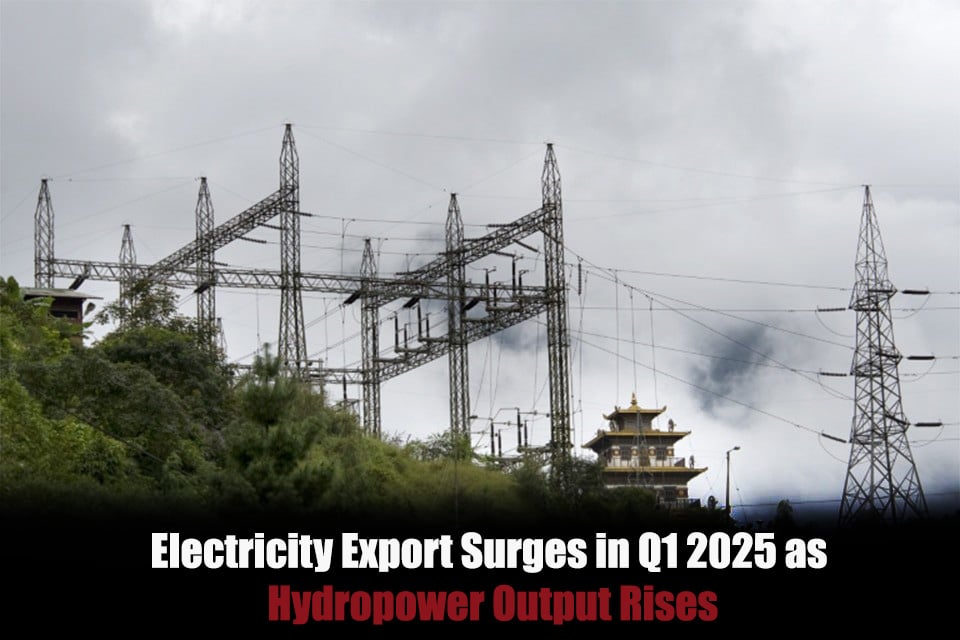
According to the Royal Monetary Authority’s (RMA) latest Monthly Statistical Bulletin, Bhutan’s electricity exports generated substantial revenue during the first quarter of 2025, marking a notable year-on-year increase.
In the first three months of 2025 alone, Bhutan exported electricity worth Nu 402.3 million, up by approximately Nu 204.2 million compared to the same period last year. Monthly figures show that Nu 114.3 million worth of electricity was exported in January, followed by Nu 97.8 million in February, and Nu 190.1 million in March.
In contrast, export earnings during the same months in 2024 were significantly lower—Nu 60.5 million in January, Nu 71.1 million in February, and Nu 66.6 million in March. The data signals a sharp increase in electricity exports, reflecting growing demand in the regional market and Bhutan’s strengthened capacity to supply surplus power.
The RMA report attributes this upward trend to Bhutan’s expanding hydropower generation, particularly during the dry season, and the regional market’s continued appetite for clean energy. The export boost is a promising sign for the country’s revenue stream, especially as it aligns with efforts to leverage hydropower as a key economic driver.
Domestic electricity sales: modest but growing
While export figures have surged, domestic electricity sales during the same period showed relatively modest but steady performance. In early 2025, domestic sales were Nu 667.4 million in January, Nu 481.9 million in February, and Nu 615.5 million in March.
Compared to the same period in 2024, these numbers reflect a slight increase. In 2024, domestic sales stood at Nu 564.2 million in January, Nu 517.9 million in February, and Nu 715.4 million in March. The variation, though marginal, suggests a gradual rise in domestic electricity consumption, aligning with the country’s economic growth and rural electrification efforts.
Electricity imports plummet in 2025
A major highlight of the report is the significant decline in electricity imports this year. In January 2025, Bhutan imported only 194 million units of electricity, and notably, no electricity was imported in February or March.
This marks a sharp drop from 2024, when the country imported 337 million units in January, 352 million units in February, and 307 million units in March, collectively valued at Nu 996 million. The reduction in imports is seen as a positive indicator of improved water resource management, enhanced domestic generation capacity, and effective energy planning.
Hydropower production rises
Bhutan’s total hydropower generation in the first quarter of 2025 reached new highs, with cumulative production of 371.8 million units in January, 288.8 million units in February, and 351.6 million units in March. This reflects a slight increase compared to the same months in 2024, which recorded 313.2 million, 276.5 million, and 359.6 million units respectively.
March 2025 again registered the highest monthly output, showing a 62.8 million unit increase from February and a 40 million unit increase from January. This performance underscores improved water availability and operational efficiency. The seasonal trend also remains consistent, with higher generation in spring as water flow improves following the winter months.
Power contribution by major plants
Hydropower generation during the first quarter of 2025 was driven by six major plants: Basochhu (BHP), Chhukha (CHP), Dagachhu (DHPC), Kurichhu (KHP), Tala (THP), and Mangdechhu (MHP). Collectively, they produced around 1,012.2 million units of electricity.
Among them, the Tala Hydropower Plant (THP) consistently led generation. In January 2025, THP alone generated 142.7 million units, compared to 125.2 million units in January 2024. The steady output from these plants has been pivotal in strengthening both domestic supply and export potential.
Hydropower ambitions: A revised vision
Bhutan had previously set an ambitious target to generate 10,000 MW of hydropower by 2020—a goal that was not achieved. The government has since recalibrated its plans, focusing on 7,600 MW through 10 identified projects.
According to the 2023–24 National Budget Report, these include:
- Kholongchhu Hydroelectric Project (600 MW) – currently stalled
- Kuri-Gongri Hydroelectric Project (2,640 MW)
- Dorjilung Hydropower Project (1,125 MW)
- Nyera Amari Hydropower Project (404 MW)
- Bunakha Reservoir Project (180 MW)
- Integrated Gongri Reservoir/Jerichhu Pumped Storage Project (2,500 MW)
- Five small hydropower projects contributing 181 MW
These projects, once operational, are expected to significantly bolster Bhutan’s generation capacity and further cement its role as a regional powerhouse for clean energy.
Sherab Dorji from Thimphu