

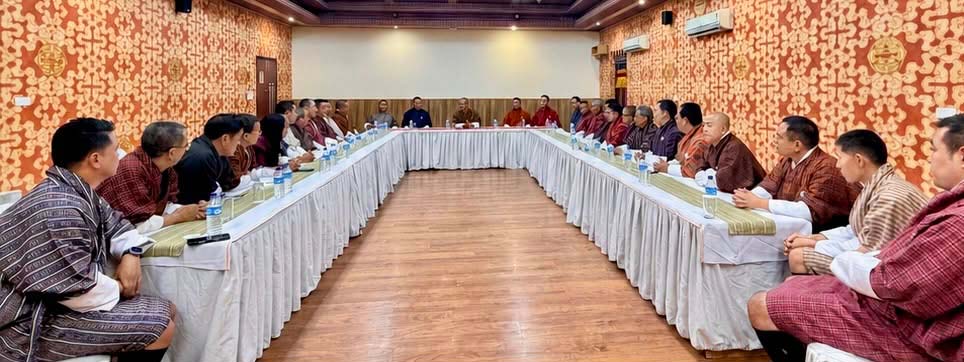
History was made in Bhutan’s democratic journey on 19 August 2026 when, in a rare and unexpected turn, the Opposition’s nominee for Speaker, Bhutan Tendrel Party’s (BTP) Tempa Dorji, defeated the ruling People’s Democratic Party’s (PDP) nominee, Health Minister Tandin Wangchuk, by a single vote to become Speaker-elect.
The outcome of the National Assembly’s extraordinary sitting was remarkable not only because an Opposition candidate captured one of the most important offices in Parliament, but because Tempa Dorji needed, and secured, the support of eight PDP members to overturn the ruling party’s numerical advantage.
The vote has therefore opened an entirely new chapter in Bhutanese parliamentary politics. The Speakership, traditionally expected to remain within the governing party when it commands a majority, has instead gone to the Opposition—an outcome rare in parliamentary democracies and unprecedented in Bhutan’s young democratic history.
Several explanations for this extraordinary outcome has been offered on social media and individual conversations. Business Bhutan looks at few of those.
What the PDP Party Says
The outcome came out as eight PDP members voted for Tempa Dorji. While some has called it as the exposition of differences amongst the PDP, others have heralded as democracy in action, where party members voted in the interest of the House and not along party lines.
“The result was unexpected and a serious setback, given our clear majority,” the PDP office has said, while acknowledging that eight PDP members did not vote in accordance with the party’s collective decision. As the election was conducted through a secret ballot, the party said it could not determine who voted against its decision or why they did so.
“Since it was a secret ballot, we cannot know their reasons and will not speculate,” the party office said.
While there is public speculation that internal friction or dissatisfaction among ruling party MPs could have contributed to the outcome, the PDP, however, has stopped short of describing the development as evidence of a wider division within the party.
The party acknowledged that the collective decision was not upheld by all its members and said the reasons behind the divergence would need to be discussed internally.
“Whether this reflects misunderstanding or dissatisfaction will be discussed internally, but it is premature to call it a wider division within the Party,” the party office said.
However, the party said it respects the outcome, congratulates the newly elected Speaker and will work with him constructively.
BTP’s Candidate
Did the selection of Tempa Dorji as the BTP’s candidate have anything to do with swinging the moods of eight PDP members to the BTP’s side?
“A look at social media, where I have not seen anything negative written about Tempa indicates that it did,” a former National Council (NC) member, who calls Tempa Dorji a “highly respected person, likable, humble and with integrity as one of his forte,” says. According to the former NC member, “BTP chose a candidate who could cross party lines.”
“The opposition did not simply nominate its party leader or its most prominent political figure or the only female member. It chose Tempa Dorji, a candidate with professional experience, parliamentary experience and a commitment to public service,” he added.
Underlining that a Speaker is different from a minister or party leader, he said that in the choice of a person who will preside over the House, regulate its proceedings and protect the dignity and functioning of Parliament, Tempa Dorji would have been seen as someone with an edge. “If the election was for a cabinet berth, he could have lost.”
The BTP leadership also deserves credit
None of this would have happened without the political calculation of BTP President and Opposition Leader (OL) Dasho Pema Chewang.
Aspiring politician Tandin Wangchuck, who says he “saw something of the like happening,” argues that the victory was not Tempa Dorji’s alone. “It was a victory for the OL, who brought forward a nominee at the penultimate moment. It was a political calculation by the BTP leadership, for the party and for democracy,” he says.
By entering the race with a nominee, Tandin argues, the BTP transformed what could have been a foregone conclusion into a genuine election. “The election became more than a formality,” he says.
He believes the one-vote margin also tells an important story. “It would be naive to think that the OL and his party simply went home that night. They would have made calls, engaged with MPs and forced every member to make an individual choice. That was politically significant. And the one-vote victory shows that the calculation was not misplaced.”
More importantly, Tandin says the BTP leadership understood something fundamental about the Speakership: unlike most political contests in Parliament, it is a position where the interests of the Government and Opposition do not necessarily have to fall along the usual government-versus-opposition divide.
That understanding, he says, was at the heart of the BTP’s decision to contest the Speaker’s election—and ultimately turned a seemingly predictable outcome into one of the most consequential votes of the parliamentary session.
Did PDP miscalculate?
The PDP’s approach throughout the process also deserves scrutiny, from the choice of its nominee to the possibility that the party could have done more to prevent the BTP from entering the race.
A former media professional, now based in Australia, believes the PDP may not have done enough to persuade the BTP against fielding its own candidate, while also failing to sufficiently secure the support of its own members.
“It is possible that the risk factors were not fully considered,” he said. “We have seen the party win by just one or two votes on important bills in Parliament. Those should have been indications that MPs do not always vote strictly along party lines.”
He believes the choice of nominee may also have influenced the outcome. “A different nominee from the PDP could have mattered,” he said.
Lyonpo Tandin Wangchuk is a senior and experienced political leader. However, the BTP has largely encountered him in his capacity as a minister, including on issues where the two parties have taken opposing positions.
“That may have made the BTP uncomfortable with having him as Speaker and encouraged them to put forward their own candidate,” he said.
A vote for principles
“The Speaker’s office may have mattered more than party loyalty. For some MPs, therefore, the question may not have been: Who is my party’s candidate? It may have been, who I believe can preside over the House fairly,” Sonam Dorji, an entrepreneur and aspiring politician based in Thimphu, says. According to Sonam, “the victory was for the House.”
Sangay Rabten and Tashi Namgyal, Thimphu