

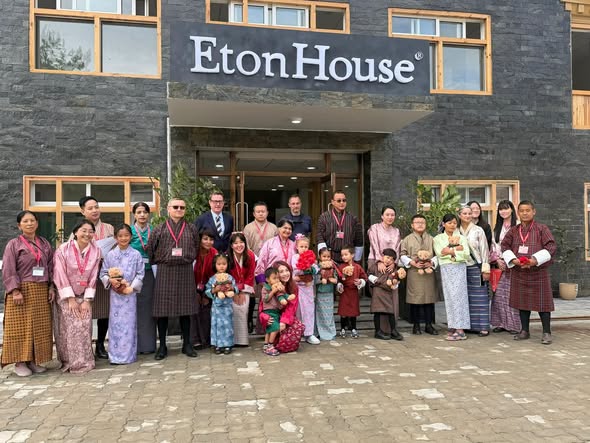
EtonHouse Bhutan International School has begun operations in Thimphu with nine students, marking the opening of Bhutan’s first international K–12 school and introducing a new option for families seeking internationally recognised education without sending their children abroad.
Classes officially started on August 31 at the former Kelki School premises, with the first cohort comprising students from Kindergarten to Class VI.
EtonHouse Singapore and Bhutan CEO Evelyn Tay said enrolment is expected to increase in October, with some families having already registered their children for the next academic year. The school plans to gradually expand its intake and introduce higher grades as its campus and academic programmes develop.
Founding Principal Michael Leachy said the school’s secondary programme would follow the Cambridge pathway, with the Cambridge curriculum planned from Year Seven. Students will eventually progress towards IGCSE examinations at the end of Year 11, followed by pre-university A Levels.
The school has started with seven teachers, including three expatriate teachers and four Bhutanese teachers. The expatriate teachers, who come from EtonHouse Singapore, have previous teaching experience within the EtonHouse group. In addition to teaching, they will support the professional development of Bhutanese educators and share their experience of working within the group’s educational approach.
The Bhutanese teaching team includes a teacher who previously taught in the United States and now teaches Dzongkha, along with three associate teachers supporting the main homeroom teachers.
Leachy said the Bhutanese associate teachers bring experience from Bhutan’s education system and have already undergone professional development in Singapore. Before the school opened, Bhutanese teachers spent time at EtonHouse schools in Singapore, where they were introduced to the group’s pedagogy, international education practices and curriculum approaches. Professional development, he said, will continue as the school expands.
For younger students, the school is introducing an inquiry-based early-years approach influenced by the Reggio Emilia philosophy. At the primary level, it plans to use the International Primary Curriculum alongside Singapore Mathematics.
Executive Principal and Head of Pedagogy Atima Joshi said the school was established to provide another option for families seeking an international education pathway while keeping their children in Bhutan.
She said some families looking for international education had previously faced limited choices domestically and had therefore considered sending their children overseas. “EtonHouse provides another option for these families by allowing children to pursue an international education while remaining close to their parents, extended families, culture, language and community,” she reiterated.
The school has introduced separate fee structures for Bhutanese and expatriate families. School officials acknowledged that EtonHouse is a fee-paying international school and said offering a globally recognised education requires a financially sustainable operating model.
However, the school said its contribution to Bhutan’s education sector would extend beyond its enrolled students. It plans to invest in teacher development, scholarships and access programmes, community activities and educational initiatives. It also intends to organise community events and educational conferences and participate in selected initiatives focusing on wellbeing, STEAM, artificial intelligence and inquiry-based learning.
EtonHouse also plans to develop a local employment and procurement ecosystem by engaging Bhutanese teachers, professionals, businesses and service providers. The school said Bhutanese businesses and service providers have already been involved in establishing the school, while further opportunities are expected as operations expand.
Its approach will also seek to bring EtonHouse’s inquiry-based pedagogy and international curriculum pathways into dialogue with Bhutanese values, educational philosophy, cultural heritage and emphasis on wellbeing. School officials said the aim is not simply to import an international curriculum but to build an educational environment that incorporates Bhutanese context and expertise.
Although classes have begun, construction and renovation of the campus are still underway. According to the Education Ministry, the first phase of the school’s development remains on track for its contractual completion date in September 2026. EtonHouse said phase-one renovation work is scheduled for completion on September 9, after which the second phase will begin.
The second phase is expected to take longer as additional learning spaces are developed around the school’s educational approach. Classrooms and other facilities are being designed to support inquiry, collaboration and student learning.
A specially designed dragon-themed playground is expected to arrive in October. The school said the design draws inspiration from Bhutan’s identity as the Land of the Thunder Dragon and Singapore’s iconic dragon playground.
The establishment of EtonHouse Bhutan International School follows a partnership between EtonHouse and the Royal Government of Bhutan to establish the country’s first international K–12 school.
The partnership is intended to broaden educational choices for Bhutanese families, particularly those who might otherwise consider sending their children overseas. It also provides international families living in Bhutan with an international education pathway without requiring their children to leave the country.
As enrolment grows, EtonHouse plans to progressively introduce higher grades, expand its teaching team and continue investing in the professional development of Bhutanese educators. The school said its long-term contribution will ultimately be measured not only by student enrolment, but also by its engagement with Bhutan’s wider education ecosystem.
Nidup Lhamo, Thimphu