

In a landmark decision, the Royal Government of Bhutan (RGoB) has announced a sweeping reduction in vehicle taxes, following the complete removal of the Green Tax previously imposed on motor vehicles. This bold initiative aims to make personal transportation more affordable for citizens while simultaneously stimulating economic activity across the country.
The revised taxation structure is expected to significantly lower the cost of vehicles across various categories, offering immediate financial relief to prospective buyers. By eliminating the Green Tax—a levy initially introduced to encourage eco-friendly transportation—the government has paved the way for a new era of increased vehicle accessibility.
One of the most striking aspects of this reform is the differentiated tax reduction based on engine capacity and fuel type. Petrol-powered vehicles, in particular, stand to benefit the most. For instance, cars with engine capacities exceeding 1200 cc but not exceeding 1500 cc will see the highest tax cut of 21%, marking a substantial drop in purchase costs. Popular models in this segment include the Honda WR-V and Hyundai Grand i10, vehicles highly favored by Bhutanese consumers.
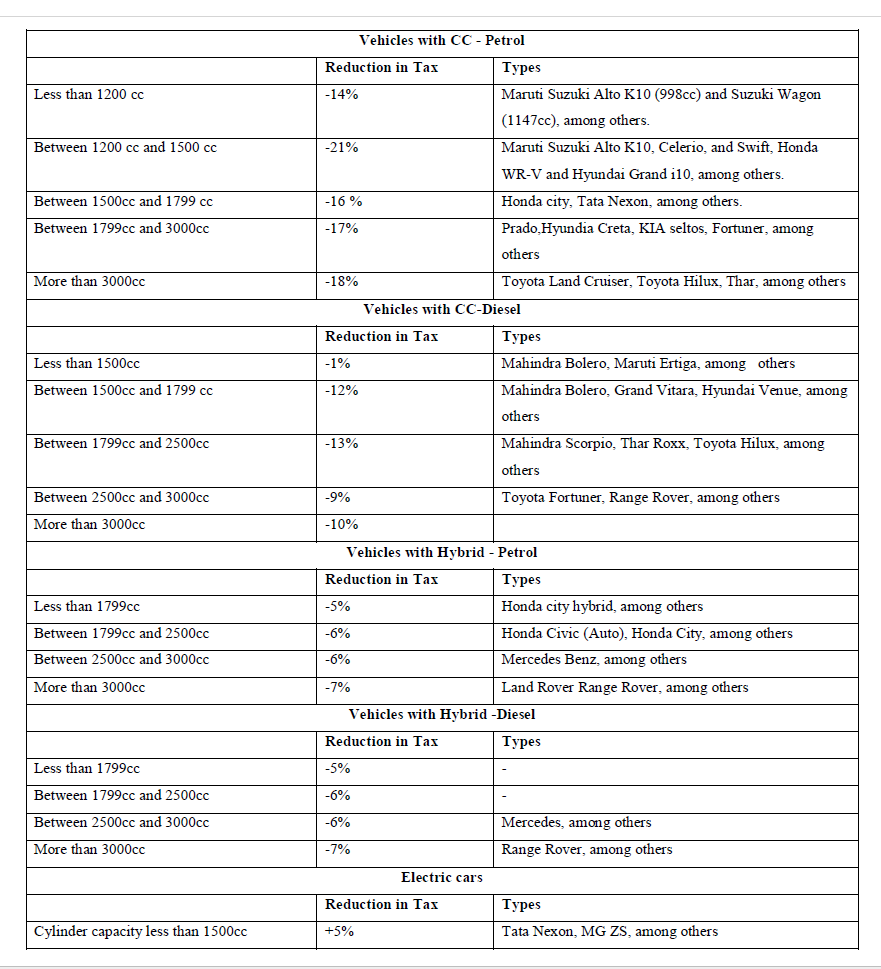
Tax Reductions Across Vehicle Segments (Refer page 10 for full information)
Small Petrol Cars (<1200 cc)
Models such as the Maruti Suzuki Alto K10 (998 cc) and Suzuki WagonR (1147 cc) will see a 14% tax reduction, making compact, fuel-efficient cars more accessible to the general public and promoting urban mobility.
Mid-Range Petrol Vehicles (1200–1500 cc)
This category, including Maruti Celerio, Swift, Honda WR-V, and Hyundai Grand i10, receives the highest reduction of 21%, encouraging wider ownership of mid-sized vehicles.
Upper Mid-Range Petrol Vehicles (1500–1799 cc)
Cars like the Honda City and Tata Nexon benefit from a 16% reduction, supporting both personal and commercial vehicle ownership.
Large Petrol Vehicles (1800–3000 cc)
SUVs and sedans such as the Hyundai Creta, KIA Seltos, Toyota Fortuner, and Toyota Prado will now be subject to a 17% tax reduction.
Premium Petrol Vehicles (>3000 cc)
Top-tier models like the Toyota Land Cruiser, Hilux, and Mahindra Thar are now more attainable with an 18% reduction, making premium vehicles more accessible to Bhutanese consumers.
Diesel Segment
While tax reductions are more modest for diesel vehicles, the impact is still noteworthy:
- <1500 cc: 1% reduction for vehicles like the Mahindra Bolero and Maruti Ertiga
- 1500–1799 cc: 12% reduction, covering models like the Grand Vitara and Hyundai Venue
- 1800–2500 cc: 13% reduction on vehicles such as the Mahindra Scorpio, Thar Roxx, and Toyota Hilux
- 2500–3000 cc: 9% reduction, including Toyota Fortuner and Range Rover
- >3000 cc: 10% reduction, easing access to high-capacity diesel vehicles
Hybrid Vehicles
Hybrid vehicles have also been incentivized under the new regime, signaling Bhutan’s continued support for greener alternatives.
Petrol-Hybrids
- <1799 cc: 5% reduction (e.g., Honda City Hybrid)
- 1800–2500 cc: 6% reduction (Honda Civic Auto, Honda City)
- 2500–3000 cc: 6% reduction, including luxury brands like Mercedes-Benz
- >3000 cc: 7% reduction, benefiting high-end hybrids such as the Range Rover
Diesel-Hybrids
- 2500–3000 cc: 6% reduction (e.g., Mercedes-Benz)
- >3000 cc: 7% reduction, covering luxury models like the Range Rover
Electric Vehicles (EVs)
While the Green Tax has been lifted, a 5% tax will be applied to electric vehicles with engine capacities under 1500 cc, including popular models such as the Tata Nexon EV and MG ZS EV. This marks a slight shift in policy as Bhutan balances sustainability with economic pragmatism.
This transformative policy was formalized through the Excise Tax Bill of Bhutan 2025, which was tabled in Parliament alongside revised rates categorized by fuel type, engine capacity, and vehicle usage. The National Assembly officially adopted the bill on 17th June 2025, with an overwhelming 43 votes in favor and only 2 against out of 45 members present.
The legislation maintains the new excise and green tax rates below previously applicable levels, signaling the government’s intent to ease financial burdens on citizens and encourage greater mobility.
This decisive move by the Royal Government of Bhutan represents a significant policy shift aimed at enhancing affordability, stimulating the automotive market, and catalyzing economic growth. By removing the Green Tax and recalibrating vehicle excise duties, Bhutan is not only making personal transportation more accessible but also positioning itself for a dynamic and inclusive future.
The following are some of the list of cars with engine sizes, along with their taxes reduced, which are available in Bhutan:
Sherab Dorji from Thimphu