

As wars rage, violence claims lives and divisions deepen across the world, Bhutan offered a remarkable contrast on November 1, 2026. In Gelephu, more than 40,000 volunteers came together in peace and devotion to raise 108 sacred Jangchub Chortens in a single day.
It was an extraordinary feat of collective endeavour. But the real story went far beyond the structures: a nation united by faith, a people’s devotion to their King and thousands of hearts beating for one common purpose.
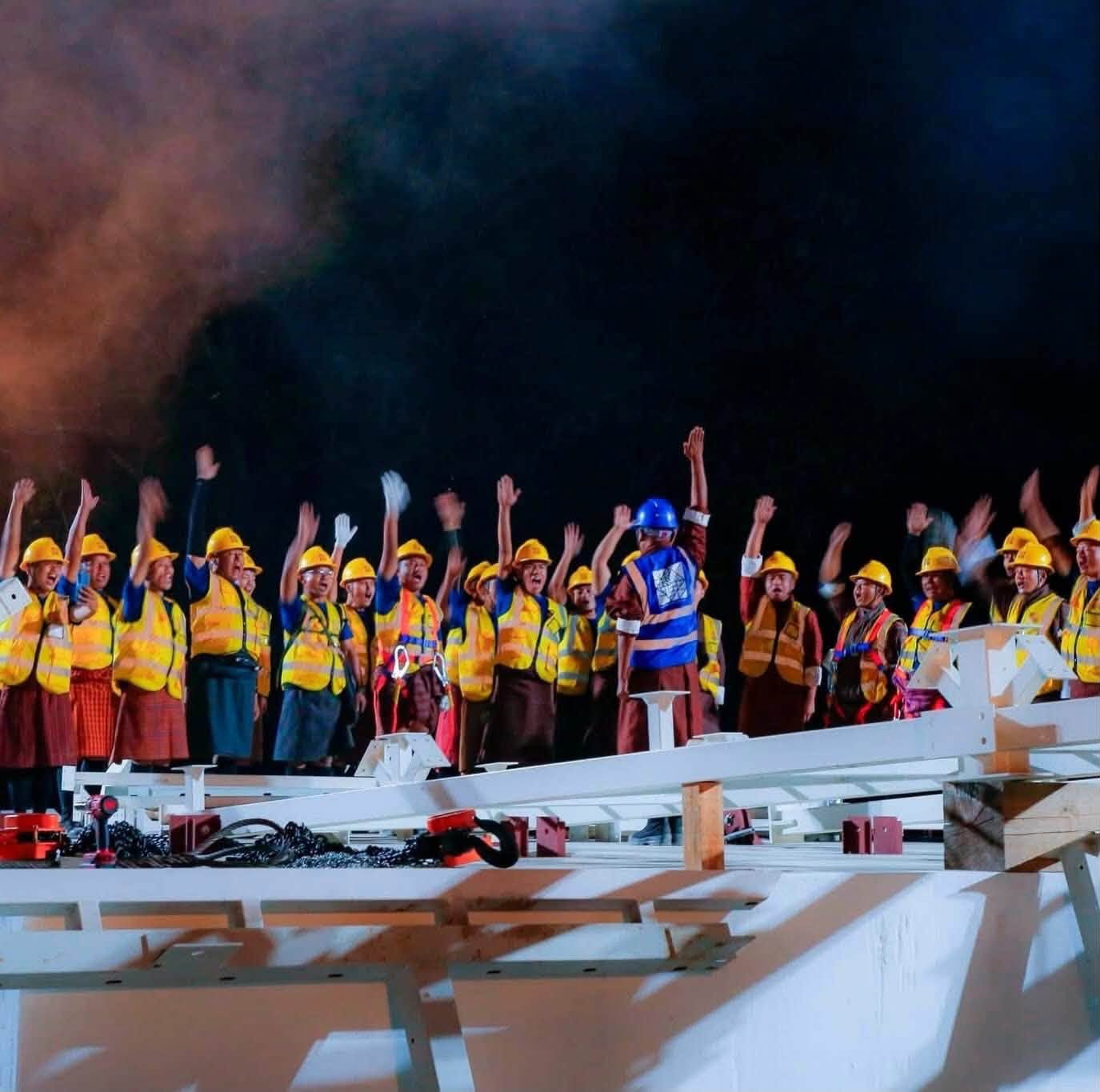
Beginning shortly after midnight, the monumental undertaking saw 108 chortens, each standing 15 metres tall and spaced 108 metres apart, completed along a 12-kilometre stretch of the Mau Chhu at Gelephu Mindfulness City (GMC).
The work was undertaken through zhabto, Bhutan’s tradition of voluntary community service, bringing together students, farmers, doctors, monks, retirees and people from all walks of life. With construction materials prepared in advance, teams of 20 to 24 people worked on each chorten. Formal construction began at 3am and concluded at noon, completing the historic undertaking in less than nine hours.
Beyond the construction site, an estimated 200,000 people gathered to witness the occasion. The spectators’ gallery was filled to capacity. Against the darkness, thousands held glowing orbs of light, while others sat on the ground or inside tents, joining in the rhythmic chanting of “Om Mani Padme Hum”.
The six-syllable mantra, associated with Avalokiteshvara, the Bodhisattva of Compassion, embodies the aspirations of compassion and wisdom and the wish to free all sentient beings from suffering.
As the chanting continued into the evening, individual voices merged into one collective prayer. It was a deeply moving sight: a nation giving physical expression to a vision rooted in its spiritual traditions.
Addressing volunteers after the successful completion of the project, His Majesty The King credited generations of Bhutanese, particularly the Fourth Druk Gyalpo, for safeguarding the country’s values and guiding its progress.
His Majesty said the greatest achievement was not simply the construction of 108 chortens in a matter of hours, but the blessings, prayers, compassion and love for the country that had brought people of different generations and backgrounds together.
“That is the Bhutanese spirit. That is the greatest accomplishment of this day and it is something we should all hold with great pride.”
His Majesty expressed the hope that the country’s unity, devotion and compassion would endure.
“My prayer is this — that we never ever change.”
“Because if we remain who we are, there is nothing we cannot face.”
For those who participated, however, Project 108 was not simply about building religious monuments. It was an opportunity to contribute to something they believe will carry spiritual significance for generations.
Emma Slade, also known as Ani Pema Deki, a fully ordained Buddhist nun said witnessing the project had been deeply moving.
“Did you notice how peaceful it has been despite so many people being here? It’s very respectful and calm,” she said.
For her, the collective nature of the undertaking was particularly powerful.
“We are all part of this, creating something together. All our wishes and hopes are coming together and multiplying. I think that’s a very powerful thing to be part of.”
Thirty-five-year-old Tandin Namgyel, a volunteer from Punakha, reflected on how quickly His Majesty’s vision had become reality.
“On February 21, His Majesty announced the vision for the 108 Jangchub Chortens. Just 253 days later, the vision is realised in Gelephu, through the participation and dedication of thousands of people,” he said.
“What initially appeared to be an ambitious and difficult undertaking became possible through the collective contribution of volunteers, workers, institutions and communities. This experience is not something that I get to witness every day. Such a thing either happens only in dreams or once in a thousand years.”
International visitors were equally moved. Jocelyn and Dalisay, who travelled from the Philippines, said the experience surpassed their expectations of Bhutan.
“What we heard about the country through word of mouth and online videos was far less ethereal than what we experienced after arriving here,” they said.
For 65-year-old Tshering Rabten from Bumthang, the journey to Gelephu was also a family experience. He travelled with his entire family in his Bolero pickup, bringing together different generations to witness the historic occasion.
“All generations of my family could come together and witness the event. It is also the longest distance we have travelled together as a family, and it will remain etched in our memories forever,” he said.
Ultimately, the greatest achievement of November 1 may not be captured by the number of chortens raised, the speed of construction or the scale of the gathering. As His Majesty reminded the volunteers, what mattered most was how people felt, what they experienced and what they learnt through the collective effort.
The 108 Jangchub Chortens will stand along the Mau Chhu for generations as monuments of faith and devotion. But the spirit that brought them into being may prove an equally enduring legacy.
Tashi Namgyal, Thimphu